Whamit!

The Weekly Newsletter of MIT Linguistics

Issue of Monday, October 26th, 2026

MIT @ Algonquian Conference

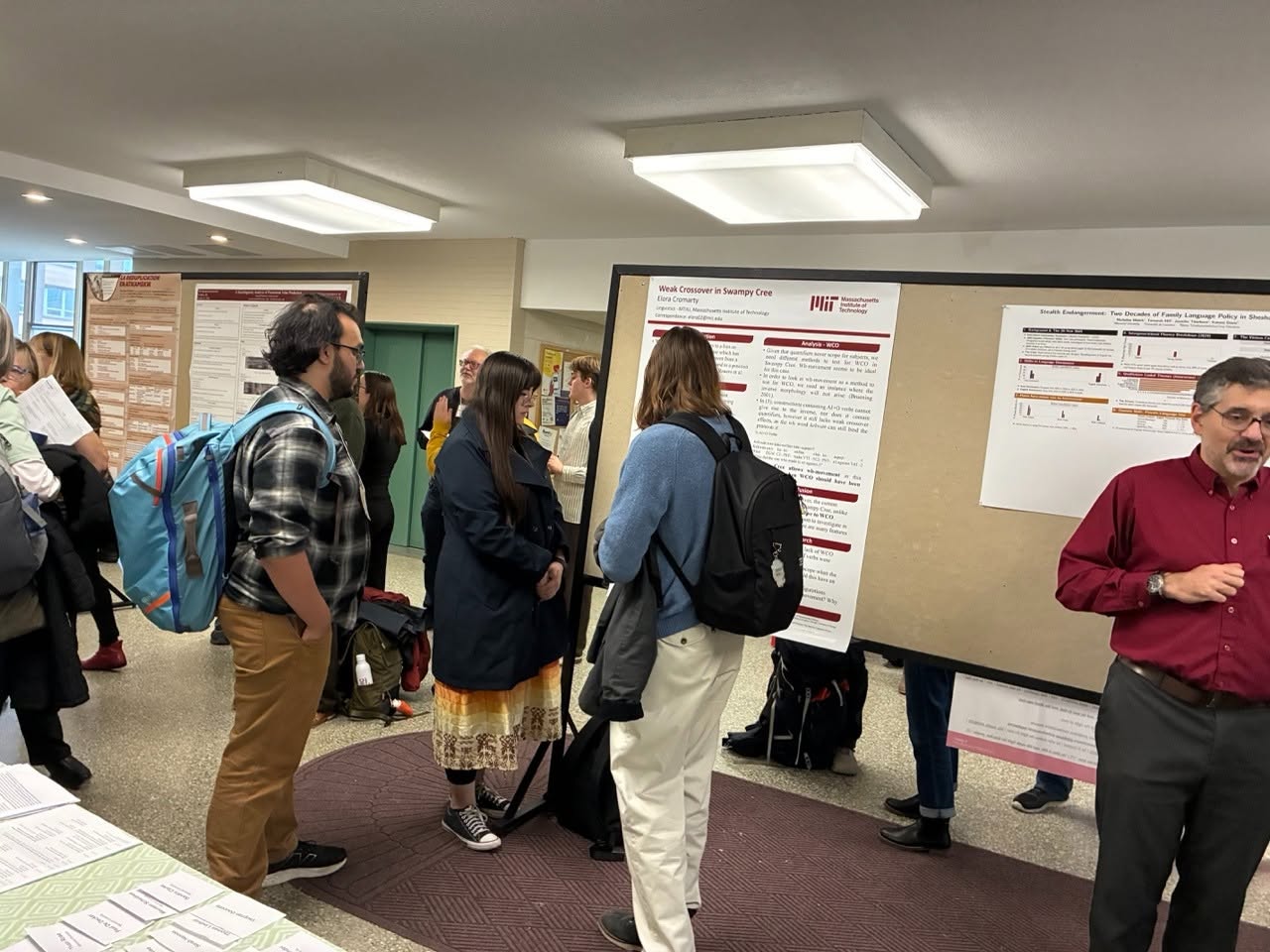
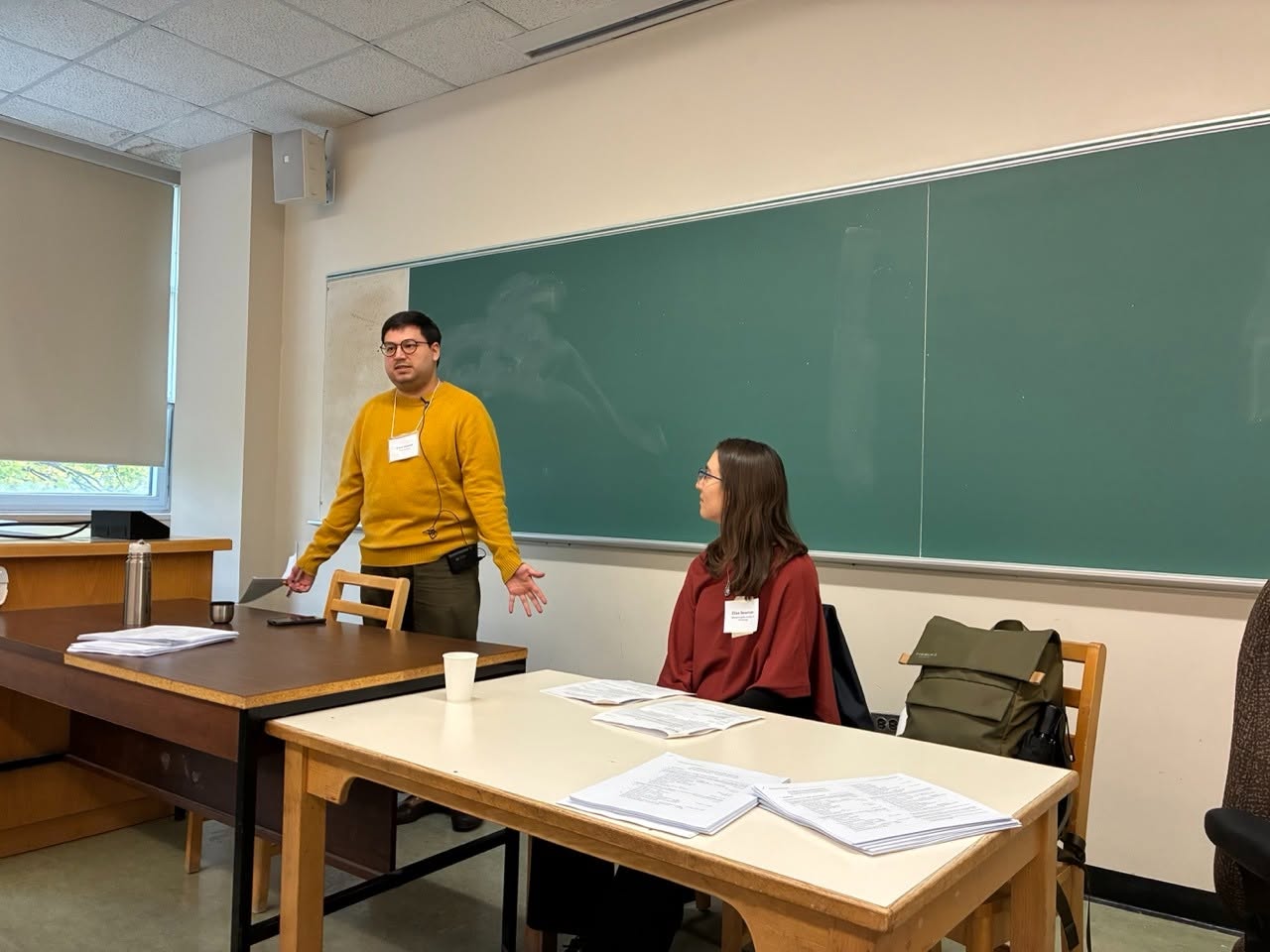
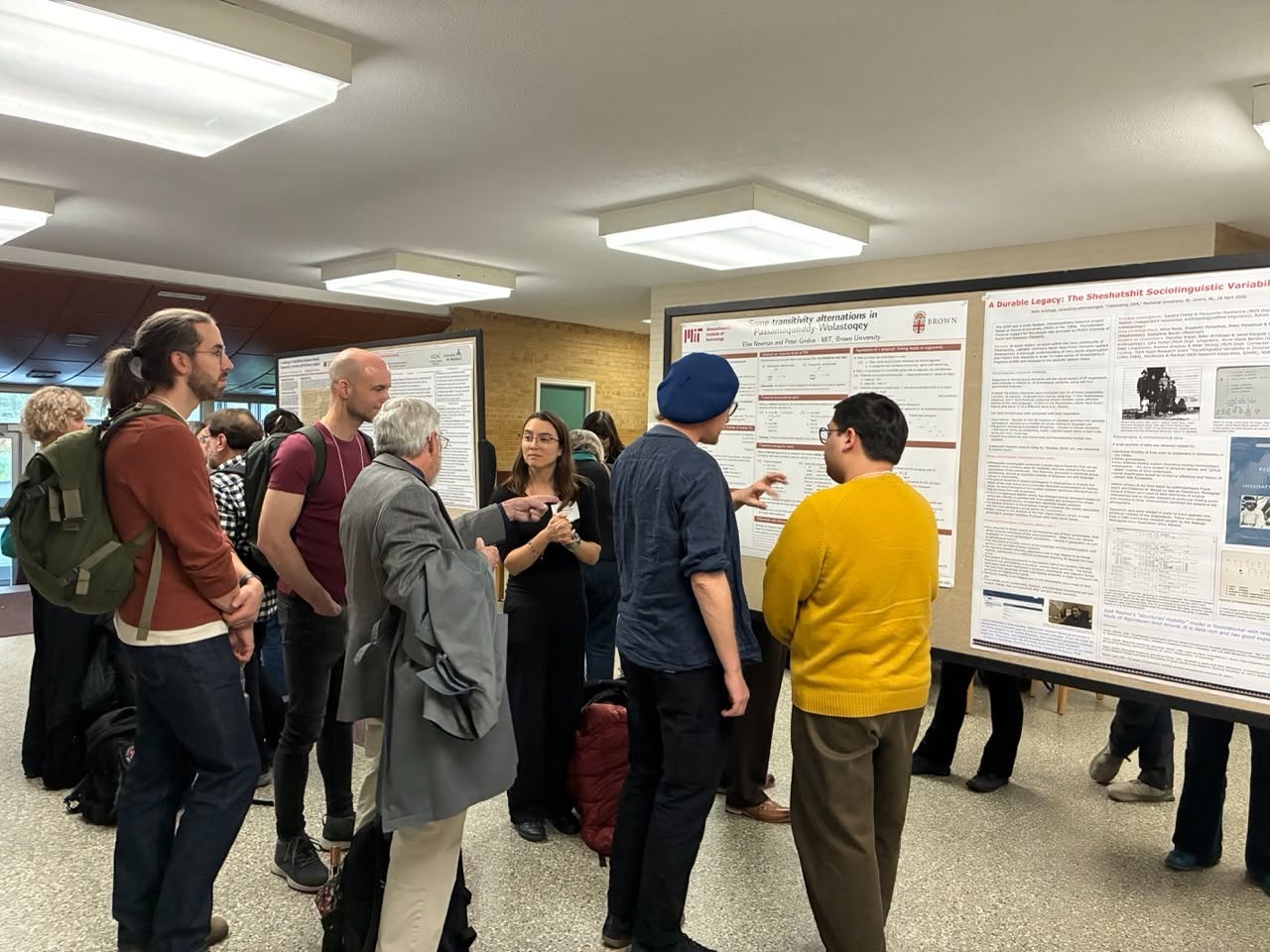
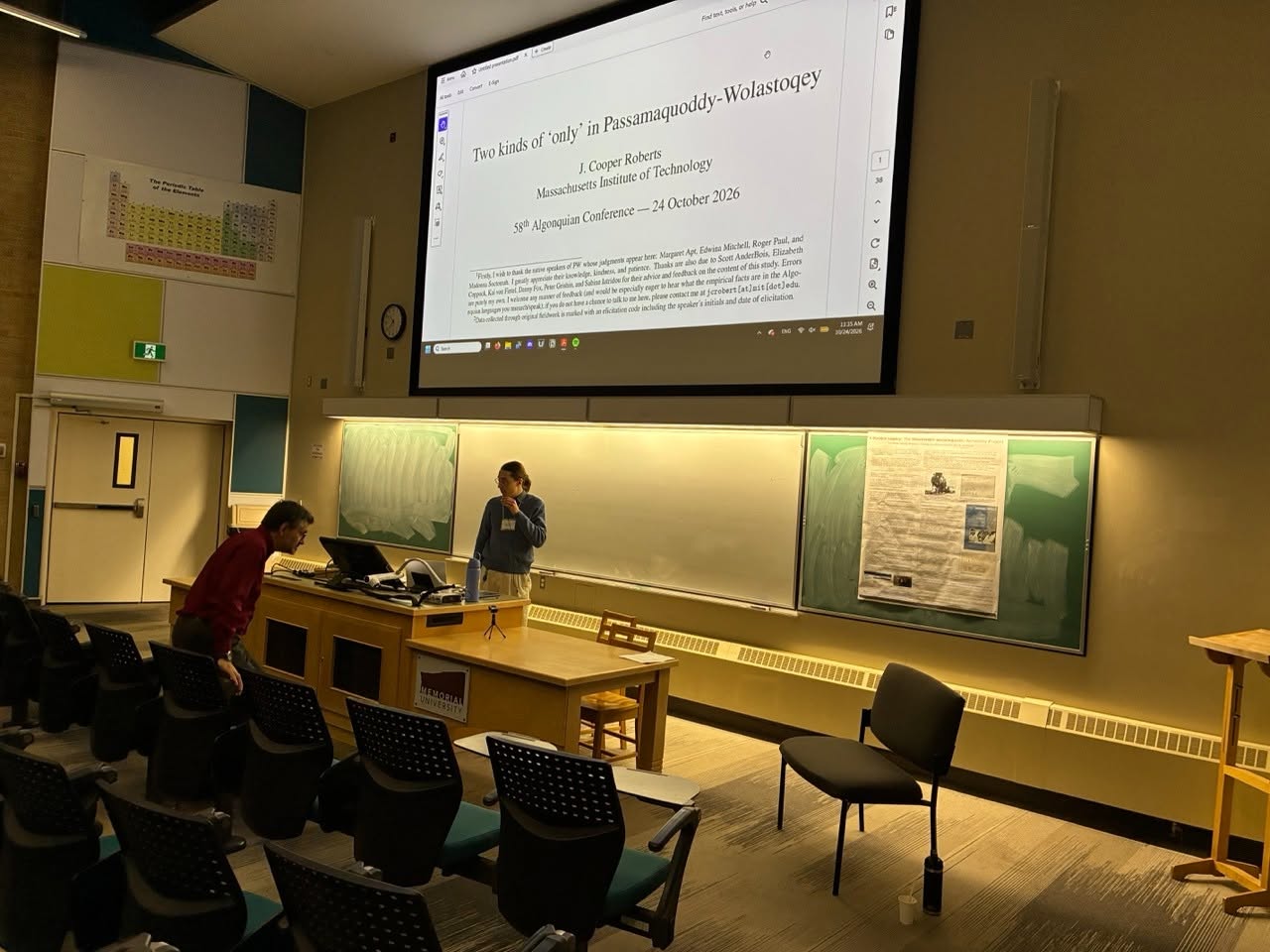
MIT Linguistics was well represented at the recent Algonquian Conference, held at Memorial University of Newfoundland.

Elora Cromarty (current student in the MITILI program), Peter Grishin (‘23, postdoc ‘23-‘25), Elise Newman (‘21, current faculty), Norvin Richards (‘97, faculty), and Cooper Roberts (current student in the doctoral program) all presented at the conference.

Elora gave a poster, and participated in a co-authored talk (with Joel Jansen, Grace Yang, and Antti Arppe), on her work with Swampy Cree – and also participated in a keynote panel discussion on “Youth in Leadership”. The other MIT-related participants presented their work with Passamaquoddy-Wolastoqey. Peter and Elise co-presented both a paper and a poster, and Norvin and Cooper each gave talks.

Norvin Richards writes: “The conference was both inspiring and educational, and we’re looking forward to putting what we’ve learned into practice.”

Conference program: https://algonquianstudies.org/ac58-program/
MIT Linguistics at the Algonquian Conference MIT Linguistics at the Algonquian Conference MIT Linguistics at the Algonquian Conference MIT Linguistics at the Algonquian Conference

Syntax Square 10/27 - Zachary Feldcamp (MIT)

Speaker: Zachary Feldcamp (MIT)
Title: Fragment answers in subject positions
Time: Tuesday, October 27, 1-2 PM
Location: 32-D461

Abstract:

Whereas the syntax of fragment answers is typically discussed in root contexts, it has been observed that they may also occur as complements of bridge verbs (Temmerman 2013) and as predicates in a copular clause (Weir 2017). In this work-in-progress talk I consider the distribution of fragments in subject position, such as the PP fragment in (1B).

(1) Q. Where should we put the pie?
A. On the table would be a good idea.
Approximately means: “For us to put the pie on the table would be a good idea.”

I show that such “fragment subjects” present a paradox. On the one hand, fragment subjects behave like fragments elsewhere in exhibiting connectivity for case and binding, indicating covert clausal structure. On the other hand, they are more like gerunds than clauses (i) in freely allowing embedding and (ii) disallowing it-extraposition. The puzzle is that gerunds in DP-selecting complement positions do not generally permit fragments, indicating that ellipsis of gerunds is not a freely available operation. Various approaches to this puzzle are discussed.

LF Reading Group 10/28 - Kai von Fintel (MIT)

Speaker: Kai von Fintel (MIT), presenting joint work with (An)Thony Gillies (University of Arizona)
Title: Yo-yo conditionals and counterfactual supposition
Time: Wednesday, October 28, 1-2pm
Location: 32-D461

Abstract:

There are two ways of articulating counterfactual thought experiments about what would have been the case if some (specific) things had been the case: counterfactual supposition and counterfactual conditionals. We introduce a novel puzzle about a class of iterated counterfactual thought experiments, the problem of yo-yo conditionals like If it had rained then if it hadn’t rained the seats would be wet. We show that yo-yo conditionals raise serious issues for all extant theories of counterfactual conditionals. There are some fixes we can and will consider, but lurking there’s a hard problem that we find both intriguing and infuriating.

LingLunch 10/29 - Maya Honda & Cora Lesure (MIT)

Speakers: Maya Honda & Cora Lesure (MIT)
Title: Take the LEAP! Linguistics Education and Pedagogy for All
Time: Thursday, October 29, 12:30-2pm
Location: 32-D461

Abstract:

Language is essential to being human and to understanding ourselves. Yet Linguistics, the scientific study of human language, remains largely unknown as a field and inaccessible to the general public in the US. LEAP—Linguistics, Education, and Pedagogy—is a departmental outreach initiative working to address this problem in two key ways: by creating and implementing teaching materials for middle school and high school students, and by creating resources to promote the accessible communication of linguistics research.

In this presentation, we will discuss our belief that studying Linguistics offers middle school and high school students the opportunity to develop scientific thinking skills and an understanding of the rule-governed nature of language, while cultivating metalinguistic awareness. We will also discuss the key challenges of making big questions in the field (and possible answers) conceptually accessible to students and also to non-linguists beyond the classroom. We will discuss the ways LEAP projects attempt to address these challenges, as well as ways for you to get involved in this important work.

Ultimately, we must all work together as a community to create access and promote awareness about Linguistics. These goals transcend the work of a single person or the LEAP initiative. We need your insight, your expertise, and your collaboration. We hope you will join us in this evolving conversation. To that end, we invite you to reflect on the following discussion questions in anticipation of our presentation:

  1. What do you think is vital for middle school and high school students to know about your research area?
  2. What do you find is most challenging about making your work accessible to a general audience?