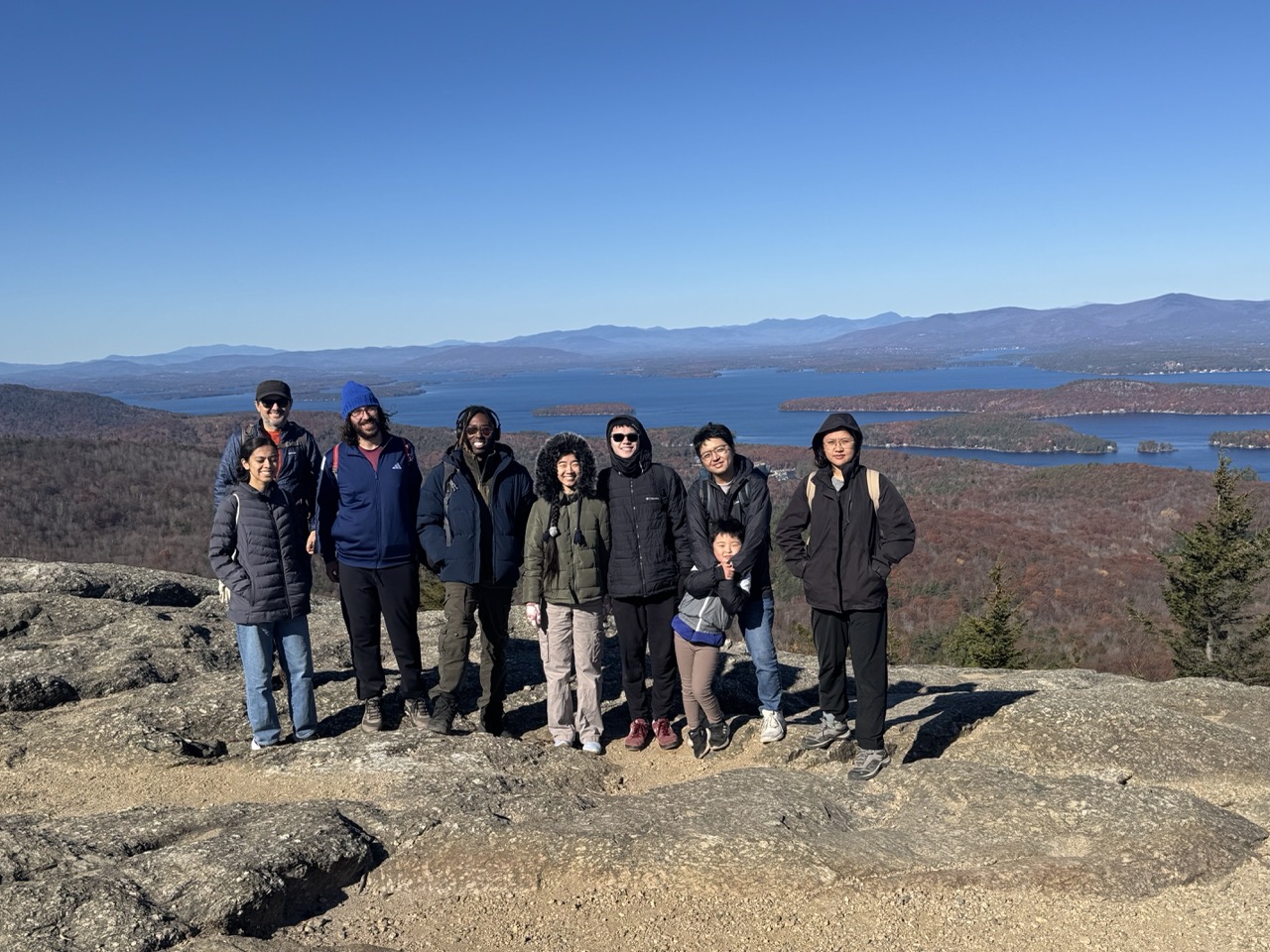
On Sunday November 1st, Amy, Christopher, Jad, Shota and Martin and close friends/family enjoyed the beautiful weather on Sunday hiking up Mt Major (NH).
Check out the beautiful view in the photo below!
The Weekly Newsletter of MIT Linguistics
On Sunday November 1st, Amy, Christopher, Jad, Shota and Martin and close friends/family enjoyed the beautiful weather on Sunday hiking up Mt Major (NH).
Check out the beautiful view in the photo below!
Speaker: Kai von Fintel (MIT), presenting joint work with (An)Thony Gillies (University of Arizona)
Title: Yo-yo conditionals and counterfactual supposition
Time: Wednesday, October 28, 1-2pm
Location: 32-D461
Abstract:
There are two ways of articulating counterfactual thought experiments about what would have been the case if some (specific) things had been the case: counterfactual supposition and counterfactual conditionals. We introduce a novel puzzle about a class of iterated counterfactual thought experiments, the problem of yo-yo conditionals like If it had rained then if it hadn’t rained the seats would be wet. We show that yo-yo conditionals raise serious issues for all extant theories of counterfactual conditionals. There are some fixes we can and will consider, but lurking there’s a hard problem that we find both intriguing and infuriating.
On September 26, our department and colleagues from around the world gathered to celebrate the 60th birthday of our wonderful colleague and section head, Danny Fox!
Fox Fest, organized by his former students — themselves now eminent researchers in their own right — attracted speakers, commentators, poster presenters, and audience from just about everywhere. The Dean of our School of Humanities, Arts, and Social Sciences, philosopher Agustin Rayo, began the proceedings with ten full minutes of praise for Danny as not only a brilliant and influential researcher (which we already knew) but as a selfless and wise advisor and colleague to others across the School and Institute. Five talks with commentary followed the Dean’s introduction, and ten posters, along with lots of discussion — and of course the day was concluded with a party.
Capping the celebration was the publication and presentation of a 518-page Festschrift for Danny Fox, full of excellent papers by his peers and colleagues influenced by his work in semantics, pragmatics, syntax, and how all these areas of our field reveal the workings of the human mind.


Photo credits: Jiamu Zhu and social media accounts of Yale Linguistics and Salzburg Linguistics - thank you!
Apologies for the delayed announcement of the great day!
MIT’s School of Humanities, Arts, and Social Sciences (SHASS) celebrated its 75th anniversary a few weeks ago with a three-day symposium — and it wouldn’t be a celebration without linguists, would it? Two of our faculty colleagues, Norvin Richards (PhD 1997) and Elise Newman (S.B. 2016, PhD 2021), and one of our most eminent alums, Jessica Coon (PhD 2010), participated in different panels of the symposium.
Norvin talked about the MIT Indigenous Language Initiative (MITILI), which he leads — what it has meant to us as a community, what we have learned about language from it, and what it has meant to its graduates and their communities — the communities for which the entire initiative was created in the first place.


Elise, who double-majored in physics and linguistics at MIT, spoke about the moment she realized that languages can be studied in much the same way physicists have studied the rest of the natural world — and then exemplified this with her own research discovering and explaining some universals of argument structure.


Jessica, a specialist in Mayan languages (and more recently, Iroquoian as well), spoke eloquently about the paths that her graduate study at MIT opened up for her, some things she has discovered in her fieldwork and theoretical investigations, and the paths that she herself now opens up for others through her own teaching and research.


These were intellectually challenging and often moving events, with talks by our colleagues and friends interspersed meaningfully with talks highlighting all the SHASS fields, followed by unusual and fascinating group discussions and Q&A. Happy birthday, SHASS!
The 19th Workshop on Altaic Formal Linguistics (WAFL 19) was held from June 30 to July 2, 2026 at ZAS. Two of our alumns gave an invited talk:
The following current students, faculty and alumns also presented their work:


The 20th meeting of Laboratory Phonology (LabPhon 20) was held in Montréal, Québec, Canada from June 26–28, 2026, with satellite workshops on June 25 and 29, and a keynote lecture on June 25. MIT linguistics was well represented by the following current students and faculty:
And by our alumns:

A paper co-authored by our colleague Elise Newman and alum Kenyan Branan (PhD 2018) of the University of Göttingen has just been published in Syntactic Theory & Research (otherwise known as STAR). Entitled “Paths: the ghosts of features past”, here is the abstract, and here is the link to the paper: https://sites.google.com/view/kbranan/home
We discuss a set of cases where an adjunct or specifier is neither uniformly opaque nor uniformly transparent for long distance dependencies but rather its transparency is sensitive to other properties of its local context besides adjuncthood/specifierhood. These cases pose a problem for classic analyses of the Condition on Extraction Domains, as non-complements are usually taken uniformly to be islands for extraction. To describe the variable transparency effects observed, we first suggest that each exception to the Condition on Extraction Domains occurs in a multiple specifier environment, like that proposed by Jonathan Nissenbaum (2000, doctoral thesis, Massachusetts Institute of Technology) for parasitic gap constructions. We furthermore propose a theory of locality that makes fine-grained predictions about what phrases are accessible for operations external to them. The proposal features a path-based view of locality in dependency formation, where projection of a feature from the goal to the probe’s sister is necessary for a dependency to be well-formed. On our view, the feature projection algorithm allows goals to project their features only when their sisters have certain properties, predicting that complements and second specifiers but not first specifiers are transparent for long distance dependencies.
Congratulations Elise and Kenyan!
We were very excited to learn that our colleague Martin Hackl and Yoon Kim of the Dept. of Electrical Engineering and Computer Science have been awarded a collaborative research grant from the MITHIC SHASS+ Connectivity Fund, which connects scholars in MIT’s School of Humanities, Arts, and Social Sciences (SHASS) with colleagues from other parts of the Institute.
Their project is entitled “Landmarks of Human Language Acquisition as Benchmarks for LLMs”:
Children acquire their native language from remarkably limited input: roughly 20 million words by age six. This is orders of magnitude smaller than the training data of LLMs exhibiting sophisticated language abilities. How children accomplish this is not fully understood, nor is the extent to which such LLMs employ analogs of human grammatical knowledge. The project aims to establish a set of developmental landmarks of human language acquisition to be used as benchmarks for purpose-designed mini-LLMs endowed with learning biases hypothesized to enable human language acquisition. Successful models may offer clues to increase efficiency in LLMs more broadly (biomimicry).
Congratulations Martin and Yoon!
A new journal in semantics is here: Semantics of Natural Languages (SNL), a diamond open-access journal dedicated to the study of meaning in natural languages and the scholar-owned, scholar-led successor to Natural Language Semantics.
There are several MIT connections to the launch:
Learn more here: https://snl-journal.org/
Browse accepted articles: https://snl-journal.org/news/944/
Read the open letter: https://snl-journal.org/news/942/
Submissions: https://snl-journal.org/submissions/
We are as delighted as can be to announce that Shota Momma will be joining our faculty as Associate Professor of Linguistics this Fall! Prof. Momma is a specialist in psycholinguistics and its interaction with linguistic theory — with a particular focus on the mechanisms of sentence production, an area in which he is a true pioneer. Shota comes to us from the University of Massachusetts, Amherst, where he has been an Assistant Professor since 2019. He received his PhD in Linguistics from the University of Maryland in 2016, with a dissertation directed by our alum Colin Phillips (PhD 1996), and subsequently completed a postdoctoral fellowship at UC San Diego with Vic Ferreira. Asked about his thoughts and plans as our newest faculty member, Shota wrote:
”I’m deeply honored and excited to be joining the MIT linguistics department, which has been home to so many people I deeply respect, past and present. I’m looking forward to learning from my future colleagues and to building a vibrant intellectual community together. My research aims to understand how people construct sentences in their minds during both comprehension and production, drawing on insights from linguistics and cognitive science more broadly. I’m confident that exciting new research directions will emerge at MIT - something I already began to experience during my visit in 2023.”
Welcome! We can’t wait for you to join us!
photo source: https://bpb-us-e2.wpmucdn.com/websites.umass.edu/dist/5/13737/files/2020/02/Shota-Momma.jpg 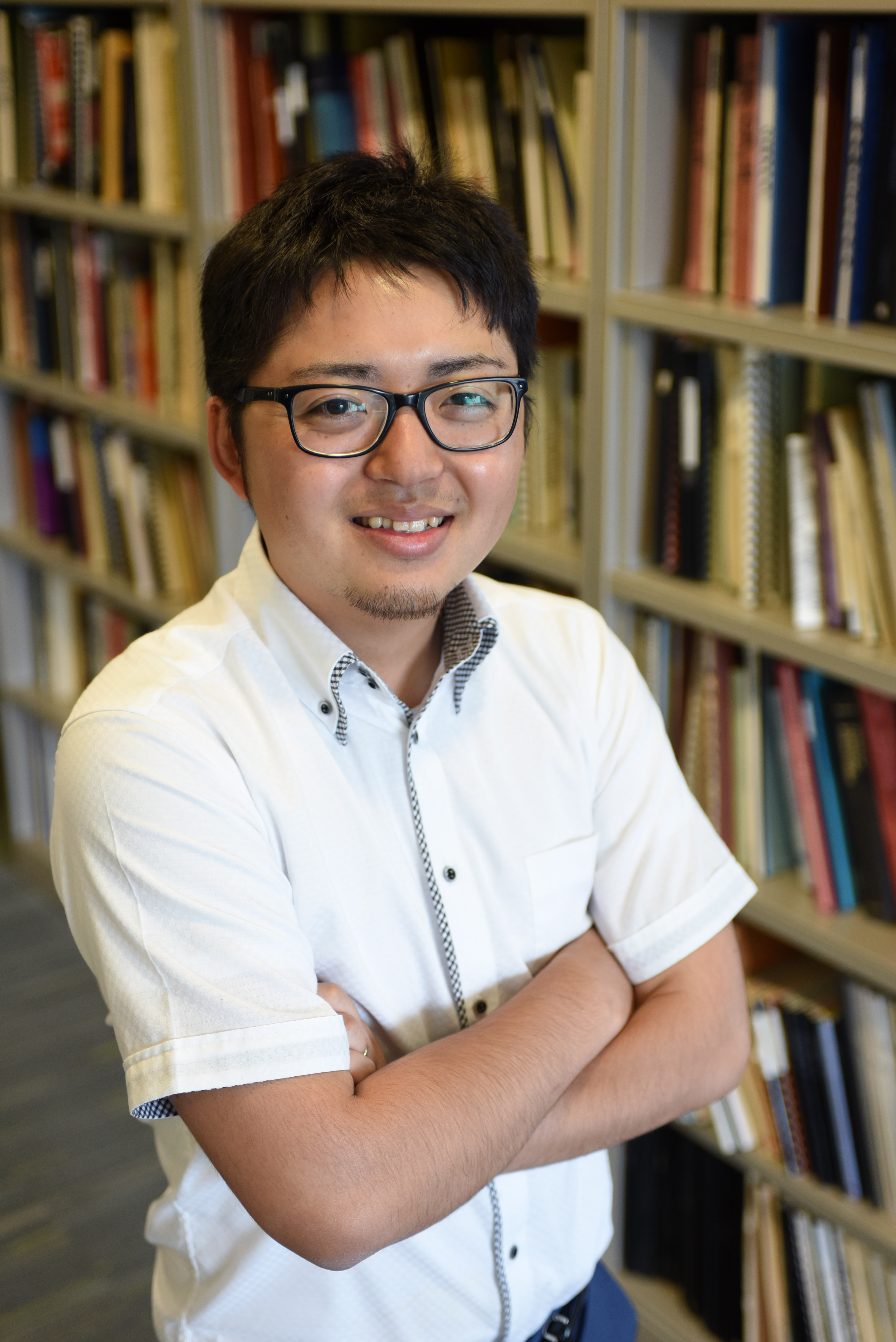
This year, the 44th West Coast Conference on Formal Linguistics (WCCFL44) was held at Universidad Nacional Autónoma de México in Mexico City on May 6-8. Some of our current students, faculty and alums presented their work:

The book entitled The Acquisition of Relativization by Suzanne Flynn and colleagues was recently published by Cambridge University Press in the series of Cambridge Studies in Linguistics. Congratulations, Suzanne!
You can find the book here.
Congratulations to David Pesetsky on being named a 2026–27 SHASS Faculty Fellow! David is one of 12 professors selected for the new SHASS Faculty Fellows cohort:
During his fellowship, [David Pesetsky will] investigate why there’s more than one kind of clause in the world’s languages. While linguists and researchers assume that clauses in most of the world’s languages come in different flavors, finite and infinitival, gerunds, and so on, they don’t yet know why.
The fellowship supports research and writing across the School of Humanities, Arts, and Social Sciences. Read more here: https://shass.mit.edu/twelve-professors-selected-for-2026-27-cohort-of-shass-faculty-fellows/
We are delighted to announce that two projects from MIT Linguistics have been selected for funding under the MIT Human Insight Collaborative (MITHIC) initiative, a new program in MIT’s School of Humanities, Arts, and Social Sciences:
PWRRD is the union of two facets of linguistic research conducted at MIT: theoretical advancement and the revitalization of indigenous languages. PWRRD brings these two threads together by assembling a coalition of Passamaquoddy-Wolastoqey speakers and MIT linguistics students, postdocs, and faculty to document, model, and ultimately revitalize the Passamaquoddy-Wolastoqey language. Passamaquoddy-Wolastoqey is critically endangered, with an aging speaker population. To increase access to language instruction among the Passamaquoddy-Wolastoqey community, we will use the results of our research to build an online language learning tool in collaboration with teachers and learners of the language.
https://shass.mit.edu/mit-human-insight-collaborative-announces-funding-awards-for-25-projects/
https://mithic.mit.edu/humanities-cultivation-fund-projects/
Later in January, Vlad Orlov, Cooper Roberts and Norvin Richard went to Maine for the winter Passamaquoddy group trip!

On November 22rd and 23rd, Hani Al Naeem, Christopher Legerme, Cora Lesure, Vincent Zu (MIT Chemical Engineering postdoctoral associate), and Jacob Kodner (Harvard Linguistics graduate student) taught over 50 ninth through twelfth grade students at Splash, a weekend extravaganza of courses organized by MIT ESP (Educational Studies Program).
Hani and Christopher offered “Sounds in Motion: Exploring the Science of Speech”; Cora offered “Rhyme and Reason: Exploring the Linguistics of Poetry”; Vincent offered “Linguists vs. Machine: Who Had the Telescope?”; and Jacob offered “The Beauty and Complexity of Language: Introduction to Linguistics”. The courses were designed by each instructor and developed and vetted through a collaborative process. Maya Honda observed all of the classes and attests to the great job everyone did sharing their knowledge and passion for linguistics with the Splash students.


A much-missed visitor from the 2024-2025 academic year, Adam Przepiórkowski, organized this year’s meeting of Generative Linguistics in Poland (GLiP), with MIT alums and faculty as invited speakers. Susi Wurmbrand (University of Salzburg) spoke on “Syntax as a function: A Redundancy and Deficiency approach to Grammar within linguistic behavior”; Jonathan Bobaljik (Harvard) spoke about “Old and new objects: Word order and structure in Itelmen”; and David Pesetsky (MIT) gave a talk entitled “Generalized Dependent Case: Towards a maximally sparse theory of passive”.
Adam’s own talk, a joint presentation with colleague Sebastian Zawada, was entitled “Slavic case is not boring: Agreement in Polish copular clauses” (an elegant reply to a side-remark in a famous paper of Jonathan’s that suggested Slavic case might be). David and his fellow alums report that the event, hosted by the Institute of Computer Science at the Polish Academy of Sciences (IPI PAN), was full of interesting papers, and was truly excellent meeting from every perspective.
(photo credit: Adam Przepiórkowski)


MIT Linguistics was well-represented at NELS 56, held at New York University from October 17–19, 2025. Two of our alums were invited speakers: Sam Alxatib (PhD 2013) of CUNY, gave a talk titled “Embedded tense: how to learn what some things can(not) mean (joint work with Spencer Caplan)”; and Tanya Bondarenko (PhD 2020), now a Harvard University, gave a talk titled “Selective opacity and clausal embedding”.
Here are the talks and posters presented by our faculty, current students and graduates in recent 10 years:
And more from our alums:
In a high-octane, back-and-forth showdown that could only be described as syntactically chaotic, Noam’s Gnomes edged out the athletic but less semantically structured ZBT fraternity team in a thrilling 6-5 victory.
The Gnomes opened the scoring early, with a well-parsed through ball resulting in a tidy finish that had fans chanting “Tree that sentence!” But ZBT quickly responded with a goal of their own, leveling the playing field and reminding everyone that brute athleticism can sometimes trump careful analysis.
From there, the first half turned into a lexical breakdown for the Gnomes. Though they briefly retook the lead at 2-1, their syntax soon unraveled. ZBT rallied with three unanswered goals, including a particularly devastating counterattack off a misplaced modifier from midfield. By halftime, the frat boys were up 4-2 and looking confident, flexing both muscles and minimal tactical nuance.
But the second half belonged to the Gnomes.
Adjusting their structure and clearly undergoing a pragmatic shift in formation, the linguists came out with renewed cohesion. They scored four consecutive goals, each more elegantly diagrammed than the last — including a cheeky backheel dubbed “The Recursion” that put them up 6-4. Fans of transformational grammar were in ecstasy.
ZBT did manage to claw one back late in the game, narrowing the score to 6-5, but the Gnomes held strong through stoppage time, parsing out the clock with expert possession and clever subclauses down the flanks.
Final Score: Noam’s Gnomes 6 — ZBT 5
A wild, referentially rich affair where form met function — and function triumphed, just barely.

The Annual Meeting on Phonology (AMP 2025) was held September 25-27 at University of California, Berkeley. Several of our current students, faculty and alumni presented their work:
The 35th meeting of Semantics and Linguistic Theory was held at Harvard University on May 20-22, 2025. MIT linguistics was well represented by current students, faculty and visitors:
The following alums also presented their work:


We are ecstatic to announce that Viola Schmitt will be joining our faculty next academic year as Associate Professor of Linguistics with tenure! Most of Viola’s research focuses on semantics, but with deep connections to syntactic and philosophical issues as well. Viola comes to us from the Humboldt University, Berlin, and has also taught at the Universities of Graz and Vienna. She was a visiting professor in our department last year, and her influence on our department as a superb teacher and advisor from just that brief visit is already profound. We could not be more pleased or more proud that she will be joining us. Welcome Viola!
Viola’s website: https://sites.google.com/view/viola-schmitt/home
“The Wilbur Cross Medal, named in honor of former Graduate School Dean and Governor of Connecticut Wilbur Lucius Cross, was established in 1966 to honor alumni of Yale Graduate School for outstanding achievements like those of Dean Cross during his multifaceted career. It is the highest honor that the Graduate School bestows on its alumni. Recipients of the medal return to campus to receive the award and spend time with their departments.
“Medalists are nominated by their peers in recognition of their achievements as leaders in their respective fields, true innovators, and world-changing thinkers. They are among the best examples of what can be accomplished with a doctoral degree after leaving Yale.”
Our colleague Norvin Richards had not one but two papers published last week!
The first, entitled “Reconstructing Stress in Wôpanâak”, appeared in the International Journal of American Linguistics. Here is the abstract:
Wôpanâak (also called Wampanoag, Massachusett, Natick), the original language of much of eastern Massachusetts, is known to us from a variety of seventeenth, and eighteenth-century documents, which mostly do not indicate the position of word-level stress. We do have one poem in Wôpanâak, a translation of the book of Psalms into verse. In this paper I present a description of the rules for stress in Wôpanâak, based largely on an analysis of the metrical version of Psalms.
In social media comments, Norvin thanked the members of the Wôpanâak Language Reclamation Project “whose work on this language has been a constant inspiration for me” — and described the paper more informally this way:
It’s about how to figure out which syllable to stress in words in Wôpanâak, the language of the traditional owners of a lot of eastern Massachusetts. Figuring this out is a challenge, because the language spent over a century not being spoken at all, so we know it from 17th- and 18th- century documents, mostly religious documents, which don’t indicate stress. Fortunately, there is one surviving poem in Wôpanâak. Unfortunately, the poet in question was not a terrific poet, and the meter is very uneven. Fortunately, the poem is also very long! So if you are sufficiently stubborn, you can scrape together enough information to figure out the system.
Norvin’s second paper to appear last week is entitled “Finding something to lean on”, and was published in Language, the flagship journal of the Linguistic Society of America. Here’s the abstract:
Phrases in a number of syntactic contexts are required, in a variety of languages, to end in their heads. This article offers a unified theory of the relevant properties of these contexts and of why the phenomena in question, while widespread, are not completely universal. The theory makes use of proposals made independently in contiguity theory (Richards 2010, 2016): the relevant syntactic contexts are argued to involve a prosodically dependent element that must attach prosodically to the head of the phrase to its immediate left, and this attachment is often blocked if the phrase in question is not head-final.
Congratulations, Norvin!
MIT Linguistics was well represented at the Workshop on Theoretical East Asian Linguistics 14 held at the University of Southern California, Los Angeles. Some of our current faculty colleague and almuni gave invited talks:
Several of our faculty and alumni also gave the following talks:
Our faculty colleague Shigeru Miyagawa recently published an article titled “Linguistic capacity was present in the Homo sapiens population 135 thousand years ago” in Frontiers in Psychology on March 11. You can read the abstract below and access the article here:
Recent genome-level studies on the divergence of early Homo sapiens, based on single nucleotide polymorphisms, suggest that the initial population division within H. sapiens from the original stem occurred approximately 135 thousand years ago. Given that this and all subsequent divisions led to populations with full linguistic capacity, it is reasonable to assume that the potential for language must have been present at the latest by around 135 thousand years ago, before the first division occurred. Had linguistic capacity developed later, we would expect to find some modern human populations without language, or with some fundamentally different mode of communication. Neither is the case. While current evidence does not tell us exactly when language itself appeared, the genomic studies do allow a fairly accurate estimate of the time by which linguistic capacity must have been present in the modern human lineage. Based on the lower boundary of 135 thousand years ago for language, we propose that language may have triggered the widespread appearance of modern human behavior approximately 100 thousand years ago.
MIT News featured an article on this publication on March 14, which you can read here.
Our colleague Danny Fox presented joint work with students Omri Doron (6th year) and Jad Wehbe (5th year) at a colloquium at UMass Amherst, entitled “Assertion, Presupposition and Local Accommodation”. You can read the abstract here.
Our colleague Elise Newman was an invited speaker at a workshop about Locality across the board in the pun-inviting locality of Nice. Her talk was entitled “The locality of subcategorization: a case for underspecified category”, and here is the abstract for it:
This talk is concerned with the selectional mechanism that underlies verb-argument pairs like (1).
Following Pesetsky (1982), I’ll refer to the relationship between the verb and its arguments in (1) as l-selection, where the verb requires a particular lexical item to head its argument. This distinguishes the relationship in (1) from other kinds of selection based on syntactic (c-selection) or semantic (s-selection) properties.
Such a distinction among selectional rules echoes earlier work, such as Chomsky (1965), which claimed that relationships like (1) were governed by strict subcategorization rules, in contrast with selection of a subject, for example, which was governed by selectional rules. Some differences between the two kinds of rules pertained to their locality conditions and the kinds of properties they were sensitive to: 1) strict subcategorization was limited to head-complement pairs, while selectional rules could create other kinds of branching structures, and 2) strict subcategorization rules only applied when there was no more general syntactic property to appeal to.
Puzzle: the modern view of selection (which only makes use of selectional rules) does not capture the original locality distinction between subcategorization and selection: l-selectional relationships like (1) seem to only arise in head-complement pairs. In other words, we do not find cases where a head l-selects for the head of its specifier.
This is a puzzle in current frameworks. Since Merge underlies both complementation and specifier-formation, it is not obvious what syntactic tools we have for enforcing only complementation in these cases.
I offer a proposal that captures the locality profile of strict subcategorization within a current feature-driven framework. Building on Newman (2024), the proposal makes use of an underspecified categorial feature X, which can be checked by any kind of element. The interaction between X-checking and the checking of other c- selectional features imposes restrictions on the order of operations: elements that are not c-selected can only check X, and therefore must merge first, or they will be bled by Merge of another element (which can check X in addition to whatever feature selected it). The requirement to merge first is what restricts l-selected elements to being complements.
While this may seem like just a solution to a technicality, the account makes predictions for the locality of A-movement as well, when we consider how l-selection interacts with the functional hierarchy more generally. I will argue that the functional hierarchy stems from a mixture of l-selectional and c-selectional requirements, where the interaction between the two can produce smuggling configurations (Collins 2005). When smuggling happens, arguments can obviate certain locality conditions on A- movement to derive phenomena such as symmetric passivization.
Adam Albright gave a talk at the Deparmental Seminar of Department of Linguistics and Modern Languages, Chinese University of Hong Kong, on January 21st, 2025, with the title “Complex Restrictions from Simple Constraints”. You can read the abstract here:
A recurring finding in the past 30 years has been that phonological restrictions that are categorical in some languages often appear as gradient restrictions in others. This parallel is tantalizing, but do languages also exhibit gradient restrictions that have no categorical counterparts? In this talk, I report the results of on-going work applying linear modeling to develop statistical models of lexicons that can identify and quantify gradient restrictions. Results from modeling the lexicon of Lakhota (Siouan) reveal numerous gradient restrictions on combinations of structures, such as a ban on two fricatives within a root, and a ban on combinations of fricatives and consonant clusters. The observed restrictions have (to the best of my knowledge) never been observed as categorical effects, and never motivate alternations.
These complex restrictions raise a number of learnability questions: first, although there is strong statistical evidence for these restrictions as a group, the support for individual restrictions varies, even in a lexicon of modest size. How do children learn such restrictions, with even smaller lexicons? This question is especially pressing if we take the complexity of the relevant constraints into account: in models that evaluate grammars according to the trade-on between complexity and fit, more complex grammars require greater statistical support. Finally, if learners are able to enforce complex constraints, why do we never observe categorical restrictions based on them? I propose that all three problems can be resolved in a model in which complex restrictions may emerge through the cumulative interaction of simpler constraints. I show how in a weighted constraint model based on maximum entropy, combinations of gradient restrictions can “gang up” to create complex restrictions, without the use of complex constraints.
MIT Linguistics was well represented at the 2025 Annual Meeting of the Linguistic Society of America at Philadelphia Marriott Downtown from 1-9 January. Many of our current students, faculty, and visitors gave talks and posters:
Several of our alumni also participated in the following presentations:
On December 7, the Department of Linguistics and Philosophy at MIT organized a celebratory workshop in honor of our colleague, semanticist Irene Heim, professor emerita of Linguistics — on the occasion of her having been awarded the 2024 Rolf Schock Prize (jointly with Hans Kamp) which we reported earlier here. As we noted at the time, quoting the award description, the award is considered a kind of Nobel prize:
“The Rolf Schock Prize is unusual in that it rewards both logic and philosophy, mathematics, visual arts and music. The laureates are selected through a unique collaboration between three Swedish royal academies: the Royal Swedish Academy of Sciences, the Royal Academy of Fine Arts and the Royal Swedish Academy of Music. The final decision is made by The Schock Foundation.”
You can read more about Irene, her achievements, and the prize, in this article from MIT News: https://news.mit.edu/2024/mit-linguist-irene-heim-shares-schock-prize-logic-philosophy-1016

The workshop program featured 5 talks by former students of Irene’s from linguistics and philosophy: Mat Mandelkern (NYU philosophy), Luka Crnic (Hebrew University), Maribel Romero (Konstanz), Wataru Uegaki (Edinburgh), and Valentine Hacquard (Maryland). A poster session featured research by current and recent students Ido Benbaji & Omri Doron; Shrayana Haldar; Filipe Hisao Kobayashi & Enrico Flor, Paul Meisenbichler; and Adele Mortier-Henot — and by Elena Guerzoni, Furkan Dikmen, & Penka Stateva; Chris Kennedy, Bernard Schwarz & Luis Alonso Ovalle; and Tue Trinh, Itai Bassi, and Danny Fox.
At the workshop, Amir Anvari announced the creation of the Heim Archive, a repository of Irene’s published papers and her equally famous unpublished notes and class materials.
More than 80 guests, including students of Irene’s, colleagues and friends from all over the world were able to come on short notice. The event reflecting the broad and lasting impact of Irene’s research and teaching on the field. We are so extremely fortunate to count Irene as one of ours.


Congratulations to Michael Kenstowicz, whose article surveying (and entitled) “Generative phonology” has just been published in the second edition of Encyclopedia of Language & Linguistics edited by Keith Brown (Elsevier)!
Our colleague Michael Kenstowicz is the author or coauthor of three separate articles in the just-published Oxford Handbook of Vowel Harmony, from Oxford University Press: “Vowel harmony in pre-Generative phonology”, “Vowel harmony in Chukotko-Kamchatkan languages”, and “Palatal harmony” (with Charles Kisseberth). Our most harmonic congratulations!!
MIT Press has just announced the publication of a monograph by our newest faculty colleague Elise Newman, entitled When Arguments Merge, in its Linguistic Inquiry Monographs series. The book presents “a novel theory of argument structure based on the order in which verbs and their arguments combine across a variety of languages and language families” — and has been praised as “refreshingly original and carefully argued”, “deeply thought through”, with “far-reaching theoretical and empirical consequences”. Congratulations, Elise!

Last week, Elise Newman presented and co-presented two talks at the Workshop on Locality at the University of Göttingen. Her solo talk was entitled “When wh-phrases are their own interveners, and she also presented a joint talk with Rob Truswell (based on even more joint work with Caroline Heycock), enitled “When to revisit? Investigating (un)ambiguity in temporal clauses”. Ksenia Ershova presented a talk based on joint work with Nikita Bezrukov, entitled “Moving away from antilocality: A defense of very local movement”. Several MIT alumni also presented at the workshop: Kenyon Branan, Mitya Privoznov, and Susi Wurmbrand.
Last week, Jon Rawski (visiting Assistant Professor) gave an invited colloquium talk at Rutgers Linguistics. The talk was titled Mathematical Linguistics & Cognitive Complexity.
Abstract: Mathematics is the study of structures, and mathematical linguistics studies linguistic structures. Generative linguistics put the focus squarely on grammars: finite abstractions of the highly structured and complex mental computations of linguistic phenomena. The focus of this talk is the expressive power of a grammar, which directly measures the complexity of any cognitive system which instantiates it. Two key algebraic restrictions have emerged: regularity, and transduction (mappings between finite structures). I will use these notions to describe upper and lower bounds on the weak and strong capacity of human grammars (the kinds of phenomena they cover, and the kinds structures they posit during a derivation), as well as mismatches between them. These bounds enable precise theory comparison, and I will show how many linguistic theories drastically overgenerate, using reduplication as a case study. I will then consider the expressivity of so-called ‘neural language models’. I will show, using finite model theory and multilinear algebra, how regular transductions can be embedded into the tensor representations used by neural computation and Optimality Theory. I will then present new theoretical bounds on the capacity of language models, connecting various transformer models to classes of first-order transductions. The overall picture that emerges is that, under the lens of mathematical abstraction, linguistic complexity is indeed a window into fundamental aspects of cognition and computation.
Last weekend, David Pesetsky presented a paper entitled “A double life for complement if-clauses revisited” at the Fourth International Conference on Adverbial Clauses at the Free University, Berlin. Alum (PhD 1998) Susi Wurmbrand (University of Salzburg) also presented at the conference, with a paper entitled “A syntactic approach to tense in complementation and beyond”.
Our emerita colleague Irene Heim has been honored as the recipient of the Rolf Schock Prize for Logic & Philosophy — sharing the prize with Hans Kamp of the University of Stuttgart, for their “(mutually independent) conception and early development of dynamic semantics for natural language.”
As described by the awarding organization:
“The Rolf Schock Prize is unusual in that it rewards both logic and philosophy, mathematics, visual arts and music. The laureates are selected through a unique collaboration between three Swedish royal academies: the Royal Swedish Academy of Sciences, the Royal Academy of Fine Arts and the Royal Swedish Academy of Music. The final decision is made by The Schock Foundation.”
The Schock prize is thus as close to a Nobel Prize as our field offers, a splendid and overwhelmingly well-deserved honor for our colleague. Not only did Irene lay the intellectual foundation for much modern work in semantics, she was also a key founder of the semantics program in Linguistics at MIT, and one of the field’s greatest teachers. You can read more about Irene’s contributions to semantics and to our department in the biographical sketch with which a 2014 volume honoring her work began, here: https://semanticsarchive.net/…/CrnicPesetskySauerland.pdf
Congratulations Irene! Your work enriches and honors us all.

A couple of pieces in recent MIT News featuring department members:
First-year MITILI student Soledad Chango taught an exciting language course on her native language, Kichwa/Quechua during the IAP. MIT News covered the language course here: https://news.mit.edu/2024/investigating-and-preserving-quechua-0228
MIT News also recently highlighted a paper on linguistic and Alzheimer’s disease published by faculty Suzanne Flynn and research affiliate Barbara Lust, among other co-authors. Read more here: https://news.mit.edu/2024/how-cognition-changes-before-dementia-0229
Last Saturday (March 1), faculty David Pesetsky presented a talk titled “Is there an LLM challenge for linguistics? Or a linguistics challenge for LLMs?” at a one-day workshop Magdalen College, University of Oxford. The workshop entitled “Does ChatGPT know language as humans do?” was organized by our own recent alum Danfeng Wu.
This past weekend, visiting professor Jon Rawski was invited to the “Algebraic Models of Generative Linguistics” workshop at the Merkin Center for Pure and Applied Mathematics at Caltech.
Workshop description: “This meeting brings together theoretical linguists, mathematicians, mathematical physicists, and computational linguists, for informal discussions on algebraic models of the Merge operation in generative linguistics, models of the syntax-semantics interface, and models of semantic spaces, along with the question of their realization in large language models.”
A joint paper by David Pesetsky and Kanoe Evile, wh-which Relatives and the Existence of Pied-Piping has just appeared in Glossa. It originated as an Intro to Syntax squib by Kanoe, a Linguistics minor who graduated last spring, who is starting medical school. Congratulations Kanoe and David!
Congratulations to Kai von Fintel and Sabine Iatridou! Their article, Publication of Prolegomena to a theory of X-marking, was published in Linguistics and Philosophy. It also received coverage on MIT News!
The 59th annual meeting of the Chicago Linguistic Society was held over the weekend. The following members of our community presented at the conference:
Other recent MIT alums on the program include:
This weekend, the third North American Conference in Iranian Linguistics (NACIL 3) took place at UCLA, and two of the talks were from our community. First-year student Taieba Tawakoli gave a talk entitled “Ra in intransitive constructions in Dari”, and Amir Anvari gave an invited talk entitled “On (Persian) ordinals”.
Congratulations to our postdoctoral associate Dmitry Privoznov (PhD 2021) on the publication in Glossa of his article entitled “Adjunct islands are configurational”! The paper is open access and can be downloaded here.
This paper argues for the Spell Out theory of the Adjunct Condition, based on Uriagereka (1999), Johnson (2003) and Sheehan (2010), using new evidence from Balkar. The Spell Out theory makes two claims: (a) between any two phrasal sisters at least one must be spelled out and become opaque for movement; and (b) a spelled out constituent does not project its category. This predicts adjuncts to be opaque, since they are maximal projections and are merged with a phrase. The Spell Out theory predicts that modifiers can be transparent for movement, but only if they are merged with a head (as complements) or if their sister is spelled out. The argument from Balkar is based on the behavior of so-called coverbs (clausal modifiers). Balkar converbs come in three varieties: vPs attached at the vP-level or as structural complements, TPs attached between the vP and the T′ of the main clause, and CPs attached at the CP-level. vP-converbs are only transparent for scrambling if they are complements. TP-converbs are never transparent. CP-converbs are only transparent if the main clause that they modify is opaque. Thus, Balkar converbs are transparent in all and only structural configurations that are predicted to be transparent by the Spell Out theory. In the end of the paper I discuss English data from Truswell (2007) and argue that the analysis proposed for Balkar can be extended to them as well.
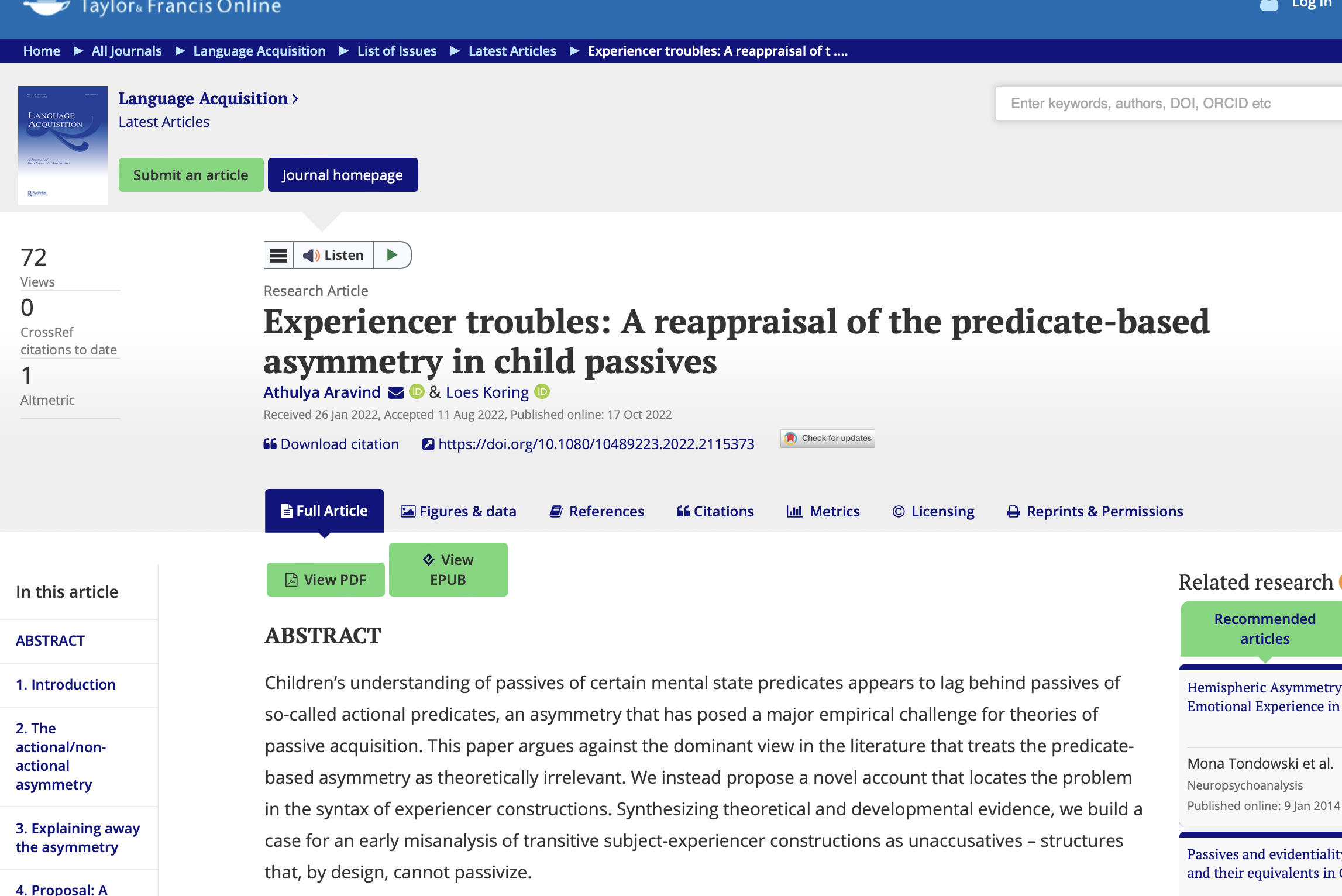
On October 14, a guest essay by our very own Michel DeGraff appeared in the New York Times: “As a Child in Haiti, I Was Taught to Despise My Language and Myself”. The essay details in a personal and powerful way the effects of language policy on Haitian education and identity, and advocates for the types of change that are promoted by the MIT-Haiti Initiative. Congratulations, Michel!
MIT News has a nice article about our colleague Michel DeGraff’s having been elected a Fellow of the LSA, as previously reported by WHAMIT!.
Congratulations to our colleague Michel DeGraff, who has been elected a 2023 Fellow of the Linguistic Society of America! This is our field’s highest honor, awarded each year to a small number of linguists for “distinguished contributions to the discipline”. This is truly fantastic news.
Michel joins current and former faculty colleagues Noam Chomsky, Kai von Fintel, Morris Halle, Irene Heim, Sabine Iatridou, David Pesetsky, and Donca Steriade, who have been honored as Fellows in previous
years, as well as more than thirty alumni of the department. Approximately a quarter of all LSA Fellows are MIT alumni or faculty. The full list of LSA Fellows can be found at
http://www.linguisticsociety.org/about/who-we-are/fellows.
Congratulations to our colleague Shigeru Miyagawa on the publication of his new monograph “Syntax in the Treetops”! See this great article from MIT News:
https://news.mit.edu/2022/shigeru-miyagawa-syntax-treetops-0503

Congratulations to faculty member Shigeru Miyagawa, whose paper “Revisiting Fitch and Hauser’s Observation That Tamarin Monkeys Can Learn Combinations Based on Finite-State Grammar” has been published in Frontiers in Psychology! The abstract is below:
Chomsky’s hierarchy (Chomsky 1959) defined formal grammars starting with finite-state grammar (FSG) as the simplest, followed by phrase-structure grammar (PSG), and so on. Although Chomsky’s original intention was to use this for human language, in particular, to show that FSG is insufficient for modeling language, a large body of work recently has utilized this hierarchy for nonhuman primate and bird systems of communication. In a groundbreaking work, Fitch and Hauser (2004) showed that cotton-top tamarins can master combinations based on FSG, but not PSG, while humans have no problem with both. While accepting their conclusion about humans, I question the assumption that the stimuli that the tamarins were able to master are FSG. In nature, monkeys are never exposed to systems that can be modeled by FSG; the alarm calls are predominantly isolated verbal units, not combinatorial. Old World monkeys do have an ability to combine calls, but the combination is limited to two items. This is not FSG in any meaningful sense. I suggest that the Chomsky hierarchy, which is productively applied to human language, does not apply to nonhuman primate calls, which are severely limited in their combinatorial possibilities.
Our colleague Athulya Aravind has been honored by MIT as one of 15 faculty singled out for their outstanding and utterly crucial support of our graduate students during the pandemic period. Read more here: https://news.mit.edu/2021/fifteen-mit-faculty-honored-committed-caring-1022. To quote the key passage:
Throughout the pandemic, numerous faculty members have stepped up to support and guide their graduate students in unique and impactful ways, through efforts such as championing diversity, equity, and inclusion programs within their departments; respecting students’ mental health concerns and finding appropriate ways to accommodate them; and fostering community within their advising groups and departments.
We are thrilled and indeed moved, but not surprised in the slightest. As the article linked above makes clear, it was graduate students themselves who nominated the recipients of this award, and participated in the selection process. Congratulations, Athulya!

A new paper by alum Ezer Rasin (PhD 2018) and faculty colleague Athulya Aravind (also PhD 2018) has just been published in the journal Natural Language Semantics, entitled “The nature of the semantic stimulus: the acquisition of every as a case study”. (It’s open access, so please click on the link to read!) Here’s the abstract:
We evaluate the richness of the child’s input in semantics and its relation to the hypothesis space available to the child. Our case study is the acquisition of the universal quantifier every. We report two main findings regarding the acquisition of every on the basis of a corpus study of child-directed and child-ambient speech. Our first finding is that the input in semantics (as opposed to the input in syntax or phonology) is rich enough to systematically eliminate instances of the subset problem of language acquisition: overly general hypotheses about the meaning of every can violate pragmatic constraints, making such hypotheses incompatible with the child’s input. Our second finding is that the semantic input is too poor to eliminate instances of what we refer to as the superset problem, the mirror image of the subset problem. We argue that at least some overly specific hypotheses about the meaning of every are compatible with the child’s input, suggesting either that those hypotheses are not made available by UG or that non-trivial inductive biases are involved in children’s acquisition of every.
In the December 2020 issue of the journal Language of the Linguistics Society of America, Michel DeGraff responds to the target article “Toward racial justice in Linguistics” by Anne Charity Hudley, Christine Mallinson and Mary Bucholtz. Michel’s article is titled: “Racial justice in Linguistics: The case of Creole studies”:
Our colleague Michel DeGraff’s ABRALIN lecture from June 14 is now available to watch and ponder.
Our colleague, Linguistics section head Kai von Fintel was interviewed about language, semantics, language acquisition, “if”, and more, in the series “Philosophical Trials”. Watch it here or click below.
Congratulations to Sabine Iatridou for being named one of the 2020 class of Guggenheim Fellows! You can read more at the Guggenheim site and in the Boston Globe.
Michel DeGraff was a speaker at the annual Northwestern University Conference on Human Rights on January 16–18, 2020 #NUCHR2020. This year, the conference’s theme was “Language and Human Rights: The Right to Speak”. Michel spoke at a panel on ”Language, education and information”. The title of his presentation was “Language and social justice: Haiti as a ‘canary’ for human rights globally.”
More information on the conference’s speakers and agenda can be found there, with useful links to organizations such as WikiTongues and Universal Human Rights Initiative that also do work at this important intersection of linguistics and human rights:
More news from the January break. David Pesetsky taught a January 10-17 course (“Proseminar in Grammatik-theorie”) at the University of Vienna on the topic of ”Theories of clause size and their implications”.
Last week, WHAMIT welcomed new graduate students and new visitors. This week, we add our enthusiastic welcome to the newest faculty member in the department: Athulya Aravind, who co-directs our Language Acquisition Lab and is a researcher in first language acquisitions and syntax. Athulya, of course, is not a stranger to the department, having received her PhD here in 2018. In between, she was a postdoctoral fellow at the Lab for Developmental Studies at Harvard. We are delighted to that Athulya has joined us!
We have some summer news to share with you:
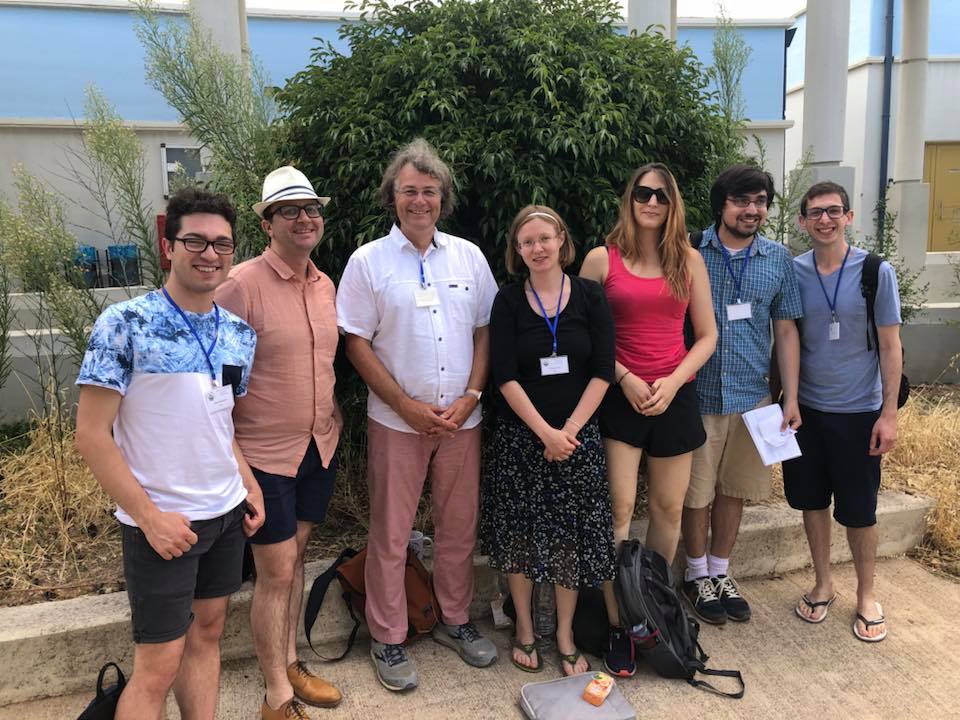
The summer school was attended by many MIT students as well: Rafael Abramovitz (4th year), Daniel Asherov (2nd year), Tanya Bondarenko (2nd year), Colin Davis (4th year), Ömer Demirok (5th year), Verena Hehl (4th year), Maša Močnik (4th year), Elise Newman (3rd year), Frank Staniszewski (3rd year) and Stan Zompi (2nd year). Rafael, Daniel, Tanya and Ömer also served as course TAs. Check out nice photos from the event, such as this one below, on the summer school’s Facebook page.

By tradition, the headship of the Department of Linguistics and Philosophy rotates between the Linguistics and Philosophy sections. From July 1, the department head will be our Philosophy colleague Alex Byrne, who has served as section head of Philosophy for the past five years. He succeeds linguist David Pesetsky, who is concluding his five-year term as department head. The new section head for Linguistics will be Kai von Fintel — but Adam Albright will serve as interim section Head during Kai’s well-earned sabbatical this Fall. Thank you all!
Norvin Richards (faculty) spent the week of April 14-21 at the University of the Basque Country in Vitoria-Gasteiz, learning about Basque and Spanish and teaching a week-long course on Contiguity Theory.
Michel DeGraff shares some good news about the Dual Language (English/Haitian Creole) Two-Way Immersion program at the Mattapan Early Elementary School which he has been helping with. The school was recently recognized with the Phil H. Gordon Legacy Award from EdVestors, a nonprofit focused on improving urban education. The award recognizes schools that are leveling the playing field for all students to learn. The Mattapan Early Elementary School was awarded $30,000 to help it grow.
The full story is available at the Boston Herald. A video presentation about the program at Mattapan Early Elementary is also available here.
Today we mourn the loss of Morris Halle, our colleague, our teacher, our friend, co-creator of MIT Linguistics, one of the most imaginative, insightful, and influential linguists in the history of the field.
We are told by his children that Morris passed away peacefully this morning at 3:45am. There will be a memorial - details to be announced.

The annual ESSL/LAcqLab and friends Winter Hike happened on Sunday. The hikers climbed Mount Pemigawassett in the White Mountains of New Hampshire. Thanks to Martin for the photos.


Michel DeGraff recently gave two presentations:
A statement from MIT faculty in Linguistics (January 12, 2018, updated January 16)
As linguists and human beings, we stand in appalled opposition to yesterday’s reported statement by Donald Trump that disparaged in grotesque racist terms the populations, cultures and circumstances of an array of countries. These include the native countries of treasured colleagues, students, and visitors to our department, past and present. We stress, now and forever, the utter incompatibility of such characterizations and sentiments with basic human values, the nature of scientific inquiry, and the fundamental lessons of our field: respect for human diversity in all its manifestations, enhanced by the continual discovery of deep threads of unity that underlie this diversity.
We take this opportunity to renew our own commitment to diversity — to building bridges that will enrich our humanity, not walls.
Adam Albright
Noam Chomsky
Michel DeGraff
Kai von Fintel
Edward Flemming
Suzanne Flynn
Danny Fox
Martin Hackl
James Harris
Irene Heim
Sabine Iatridou
Samuel Jay Keyser
Shigeru Miyagawa
Wayne O’Neil
David Pesetsky
Norvin Richards
Donca Steriade
Ken Wexler
UPDATE January 16:
MIT faculty in Philosophy (our sister program within the Department of Linguistics & Philosophy) strongly support the above statement from MIT faculty in Linguistics:
Sylvain Bromberger
E.J. Green
Sally Haslanger
Justin Khoo
Vann McGee
Tamar Schapiro
Kieran Setiya
Judy Thomson
Stephen Yablo
Shigeru Miyagawa, who was recently appointed Senior Associate Dean for the MIT Office of Digital Learning (ODL - responsible for OpenCourseWare, MITx, and other digital initiatives), has given an interview for MIT News discussing his goals for ODL and the future of digital learning and cross-institute collaboration. The full article can be found here.
On Friday, Donca Steriade was honored as a Professor Honoris Causa by the Faculty of Letters at the University of Bucharest. Congratulations Donca!
Michel DeGraff (faculty) gave a talk Cornell University as part of a new lecture series on language and inequality. On October 20th,
Michel presented Language, Education and (In)equality in Haiti: Struggling Through Centuries of Coloniality, a talk which focuses on linguistic inequality and the exclusion of “local languages” in education. While at Cornell, Michel also gave a colloquium talk on Thursday titled Walls vs. Bridges Around Creole Languages and Their Speakers. More details can be found at the Cornell Chronicle.
Shigeru Miyagawa’s article, “Integration hypothesis: A parallel model of language development in evolution,” just appeared in Evolution of the Brain, Cognition, and Emotion in Vertebrates (S. Watanabe, M. A. Hofman, T. Shimizu, eds.), Springer, pp. 225-247.
Congratulations Shigeru!
Heidi Harley (PhD ‘95) and Shigeru Miyagawa (faculty) have just had an article on the Syntax of Ditransitives published by the Oxford Research Encyclopedia of Linguistics. The article is available online at the link. Congratulations Heidi and Shigeru!
Michel DeGraff (faculty) will be giving two talks at the University of Hong Kong this week.
The first is a special seminar, and the second is part of the Second International Conference on Documentary Linguistics - Asian Perspectives (DLAP-2). Abstracts and the program can be found by following the links.
Over the weekend, Semantics and Linguistic Theory (SALT) 27 was held at the University of Maryland. On May 11, there was a workshop on Meaning and Distribution at UMD as well. MIT was represented at both!
Pranav Anand (PhD ‘06) was an invited speaker at SALT, and spoke on Facts, alternatives, and alternative facts, and Beth Levin (PhD ‘83 EECS) was an invited speaker at the workshop, and spoke on The Elasticity of Verb Meaning Revisited. In addition, MIT had several students, alumni, and faculty presenting both talks and posters.
Talks
Posters
Our very own Donca Steriade is among the recipients of the 2017 James A. and Ruth Levitan Teaching Awards in the School of Humanities, Arts, and Social Sciences.
Announcing the 2017 award recipients, Dean Nobles remarked, “This prize honors those instructors in our School who have demonstrated outstanding success in teaching our undergraduate and graduate students. These great educators, who are nominated by students themselves, have made a difference in the lives of our remarkable students.”
That Donca should receive an award for fantastic educators should come as no surprise to those of us lucky enough to have taken one of her classes. David Pesetsky notes, “The most important point is indeed the fact that Donca’s students themselves nominated her for this award — honoring one of our most distinguished colleagues and most devoted teachers.”
Congratulations Donca!
Enoch Aboh (University of Amsterdam) and Michel DeGraff have recently published a chapter in the Oxford Handbook of Universal Grammar. The chapter, titled A Null Theory of Creole Formation Based on Universal
Grammar argues that Creoles emerge from principles of UG as all other languages do, and thus can provide important insight into both contact induced and diachronic language change.
Michel writes:
Enoch and I propose an analysis of Creole formation that goes against the grain of the most popular classic textbook dogmas which cast Creoles as the “exceptional” outcome of a Pidgin-to-Creole cycle. Our is a straightforward theory of “creolization,” without any “pidgin” phase and without any other creolization-specific stipulation. That is, ours is a “Null theory of Creole formation.”
An online version of the chapter is available here.
Faculty member Michel DeGraff shares with us the news of the opening of the first dual-language Haitian Creole-English elementary school in Boston, as reported in The Atlantic:
“I think this is a great example of linguistics and education for social justice—-and an antidote against “othering” in our political era. I particularly like these headlines from the Atlantic: ”Dual-language programs universally focus on both language and culture, giving students who come from that given culture an opportunity to see their own histories prioritized by their schools and giving other students an opportunity to develop a deep appreciation for people who are different from them.”“
Michel DeGraff published the article “Mother-tongue books in Haiti: The power of Kreyòl in learning to read and in reading to learn” in the UNESCO journal PROSPECTS (Comparative Journal of Curriculum, Learning, and Assessment). The article is available here.
Shigeru Miyagawa’s most recent book, Agreement Beyond Phi has just been published by the MIT Press as an LI Monograph. Building on his previous monograph Why Agree? Why Move?, this book investigates agreement in so-called agreementless languages in arguing for a unified view of grammatical features that includes both phi-features and discourse configurational features.
“Miyagawa opens up formal syntax to include discourse-related phenomena and thus contributes to the building of a new research agenda.”—Liliane Haegeman
Congratulations Shigeru!
The MIT School of Humanities, Arts, and Social Sciences has a great post up about the David Pesetsky@60 workshop! The post can be seen here.
Michel DeGraff participated in a panel, with Ann Charity Hudley, Christine Mallinson and Mary Bucholtz, at the 2017 meeting of the American Association for the Advancement of the Sciences. The panel was about Leveraging Linguistics for Broadening Participation in Science, Technology, Engineering & Mathematics (STEM). Michel’s abstract is available here, and photos are available on Michel’s Facebook wall.
Faculty Shigeru Miyagawa is featured on MIT News’ top page: his work on language evolution inspired a musical piece, which premiered in NYC’s World Financial Center. The full article is here.
Faculty Michel DeGraff is excited to teach the first “Kreyòl Studies” course for Boston Public School teachers. The first session of a 5-session 10-hour series was this past Thursday, November 17, 2016. Here are excerpts from the course description:
“This course is to provide historical, cultural and linguistic background to fourteen Boston Public School (BPS) teachers who will support BPS’s Kreyòl/English Dual Language Program and other educators who support students of Haitian descent. Why are such Dual Language Programs so crucially important for the future success of all of our children? What do BPS teachers need to know about the linguistic, cultural, social and political backgrounds of their students from Haiti? How can the cultural and linguistic assets of these children contribute to their wellbeing and that of society at large? In answering these questions, we will mine history and linguistics for lessons that may help improve education for and about Haitians in Haiti and in the diaspora—and eventually set up models toward improving education for all children.
….
Our asking and answering these and related questions will bear on the importance of a Kreyòl/English Dual Language Program in the Boston Public School system. Such Dual Language programs can, in many ways, be a game changer as they help create, locally, citizens with global understanding of history, culture and language—citizens that can use local cultural and linguistic assets in confronting and solving global challenges.”
More details can be found here.
“Song of the Human” is a composition by the British composer Pete Wyer, who was inspired by faculty member Shigeru Miyagawa’s work on the connections between human language and bird song. The premiere in the World Financial Center was on October 12, 2016. The composer and Shigeru were guests on a WNYC public radio show; the full segment is available online. Shigeru shared two pictures from the premiere.


Michel DeGraff contributed to a report by the Linguistic Society of America on the protection of children’s rights in the implementation of the 2030 Agenda for Sustainable Development. This is a report being compiled by the United Nations Office of the High Commissioner for Human Rights. DeGraff’s comments are formulated in the context of his work as director of the MIT-Haiti Initiative and as the representative of the LSA to the Science and Human Rights Coalition of the American Association for the Advancement of the Sciences.
The report can be accessed here.
Faculty member Kai von Fintel just returned from ten days in Europe, where he talked about “The absence of certain ambiguities in some contexts” at the University of Tübingen, spent two days working on a secret project or two with fellow faculty member and co-author Sabine Iatridou, who is on sabbatical in Amsterdam, gave a public lecture on “If” and taught a class on “How to do conditional things with words” at the University of Manchester.
Faculty member Michel Degraff sends this article on the MIT-Haiti Initiative (available in both English and Kreyòl) published in the MIT Faculty Newsletter, with the following blurb:
In this article, Prof. Haynes Miller (MIT Mathematics Department) reports on his engagement in the MIT-Haiti Initiative. This report is timely in light of current recovery efforts in Haiti after the devastation caused by Hurricane Matthew. The sort of projects described in this article is what Haiti needs the most: education projects that can, at long last, preempt the man-made disasters that have been accruing, on top of natural disasters, in 2 centuries of neo-colonial exclusion, mis-education and mis-management in Haiti.
A new Brain Research article is in press with co-authors that include visiting scholar Miwako Hisagi, faculty Shigeru Miyagawa, and two alumni, Hadas Kotek and Ayaka Sugawara: “Second-Language Learning Effects on Automaticity of Speech Processing of Japanese Phonetic Contrasts: An MEG study”
The Federal University of Minas Gerais (Brazil) is hosting the UNESCO-sponsored conference Territorialities and the Humanities (October 4—7). Michel DeGraff is one of the invited speakers and he will give a talk at the panel ‘Identities and Languages’. The conference is also part of the celebration of the 90th anniversary of the Universidad Federal de Minas Gerais.
