Whamit!

The Weekly Newsletter of MIT Linguistics

Archive for the ‘Announcements’ Category

MIT @ Algonquian Conference

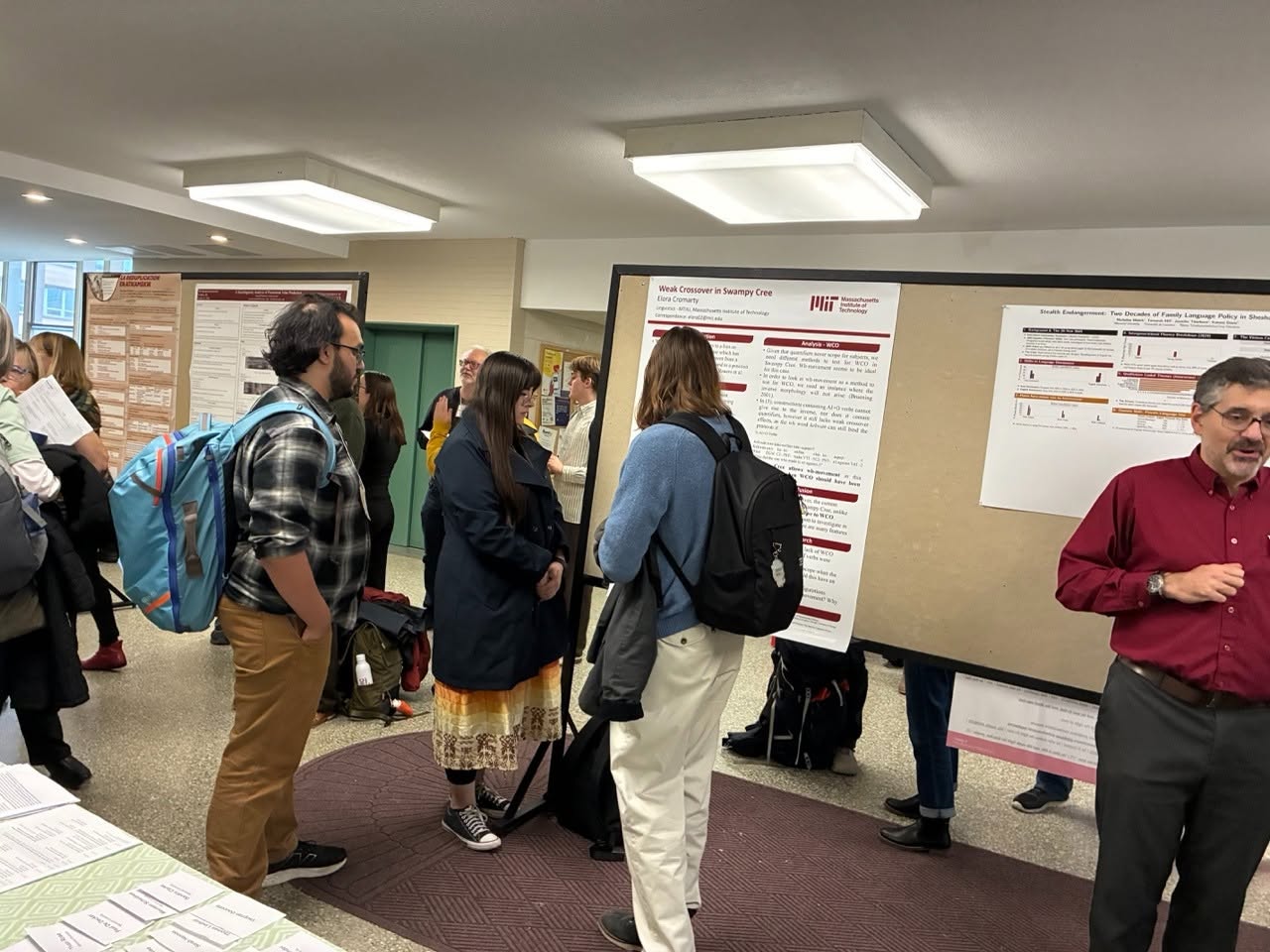
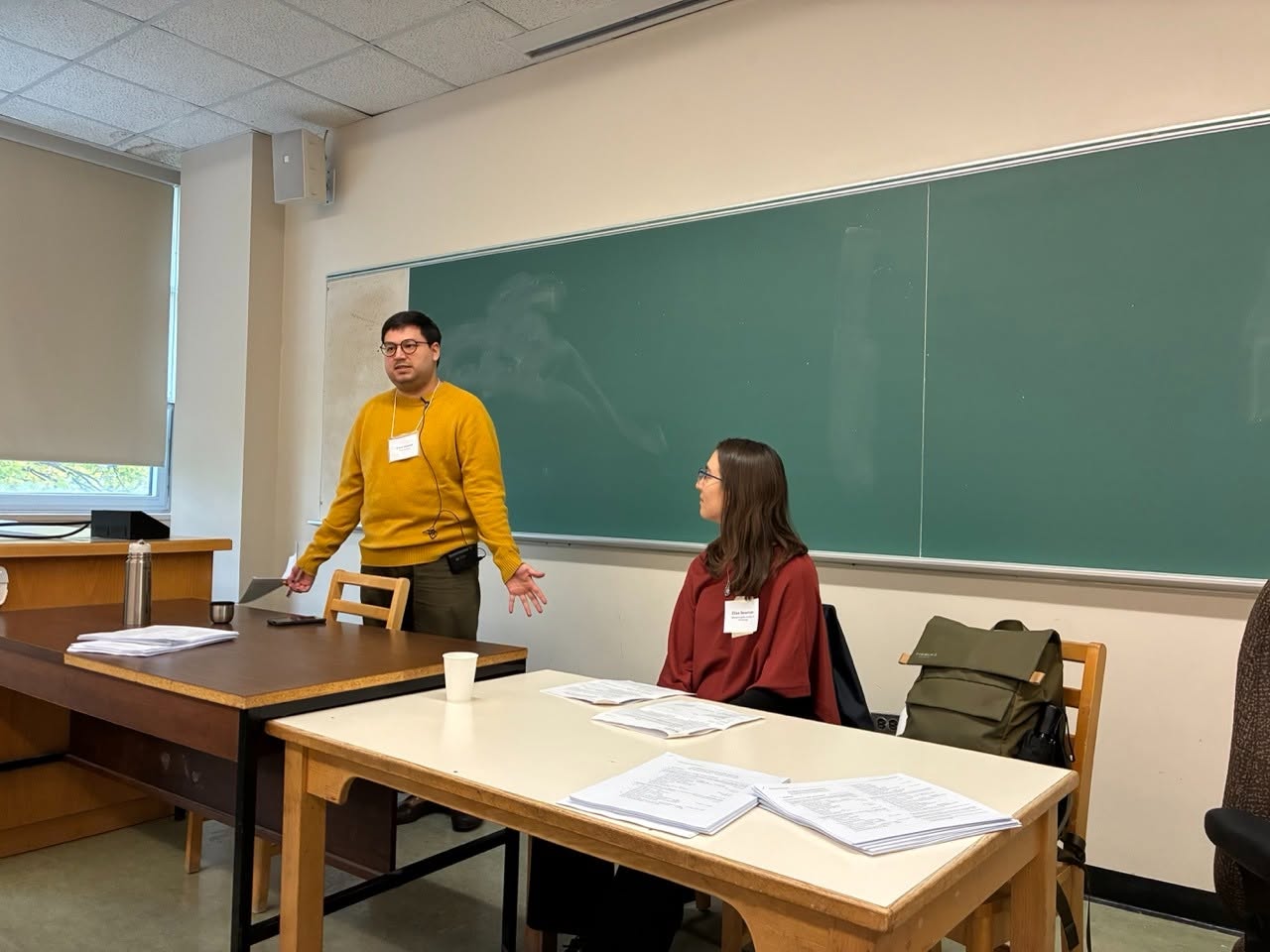
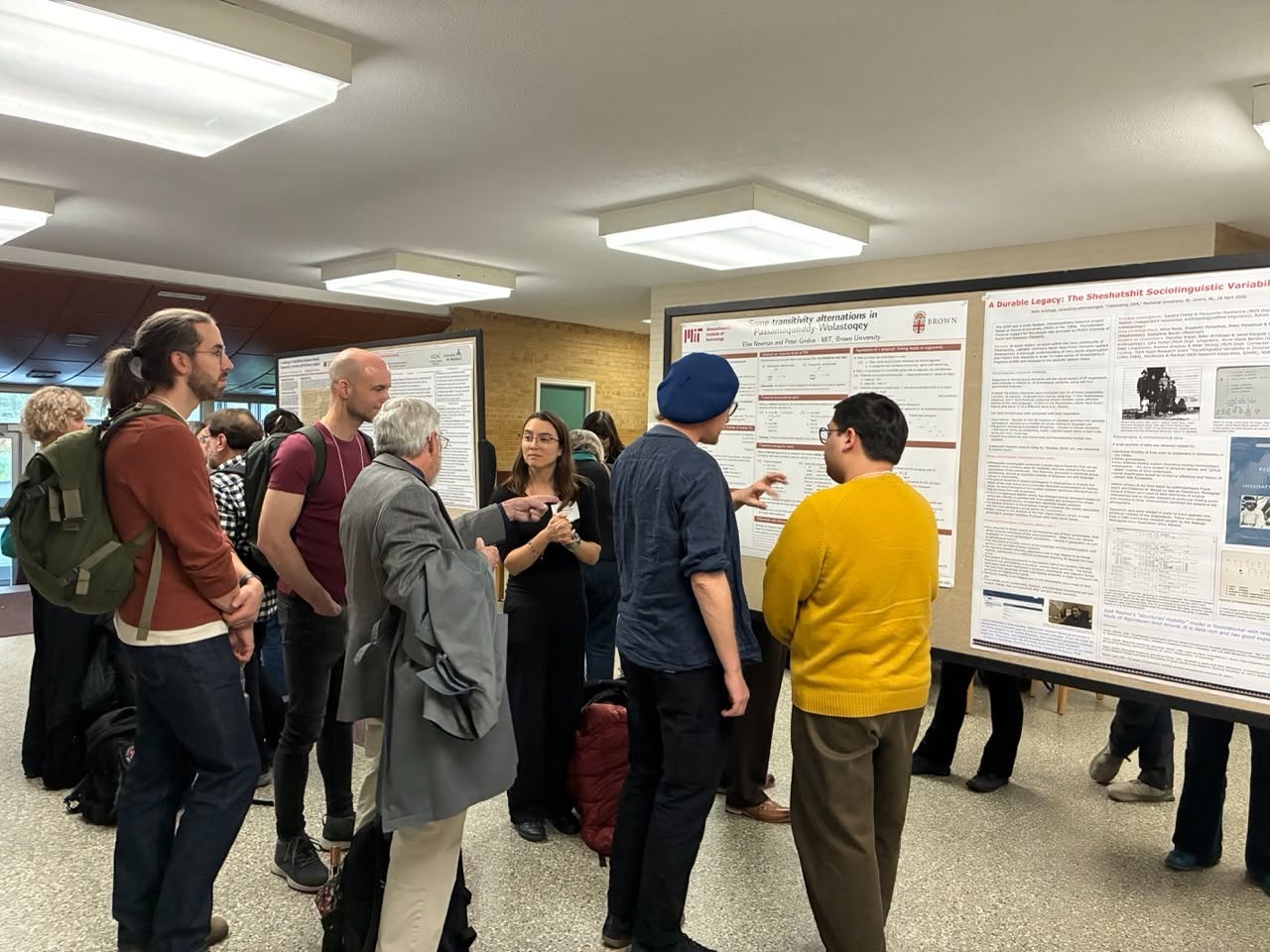
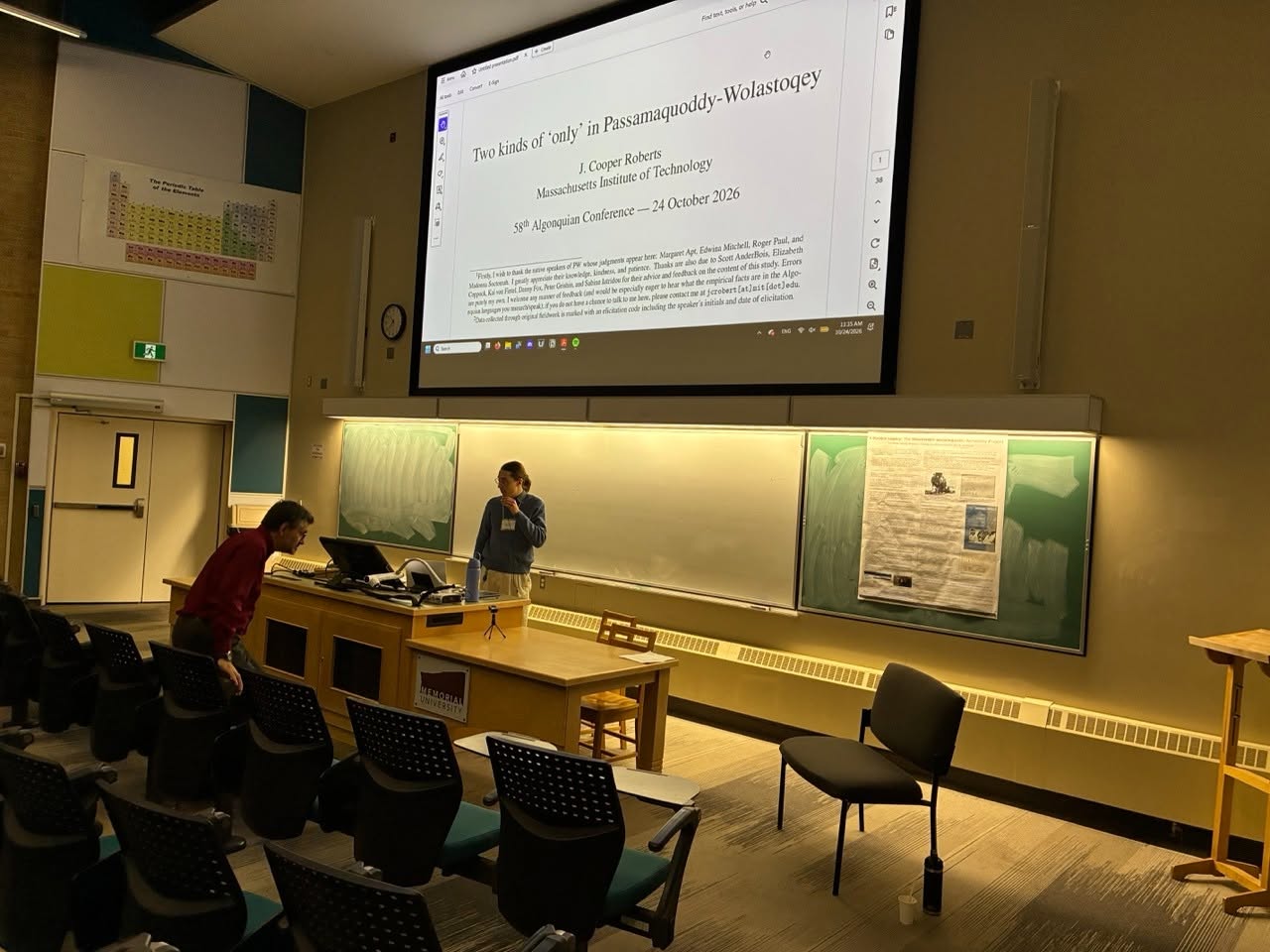
MIT Linguistics was well represented at the recent Algonquian Conference, held at Memorial University of Newfoundland.

Elora Cromarty (current student in the MITILI program), Peter Grishin (‘23, postdoc ‘23-‘25), Elise Newman (‘21, current faculty), Norvin Richards (‘97, faculty), and Cooper Roberts (current student in the doctoral program) all presented at the conference.

Elora gave a poster, and participated in a co-authored talk (with Joel Jansen, Grace Yang, and Antti Arppe), on her work with Swampy Cree – and also participated in a keynote panel discussion on “Youth in Leadership”. The other MIT-related participants presented their work with Passamaquoddy-Wolastoqey. Peter and Elise co-presented both a paper and a poster, and Norvin and Cooper each gave talks.

Norvin Richards writes: “The conference was both inspiring and educational, and we’re looking forward to putting what we’ve learned into practice.”

Conference program: https://algonquianstudies.org/ac58-program/

MIT Linguistics at the Algonquian Conference MIT Linguistics at the Algonquian Conference MIT Linguistics at the Algonquian Conference MIT Linguistics at the Algonquian Conference

LF Reading Group - Seva Masliukov (MIT)

Speaker: Seva Masliukov (MIT)
Title: Selective access to atoms and a gap in the theories of the mass/count contrast
Time: Wednesday, October 21, 1-2pm 
Location: 32-D461
 
Abstract: 
Most theories of the mass vs count contrast assume some version of a three-way split between count nouns like ‘apple’, object-level mass nouns like ‘furniture’ that refer to discrete entities but are number-neutral and not directly «countable», and substance-level mass nouns like ‘water’ that do not have clear minimal parts in their denotation.
 
The goal of this talk is to bring attention to another subgroup of nouns that rather stably map to mass crosslinguistically — granular nouns like ‘sand’, ‘salt’, ‘rice’ etc. Ontologically speaking, they clearly have natural atoms in their denotation, which can be «extracted» both lexically, as in ‘a grain of sand’, or morphologically, as in tywod ‘sand’ <=> tywod-yn ‘a grain of sand’ (Welsh). 
 
I aim to show, mostly building on data from Welsh and Russian, that despite having atomic reference on some level, these nouns severely restrict access to the minimal parts in their denotation. I will further argue that this behavior of granular nouns generally presents a problem for existing accounts of the mass/count distinction and suggest ingredients for a solution. 

Colloquium - Paloma Jeretič (University of Pennsylvania)

Speaker: Paloma Jereti? (University of Pennsylvania)
Title: “Studies on Conceptual Alternatives“ 
When: Friday, October 23rd, 3:30-5pm 
Where: 32-141
 
Abstract:

Any current theory of pragmatic meaning relies on reasoning over alternatives, i.e. sentences that could have been uttered instead. However, recent work points to the need for ‘Conceptual Alternatives’, which are alternative meanings that are built from concepts that do not have a corresponding linguistic form (Buccola, Križ and Chemla 2021). In this talk, I discuss the Conceptual Alternative hypothesis from the point of view of three studies I have done on the topic: two of them are on the implicated presupposition of anti-duality of “all”, which look at data from French and Ecuadorian Siona, which are two languages without a word for “both”, but differ with respect to whether the word for “all” is anti-dual. The third is a language acquisition study, which looks at whether children can derive implicatures that exclude an alternative meaning M before they have learned the words that mean M.

MorPhun 10/22 - Nikita Bezrukov (MIT)

Speaker: Nikita Bezrukov (MIT)

Title: Building New Plurals from Old Morphology: Evidence from Armenian

Time: Thursday, October 22nd, 5pm - 6pm

Location: 32-D769


Abstract: Modern Armenian has two major productive plural suffixes, -er with monosyllabic stems and -ner with polysyllabic stems. These are commonly thought to be historically related, with -ner developing from an earlier sequence -ni-er. I use cross-dialectal evidence, especially from the Van–Shatakh area, to support this reconstruction and then ask how such a change should be modeled formally. Building on Diertani 2011, Alexiadou 2021, and Dali & Mathieu 2021, I treat the development as restructuring of Vocabulary Items over a largely stable nominal structure, involving affix migration, recutting, and changes in the distribution of competing plural exponents.

Phonology Circle - Heidi Durresi (MIT)

Speaker: Heidi Durresi (MIT)

Title: Phonetic and phonological sound changes in an agent-based model

Time: 5pm - 6:30pm

Location: 32-D831


Abstract: At this Phonology Circle I will discuss Gubian et al. (2023), an exemplar-based agent model of phonetic and phonological sound change. Speech data from populations of speakers is used to implement computational agents, the interaction of which can predict shifts and mergers. The design of individual agents is grounded in principles of exemplar theory (Johnson 1997, Pierrehumbert 2001), in which phonological categories emerge in learners from the mapping between words and phonetic exemplars. I will also discuss some examples comparing the predictions of the model and real sound change data, including that of Gheg Albanian (Kapia and Riverin-Coutlée 2024).

LingLunch - Peter Grishin (Brown), Elise Newman (MIT), J. Cooper Roberts (MIT)

Speaker: Peter Grishin (Brown), Elise Newman (MIT), J. Cooper Roberts (MIT)

Title: What’s new with the Passamaquoddy Group?

Time: 10/15/2026, 12:30pm - 2pm

Location: 32-D461


Abstract: In this talk, we (the MIT Passamaquoddy Group) will each present some of our ongoing research on Passamaquoddy (Algonquian, Maine & New Brunswick). Topics include argument structure, the syntax-semantics of exclusive particles, and more. Hopefully, many of you will be inspired to join us!

LFRG - Iva Kova? (University of Vienna)

Speaker: Iva Kova? (University of Vienna)
Title: Can the distribution of weak NPIs be derived from Scope Economy?
Time: Wednesday, October 14, 1-2pm 
Location: 32-D461
 
Abstract: 
The same condition, paraphrased in (1), has been independently proposed to license covert scope shifting of quantifiers (Generalized Scope Economy; Mayr & Spector 2010) and to govern the distribution of weak NPIs such as any (Kusumoto & Tancredi 2013; Barker 2018).
  1. Scope Condition
    a. A quantifier Q may covertly outscope an element S only if …
    b. An NPI must be in the scope of an element S such that …
    the reading that would result from the Q/NPI taking wide scope with respect to S does not entail the reading resulting from the Q/NPI taking narrow scope with respect to S.
In this talk, I explore some consequences of this correspondence. Empirically, if both strands of research are on the right track, we expect weak NPIs to be licensed in exactly those configurations in which (non-NPI) indefinites are allowed to extend scope covertly. I discuss corroborating evidence as well as challenges and open issues. If, despite the challenges, the analogy can be upheld, it opens up a new way of capturing the distribution of weak NPIs, as an indirect consequence of Scope Economy.

Phonology Circle - Suyeon Yun (Chungnam National University)

Speaker: Suyeon Yun (Chungnam National University)

Title: Perceptual similarity and repair choice in Mongolian loanwords

Time: Tuesday October 13th, 5pm - 6:30pm

Location: 32-D831


Abstract: This study examines how perceptual similarity shapes the repair of initial consonant clusters in 355 Mongolian loanwords. Mongolian prohibits word-initial clusters but permits many medial clusters, providing a within-language test of competing, phonotactically acceptable repairs. Three patterns emerge: vowel insertion sites follow intensity patterns more closely than sonority; metathesis is restricted to clusters with a sonorant second consonant and is favored when the initial source syllable is unstressed, provided the resulting structure is permissible; and /s/-stop clusters consistently undergo prothesis, whereas /?/-stop clusters allow both prothesis and internal epenthesis. A P-map-based Optimality Theory analysis accounts for these patterns through faithfulness constraints reflecting the perceptibility of vowel insertion and segmental reordering, including differences between stressed and unstressed vowels and between the two sibilants. The study argues that perceptual similarity guides the choice among structurally acceptable repairs and that fine-grained perceptual distinctions can organize both epenthesis and metathesis within a single grammar.

MorPhun 10/8 - Lina In?iurait?-Noreikien? (Vilnius University)

Speaker: Lina In?iurait?-Noreikien? (Vilnius University)
Title: Derivational Transparency and Opacity in Borrowed Nouns
Time: Thursday, October 8th, 5pm - 6pm
Location: 32-D769

Abstract: Derivational relations in borrowed nouns have long attracted attention in Lithuanian
word-formation studies. However, relatively little research has systematically classified borrowed nouns according to their degree of derivational transparency. I examine borrowed nouns in contemporary Lithuanian from the perspective of derivational morphology. They can be divided
into two major categories: derivationally transparent and derivationally opaque. Derivationally
transparent nouns participate in a derivational opposition with independently attested base words and exhibit clear formal and semantic relations. By contrast, derivationally opaque nouns lack synchronically identifiable base words in Lithuanian and therefore do not participate in a
derivational opposition. Derivationally opaque nouns comprise two distinct subtypes: nouns with
bound stems that occur only in paired formations and nouns containing foreign formants that occur in isolation without corresponding pairs. Finally, I examine the semantic categorization of derivationally transparent and derivationally opaque borrowed nouns.

LingLunch - NELS Practice Talks

Time: Thursday, 12:30pm - 2pm

Location: 32-D461

Talk #1:

Speaker: Zhouyi Sun (MIT), Vlad Orlov (MIT), Oddur Snorrason (Queen Mary University of London)

Title: DD support at LF: On the last-resort nature of Distributed Deletion


Abstract: In this talk, we show that the interpretation of a discontinuously realized nominal (apparent left branch extraction; LBE) depends on the presence and attachment height of a parasitic-gap-containing (PG) adjunct licensed by it.

Building on Bondarenko and Davis (2023) who show than Russian LBE licenses parasitic gaps, we observe that in the absence of a relevant PG-licensing requirement, LBE obligatorily yields a split-scope interpretation with respect to an intervening scope-taking element (1a). Overt pied-piping of the corresponding nominal, by contrast, permits both high and low interpretations of the nominal restrictor (1b). Strikingly, this asymmetry disappears when a PG-containing adjunct attaches above the intervening operator: in this configuration, LBE and overt pied-piping have the same scope possibilities.

(1)

a.  [Skol?ko statej]1 Petja potreboval, ?toby ty otpravil t1
     How.many papers Peter required that you sent
     OK — papers require
     OK — require papers
b. Skol?ko3 Petja potreboval, ?toby ty otpravil [t3 statej]1
     How.many Peter required that you sent papers
     * — papers require
     OK — require papers

We argue that this interaction is problematic for adopting any single uniform analysis of LBE, whether in terms of direct subextraction, or distributed deletion. We propose instead that LBE has two competing derivations. Direct subextraction is preferred whenever possible, and blocks distributed deletion. Distributed deletion is available only as a last resort when required by an independent LF condition, such as PG licensing. We also show that this last-resort strategy is constrained by Economy Conditions, in that it moves only when necessary and only to the height necessary to satisfy the relevant LF requirement.

We further show that the same interaction is found in Icelandic and other languages and discuss additional LF conditions that force the distributed-deletion derivation. More generally, we propose that the last-resort nature of distributed deletion can be motivated by LF-requirements in addition to the previously established PF-constraints (e.g. Franks 1998, Bos?kovic? 2001).


Talk #2:

Speaker: Zhouyi Sun (MIT)

Title: Tigrinya gradable verbs: When verbalizers comparativize

Abstract: In Distributed Morphology, words are built syntactically from acategorial roots and categorizing functional heads such as v, a, and n (Halle & Marantz 1993, et seq.). In addition to determining syntactic category, categorizers may contribute semantic content. For verbalizers, previous work has focused primarily on meanings associated with argument structure and event structure (e.g. Arad 2005, Harley 2009). The range of possible meanings verbalizers can contribute remains an open question.

This work takes comparative meaning as a case study. A potential connection between verbalization and comparative meaning has been suggested by degree achievements (e.g. worsen; Bobaljik 2012: 171–172, 205–207), English out-comparatives (e.g. outweigh; Ahn 2022), and Mandarin transitive comparatives (schematically, ‘John tall Mary 5cm’; Grano & Kennedy 2012). Yet in these cases, it remains unclear whether the relevant comparative operator is contributed by a verbalizer. I suggest Tigrinya (Ethio-Semitic) offers a useful case for investigating this possibility: its gradable roots exhibit a systematic, category-conditioned positive-comparative opposition. Their adjectival forms have positive interpretations, as in b?lla? ‘smart’, whereas their verbal forms have comparative interpretations, as in t?-b?ll?? ‘she is smarter’. I show that the relevant forms are morphosyntactically verbal and semantically comparative, and argue that the comparative operator is contributed by the verbalizer. The analysis thus identifies comparison as a possible semantic contribution of verbal categorization.

LFRG - Amir Anvari (MIT)

Speaker: Amir Anvari (MIT)
Title: You are your own sibling (before exhaustification) 
Time: Wednesday, October 7, 1-2pm 
Location: 32-D461
Zoom link: https://mit.zoom.us/j/92053685079
 
Abstract: 
A binary relation is irreflexive if it does not relate any object to itself. For example, the nouns “child” and “sibling” are intuited to express relations that are clearly irreflexive. Interestingly, in certain environments nouns like “sibling” (“roommate”, “colleague”, “neighbor”, etc) act as though they are not irreflexive—an observation that can be traced back to the 10th century linguist Abu Sa’id Sirafi and was rediscovered in 20th century by Barker (1999) and in 21th century by Bassi, Chatain, Chen & Kobayashi (2021). For instance, the sentence “John is the tallest of his siblings” sounds perfectly coherent despite the fact that, on standard assumptions, it presupposes that John is one of his own siblings (compare with: #John is the tallest of his children). Inspired by Paille’s (2025) treatment of the exclusivity inference of co-taxonyms, I will argue that (i) nouns like “sibling” do not, in fact, express irreflexive relations as a matter of their lexical semantics and (ii) the intuition that they do so is due to exhaustification at LF with the identity predicate IDENT acting as the negated alternative. 

Phonology Circle 10/5 - Hani Na’eem (MIT) & Chelsea Tang (MIT)

For our Phonology Circle this Monday (10/5), we will be hearing two AMP practice talks from Hani Na’eem (MIT) and Chelsea Tang (MIT).

Time: Monday, October 5 5pm-6:30pm

Location: 32-D831

Speaker #1: Hani Na’eem (MIT)
Title: The nature of emphasis spread in Jordanian Arabic
Abstract: 

In this practice for an AMP poster presentation, I will give a summary of my work on the phenomenon of emphasis spread (ES) in Jordanian Arabic (JA). ES is a process whereby emphatics, coronals with a secondary constriction near the uvula, lower the second formant (F2) of sounds in their context, most saliently backing low vowels which are otherwise front. Previous work on ES has documented a directional asymmetry of the effect: while vowels to the left of the emphatics have their F2 uniformly lowered regardless of distance and the consonantal context, the effect on following vowels gradually fades out with distance and, in some descriptions, is blocked by high segments. The gradience of the rightward effect led to varying accounts with respect to the domain of spreading and/or the nature of the mechanism that gives rise to the effect. Some analyses (Davis 1995; Herzallah 1990; Jaber et al. 2019; McCarthy 1997; Younes 1982, 1993) posit a phonological account of rightward [rtr] harmony with various restrictions on its domain of application; others (Zawaydeh 1999; Zawaydeh & de Jong 2002) argue that ES is a ‘phonetic’ rather than a ‘phonological’ process.


Based on acoustic data from a production experiment, I argue that (i) emphatics spread [rtr] non-iteratively to two vowels to the right of the trigger, (ii) that the effect on the second vowel to the right does not reduce to a purely phonetic/coarticulatory mechanism, and (iii) that the observed gradience/smaller acoustic effect on this distant vowel is due to anticipatory coarticulation with the following context, which is outside the direct purview of the ES process. Adopting Walker’s (2011) formalism, I analyze both leftward and rightward ES through licensing constraints that seek to maximally license [rtr] in the surrounding context. While the constraint responsible for leftward spreading is highly ranked, the one responsible for rightward spreading is dominated by a CrispEdge constraint that delimits the spreading domain which I propose – as a first approximation – is sensitive to foot structure. The resulting analysis captures the directional asymmetry in ES while allowing the gradient phonetic realization of rightward spreading to emerge from the interaction between a categorical feature-spreading process and independent coarticulatory mechanisms.


Speaker #2: Chelsea Tang (MIT)
Title: From Denasalization to Backcopying in Nyandarua G?k?y?: the Emergence of Base-Reduplicant Identity from Sound Change
Abstract:

This presentation examines how a historical change in the consonant inventory of Nyandarua G?k?y? gives rise to a new pattern of consonant backcopying. Earlier descriptions of G?k?y? document a consonant system with prenasalized voiced stops but no corresponding plain voiced stops, while Nyandarua and other northern and southern varieties have undergone the loss of prenasalization, resulting in only plain voiced stops (Ngure 2005). The two varieties also differ in reduplication. Both Standard and Nyandarua G?k?y? show templatic backcopying, where the reduplicant can affect the shape or vowel quality of the base, but consonant backcopying is found only in Nyandarua.

I argue that the emergence of consonant backcopying follows from the historical change in Nyandarua Gi?ku?yu? consonant inventory. Diachronic work in Optimality Theory models sound change through changes in constraint ranking (Jacobs 1995; Holt 2003, 2015; Lleó 2003), and many analyses show that a single instance of constraint reranking can have consequences for multiple (sometimes apparently unrelated) phonological processes (Holt 2003; Miglio & Morén 2003; Padgett 2003; Smith 2023; among others). Building on these accounts, I analyze the loss of prenasalized stops as a reranking of *NC and IO-Id[nas], such that *NC comes to dominate IO-Id[nas] in Nyandarua, while varieties that retain prenasalized stops have the IO-Id[nas] >> *NC grammar. In reduplication, templatic backcopying in both varieties establishes that BR-faith is active. However, the effect of BR-faith on consonants is masked by a higher-ranked IO-Id[nas] that preserves prenasalized stops in Standard G?k?y?. By contrast, in Nyandarua, the reranking of *NC and IO-Id[nas] responsible for denasalization also places IO-Id[nas] below BR-Id[nas], allowing consonant backcopying to surface. The historical loss of prenasalized stops therefore not only changes the consonant inventory, but also gives rise to consonant backcopying in Nyandarua G?k?y?.


Aonuki published in Semantics of Natural Languages

We are delighted to announce that the paper “Scale-sensitivity of comparatives and measure phrase interpretations in Gitksan” by 5th-year student Yurika Aonuki has just been published in Semantics of Natural Languages. Congratulations, Yurika!

Here is the abstract:

This paper demonstrates that in Gitksan, measure phrases (MPs) occurring with relative gradable adjectives (GAs) like ’wii ’nakw ‘tall’ receive differential interpretations even in the absence of an overt comparative operator or an overt standard phrase, a pattern which has been only reported in Japanese (e.g., Snyder et al. 1995) and Korean (Oda 2008; contra Sawada and Grano 2011). In contrast, MPs occurring with minimum-standard GAs like k?’ak? ‘open’ receive absolute interpretations, as in many languages including Japanese (Sawada and Grano 2011). However, Gitksan differs from Japanese in two crucial ways. First, the distinction between relative and minimum-standard GAs is observed even without MPs: relative GAs can easily receive comparative interpretations on their own, while minimum-standard GAs cannot. Second, Gitksan has a morphologically free, overt morpheme k’aa, which can give rise to comparative readings with any GA and hence makes the possibility of a covert comparative operator less plausible. On a closer investigation, the comparative readings of relative GAs without k’aa show mixed behaviours of what have traditionally been called ‘explicit’ and ‘implicit’ comparatives (Kennedy 2007). I propose that these comparative readings arise from inherently context-sensitive denotations of relative GAs, building on Oda’s (2008) analysis of Japanese. The latter half of the paper examines the semantics of k’aa and analyzes it as a superlative morpheme, and highlights the role of consideration of alternatives to the subject in comparative readings observed without k’aa. 

The paper is open access: https://doi.org/10.16995/snl.29102

LFRG - Prarthanaa Bharadwaj (Goethe University, Frankfurt)

Speaker: Prarthanaa Bharadwaj (Goethe University, Frankfurt) 
Title: Polyfunctionality of the Particles -oo and -uu: The Indeterminate sytem in Kannada 
Time: Wednesday, September 30, 1-2pm 
Location: 32-D461
 
Abstract: 
In his seminal typology, Haspelmath (1997) observed that indefinite pronouns in many languages are built from interrogatives combined with focus-sensitive particles, and that the same building blocks yield negative polarity items (NPIs) and free choice items (FCIs). Work on such indeterminate systems has shown that they also extend to question formation (Kuroda, 1965; Kratzer & Shimoyama, 2002; Cable, 2010) and relative clauses (Slade, 2011; Dayal, 1997; Caponigro, 2003; Balusu, 2021). In this talk, I examine indeterminates in Kannada (Dravidian) from the perspective of the particles that license them. I present the paradigm of the disjunctive particle -oo and the inclusive particle -uu across coordination, indefinites, questions, inclusive focus, and relative clauses, and show that both the presence of a wh-word and the particle’s height of attachment determine its interpretation: -oo can occupy the clause-typing position, where it forms questions, whereas -uu never can. I then assess how far two existing accounts—Uegaki’s (2018) unified semantics of the Japanese Q-particle ka and Balusu’s (2022) analysis of Dravidian NPIs/FCIs as unconditionals can jointly account for the Kannada paradigm. 

Colloquium - Philippe Schlenker (Institut Jean-Nicod, CNRS)

Speaker: Philippe Schlenker (Institut Jean-Nicod, CNRS)
Title: “The Iconic Frontier of Formal Grammar“ 
When: Friday, October 2nd, 3:30-5pm 
Where: 32-141
 
Abstract:

Iconicity has long been known to be pervasive in sign language. But how does it interact with grammar?  On the basis of ASL data, we propose a modular framework with three key features.

  1. Semantics: Logical semantics must be extended with an iconic component. The result, which we call “Iconological Semantics”, has Logical Forms that combine standard logical operators with an iconic component (inspired by formal pictorial semantics). The “glue” between them is viewpoint manipulation. 
  2. Syntax: Certain expressions with a designated iconic behavior, called  ‘classifiers’, have not just an iconic semantics but also an iconic syntax: they take their arguments in the order in which they would appear in a simplified comic. To say that “a crocodile ate up a ball”, the normal word order in ASL is SVO if the verb (EAT) is not a classifier. But if one uses a classifier instead,  the order becomes SOV or OSV. This is because one typically sees the eating after one has seen the event participants.
  3. Pragmatics: The iconic content of classifiers is not an unstructured whole. It is divided among traditional slots of the inferential typology, such as assertions, presuppositions, implicatures, and more. Since this  iconic content is determined by classifier movement and could not be listed in the lexicon, there must be an algorithm that productively divides this iconic content among these slots.

(These claims extend from sign with iconicity to speech with gestures, but for reasons of time we will focus on sign.)

Brief survey: “Meaning after the Multimodal Revolution: Seven Things Signs and Gestures Teach Us about Meaning”, to appear in WIREs Cognitive Science.

Technical: “Iconological Semantics” “Iconic Syntax” “The Inferential Typology of Language: Insights from Sign Langage (ASL)”

Syntax Square 10/29 - Magdalena Lohninger (Salzburg)

Speaker: Magdalena Lohninger (University of Salzburg)
Title: Form of a CP, meaning of a vP: Event complements in Austrian German
Time: Tuesday, September 29, 1:00pm - 2pm
Location: 32-D461

The talk investigates clausal complementation in Austrian German, focusing specifically on complement clauses under verbs like “try, begin, finish”. While such verbs select only infinitival complements in Standard German, they can take full CPs in Austrian German, giving rise to sentences such as (1):

1)   (1) Er hat versucht/angfangen/aufghört [ dass er des Auto repariert ]
    He has tried/started/finished [ that he the car repair.3sg ]
    He tried/started/finished to repair the car

Even though such complement clauses surface as full CPs, they are highly restricted in their interpretation: they exhibit obligatory control, their time-reference must be identical to the matrix time, they cannot express any other morphological tense value than present tense, they can receive an implicative reading under verbs like “forget”, and do not permit embedded V2 or interrogatives. Hence, their interpretation resembles an infinitive (or what Wurmbrand and Lohninger 2019 term an “Event” clause), rather than what we expect from a CP. Interestingly, these “fake” CPs freely alternate with genuine infinitival complements, raising a puzzle concerning the relationship between semantic selection and syntactic size.

Given that this is very recent work, I will focus primarily on the empirical findings, and hope to get some feedback on how to develop the more theoretical aspects.

LFRG - Zachary Feldcamp (MIT)

Speaker: Zachary Feldcamp (MIT) 
Title: Generalization X under Movement
Time: Wednesday, September 23, 1-2 p.m.
Location: 32-D461
 
Abstract: Noun phrases may often be interpreted either de re or de dicto with respect to an intensional operator, while predicates are obligatorily interpreted de dicto (Percus’s 2000 Generalization X). Existing accounts capture this asymmetry by constraining the relation between a predicate’s LF position and its intensional interpretation. I investigate what happens when a predicate overtly raises across an intensional operator in “predicate inversion” constructions such as With Taylor is believed to be a lawyer. I show that such predicates remain obligatorily de dicto, even though independent binding and Condition C diagnostics indicate that they need not syntactically reconstruct. This creates a reconstruction paradox: the raised predicate must be interpreted upstairs for some purposes but downstairs for intensionality. The result poses a problem both for scope theories and for theories that posit a predicate-internal intensional variable. I argue that the data instead favor a treatment of intensionality in which predicates take an intensional argument, and that, if this argument is saturated by a variable, such a variable must compose above the predicate constituent. I then explore how such an analysis can be implemented through semantic reconstruction while preserving the familiar de re/de dicto flexibility of nominal arguments.

Phonology Circle - Christopher Legerme (MIT)

Speaker: Christopher Legerme (MIT)
Title: Representation and Computation in Phonological Theory: Faust and Scheer (2025)
Time: , 5pm - 6:30pm
Location: 32-D831

Abstract: Before asking what rules or constraints a grammar needs, we need to know what kind of representations those computations should be operating over in the first place: “If the representations are right, then the rules will follow” (McCarthy 1988:84). I’ll be presenting Faust & Scheer’s (2025) work on the behavior of stem-final TR clusters in North-Eastern Creusois (NEC), using the paper to foreground a broader methodological question pertaining to the division of labor between representation and computation in phonological theory. NEC shows a noun/verb asymmetry in the repair of illicit stem-final TR clusters. The account of Faust & Scheer combines Strict CV representations with Optimality Theory (OT) to derive deletion in nouns and metathesis in verbs through non-transderivational morphological exponence that is followed by a completely regular phonological computation in which phonology doesn’t need to make reference to syntactic category (2025: 32). And so, we are brought to consider the broader architectural question of what a modular grammar might require of its interfaces. For Faust & Scheer, their study of the NEC pattern is only one contribution to a larger debate over whether phenomena that appear to require cross-modular information really force us to weaken certain assumptions about modularity, or whether they can instead be derived by reconsidering our phonological representations and how the different components of grammar get related to one another. Please note that, as the inaugural talk of the 2026-27 season of Phonology Circle, this presentation will be oriented primarily toward introducing the NEC data, which instantiate the kinds of patterns familiar from morphophonology more generally, and the basic concepts needed to follow the paper’s argument, including the relevant machinery of OT, Strict CV, and some background assumptions about Spell-Out that motivate the analysis, rather than toward adjudicating the broader theoretical debate. That said, any comments, thoughts, or questions will of course be very welcome.

LingLunch - Eyal Marco (MIT), Roni Katzir (Tel-Aviv University), Ezer Rasin (Tel-Aviv University)

Speaker: Eyal Marco (MIT), Roni Katzir (Tel-Aviv University), Ezer Rasin (Tel-Aviv University)
Title: The complementary-distribution challenge for phonological learning: The case of [h] and [?] in English
Time: , 12:30pm - 2pm
Location: 32-D461

Abstract: The distribution of [h] and [?] in English poses a well-known challenge for the structuralist assumption that segments in complementary distribution are allophones of the same phoneme. In this study, we show that this distribution also poses a challenge within generative linguistics, a challenge of explanatory adequacy. The challenge is to explain why the English-learning child does not acquire a grammar in which [h] and [?] are derived from the same underlying representation. The generative literature has not identified this as a problem, largely because of the assumption that [h] and [?] are too phonetically dissimilar to participate in an alternation. However, we argue that phonetic accounts do not eliminate the challenge. We discuss simplicity-based theories of learning and show that under naive representational assumptions, simplicity-based learners prefer to derive [?] from an underlying /h/, rather than a longer sequence of /ng/ (or an underlying /?/), and therefore make wrong predictions about English speakers’ knowledge. The same learners, however, make correct predictions when combined with a representational framework that assumes underspecification and lexical redundancy rules. We therefore conclude that the acquisition problem can be addressed using simplicity-based learning, and that the complementary distribution of [h] and [?] provides an argument for underspecification and lexical redundancy rules.

Colloquium - Jonah Katz (UCLA) 

Speaker: Jonah Katz (UCLA) 
Title: “Template structure in musical textsetting: Evidence from early hip-hop“ 
When: Friday, September 18th, 3:30-5pm 
Where: 32-141
 
Abstract:
This talk describes the setting of lyrics to musical rhythms (‘flow’) in mid-1980s hip-hop. I argue based on the distribution of musical and linguistic features that the genre makes use of abstract templates, but that these templates are fundamentally different from metrical verse. Halle & Keyser (1971) propose that metrical poetry involves a mostly-invariant, abstract template of strong and weak metrical positions grouped into constituents of various sizes, and that metrical variation within a form stems from correspondence rules governing which linguistic materials may appear in which positions in the template. There has been significant disagreement about whether musical textsetting also involves such templates, and whether and how they might differ from poetic ones. For instance, Hayes and various colleagues (e.g. Hayes & MacEachern 1996, Hayes 2009) develop a model of folk-quatrain chanting and songforms where linguistic representations interact directly with musical meter and no abstract template mediates the relationship. Kiparsky (2006) argues that this quatrain form requires abstract poetic templates of the Halle & Keyser (1971) type to mediate between linguistic representations and musical meter. And Dell (2015) proposes, based on French song, that while textsetting does rely on templates, those templates are not abstract poetic ones: they instead encode information specific to musical tonality, rhythm, and meter.
 
The current study offers evidence from hip-hop that tends to support Dell’s view broadly, but also requires significant extensions to his theory of representations. I show that this genre uses templates to enforce local parallelism, that the templates encode multiple hierarchical levels of prominence and constituency, and that the mapping of these rhythmic templates to musical metrical positions is partly arbitrary in ways that can’t be captured by global constraints on linguistic-metrical correspondence. All of these properties are analogous or identical to general features of music, including music without words (Lerdahl & Jackendoff 1983). I therefore propose that musical textsetting be modelled with Lerdahl & Jackendoff’s hierarchical template formalism (‘time-span reduction’) for music. 

Minicourse - Jonah Katz (UCLA)

Speaker: Jonah Katz (UCLA)
Title: “Synchronic lenition”
When: Wednesday, September 16th, 1pm-2:30pm (Day 1) + Thursday, September 17th, 12:30-2pm (Day 2)  
Where: 32-D461
 
Abstract: 
In this mini-course, I’ll give an overview of several different frameworks for thinking about synchronic lenition (and fortition) patterns, then review some of my own work in the area as it relates to these ideas. The first day will focus on what lenition is, and how linguists have characterized lenition patterns in terms of articulation, perception, and information. The second day will focus more narrowly on intervocalic lenition and initial strengthening, offering some case studies and (hopefully) new data from my lab. 

Syntax Square 09/15 - Giovani Roversi (MIT)

Speaker: Giovani Roversi (MIT)
Title: Applicative left behind?
Time: Tuesday, September 15, 1:00pm - 2pm
Location: 32-D461

 I will present you some curious data from Äiwoo that I’ve been banging my head on for a while. We will see a construction that functionally speaking seems to be a relative clear case of an applicative (i.e., it adds one DP argument to the argument structure of the verb, one that would’ve otherwise had to be expressed as a PP). However, the way it’s morphologically realized is rather puzzling, because it’s nowhere near where applicatives typically are found. Given what they do syntactically, applicative heads are usually in the lower theta domain of the clause (i.e., within vP/VoiceP). Therefore, by the Mirror Principle (Baker 1988)’s terms and conditions, applicative morphemes should be very close to the verb stem — and indeed they are, in most (all?) cases I know of. However, in the Äiwoo case, the particle that marks this “applicative” construction is realized somewhere else entirely. I will discuss a couple of hypotheses about what we could be looking at, and where they break. Put on your creative syntactician hats, and help me out!

Welcome ling-26!

Šišóka Bendickson: Háu Mitákuyepi. Šišókaduta emákiyapi dó. Hello my relatives. I am called Šišókaduta. You can shorten that to Šišóka. I am a first year student in the MITILI program. I am an enrolled tribal member from the Lake Traverse Sisseton Wahpeton Oyate. I am an L2 speaker of the Santee Dakota dialect. There are no official estimates of how many Dakota speakers are left, but I would guess there are less than 300 L1 speakers. I studied Dakota language at the University of Minnesota and graduated with my BA in American Indian Studies. I worked with L1 speakers to improve my proficiency. Then I taught beginning and intermediate Dakota courses at the UMN for a decade. Before coming to MIT, I worked with Dakota and Lakota language non-profit organizations on dictionaries, classes, and learning materials. My goals are to document fluent speakers, create materials for the language community, conduct research, and work towards total revitalization of the Dakota language. During my time in the MITILI program I want to learn about linguistics generally, and more specifically about syntax and morphology. I want to apply the knowledge I gain at MIT towards my goals of documentation and revitalization of the Dakota language. I like to cook, spend time with my family, attend Dakota ceremonies, and travel. Tókšta akhé!

Mícheál Curtin [‘mih?l]: Beannachtaí an fhomhair oraibh! I am an Irish speaker and a first-year student on the MITILI program. Thus far, my career and training have been in applied theatre. For the last nine years I have been directing a drama education program for high school students in New York City, where I led a team of Actor/Teachers who use theatre as a teaching tool in public schools. In Ireland, I have led programming with elders and young people alike in support of the language revitalization movement there. I have an MA in Applied Theatre from CUNY. At MIT, I hope to gain skills that enrich my work in Ireland. I look forward to learning from other folks who have worked on revitalizing languages in other contexts. I’m originally from Brooklyn, NY and enjoy archery, Survivor, running, and board games. 

Mehment Can Dadan: Hi everyone, I am Can (he/him) with a [d?]. I am from Turkey and got my B.A. and M.A. in Linguistics from Bo?aziçi University. I am interested in phonetics and phonology, particularly in vowel harmony and stress. Other than linguistics, I enjoy watching films and talking/venting about them as well as photography. Nowadays, I am trying to learn how to play bass.

Churong Jin: Hi all! I’m Jin, originally from Beijing, China. I’m interested in semantics, and some topics that have been on my mind include neg-raising, event semantics, inquisitive semantics, and probability operators. Prior to joining MIT, I did my undergrad at UCLA in math and philosophy, and worked as an RA at the Meaning Lab at USC. Lifting, running, hiking, reading and playing video games constitute most of my life outside of academics, other than, of course, hanging out and going on spontaneous adventures with friends. I’m currently most excited about branching out to areas of linguistics beyond semantics, and my side quest is to run the Boston Marathon before I graduate.

Ogloo Jurkhaichin: I’m Ogloo, and I’m originally from Inner Mongolia, China. My main interests are in syntax and morphology, especially the ways they interact with each other and with other components of grammar. Most of my work so far has focused on Mongolian, and I’m interested in using data from Mongolian and related languages to think about broader questions in linguistic theory. Before starting the PhD program, I was a student in MIT’s Indigenous Languages Initiative, or MITILI, here in the department, so I’ve actually already been around for the past two years. I’m really excited to continue working on these questions and to explore some new directions during the PhD. 

Rowan Levick: Hi everyone! I’m Rowan (they/them). I grew up in Pittsburgh, PA and got my BA in linguistics from William & Mary in Virginia. I’m primarily interested in the phonetics phonology interface and experimental work with children and adults. I’ve done research on acoustic phonetics of nasals, vowel length perception in young children, and I worked for a developmental neurolinguistics lab at UT Dallas where we mainly studied individual differences in children’s word learning abilities. Outside of linguistics I play a lot of ultimate frisbee and enjoy glassblowing, cooking, and a good chat with friends.

Andrew Ryan: Hi, I’m Andrew! I grew up in and around New York City. Within linguistics, I mostly spend my time at the intersection of theoretical syntax and fieldwork/consultant work, my research thus far having focused on the syntax of voice-related phenomena in Waray-Waray, an underresearched language of the Eastern Visayas in the Philippines. I also have burgeoning interests in event structure, the semantics of aspect, and the nature of the lexicon. Outside of linguistics, I like many things, but none more than my cat Tombo!
 
Joseph Sarmenta: Hi! My name is Joseph. I was born in the Philippines but grew up in the US, most recently in San Jose, California. I studied linguistics at Stanford University. I’m primarily interested in phonology and syntax, but I get excited about anything that builds our understanding of the origins of language and its relation to thought. In my free time, I enjoy playing tennis, hiking/camping, making coffee, and knitting.
 
Orr Well: My name is Orr. I grew up in Jerusalem and spent the past four years at Tel Aviv University’s interdisciplinary program, where I studied linguistics, computer science, philosophy, and psychology before going on to pursue an MA in linguistics. My main interests lie in semantics and its interfaces with syntax and pragmatics, and my MA thesis concerns the role of focus in question-answer pairs. I’m also interested in computational linguistics, particularly machine learning and its relevance to language acquisition. Outside of academics, I enjoy reading, listening to music, and hiking.
 
Gary Yu: Hi, my name is Haoxi Yu, and I am from Ningbo, China. I obtained my bachelor’s degrees in Computational Linguistics and Mathematics from the University of Southern California. I am interested in various topics in syntax, particularly argument structure. In my free time, I enjoy watching tennis and football.
 
Maria Berkovich


Experimental and Computational Methods in Linguistics – new meeting group (ECML)

A new meeting group for people in the department who are engaged in experimental or computational work, or who are interested in learning more about these approaches: the (provisionally named) Experimental & Computational Methods in Linguistics group, or ECML!

The meetings will be largely informal and fairly unstructured, with more formal presentations or talks being the exception rather than the rule. The idea is to have a space for the kind of discussion that doesn’t fit neatly into a class or reading group — things like working through a methodological problem in an ongoing project, talking through statistical analyses or experimental design choices, or floating project ideas that are still at an early stage.

A broader aim is to build more of a shared and supportive culture around experimental and computational methodology across the department. We hope this will be useful to everyone, including incoming first-year students, who may find it a natural entry point for getting acquainted with the kind of work people here are doing.

ECML meets Wednesdays 2–3pm in room 32-461. The first meeting will be on September 23  — we’ll use that session mainly to talk about what people want out of the group and how to structure it going forward.

We’ll set up a mailing list shortly. In the meantime, feel free to reach out with any questions.

Hope to see you there,

Adam, Amy, Edward, Martin and Shota

Colloquium - Chris Kennedy (University of Chicago) 

Speaker: Chris Kennedy (University of Chicago)
Title: “Coordination as Aggregation (or, When Meaning Is Like Voting)” 
When: Friday, September 11th, 3:30-5pm 
Where: 32-141
 
Abstract:
The philosopher Crispin Wright says a predicate P is ‘tolerant’ with respect to a dimension D just in case “there is some positive degree of change in respect of D that is insufficient ever to affect the justice with which F is applied to a particular case” (Wright 1975).  Tolerance is most often discussed in the context of analyses of vague predicates like ‘big’ and ‘small’, but it is a feature of a wide range of linguistic constructions with indeterminate meanings, including generics, progressives, measure terms, modals, etc. Despite its ubiquity, tolerance —- and in particular the fact that it persists even when the semantic and pragmatic properties of a tolerant expression and the facts of the context of utterance conspire to make it go away —- has resisted explanation.  In this talk, I will do three things.  First, I will make the case that tolerance is something that linguists should care about. Second, I will show why existing accounts of tolerance, which have characterized it as (inter alia) a metaphysical, epistemic, semantic or cognitive fact, are unsatisfactory. And finally, I will offer a new explanation that characterizes tolerance as a pragmatic fact about how a community settles linguistic indeterminacy:  this is a coordination problem, and I claim that coordination on shared resolutions of linguistic indeterminacy has the structure of aggregation. Framing the explanation in terms of Social Choice Theory, I will show that tolerance is the empirical footprint of a strategy for ensuring that coordination on an aggregate resolution of indeterminacy is possible. 

MorPhun 9/10 - Christopher Legerme (MIT)

Speaker: Christopher Legerme (MIT)

Title: Some Aspects of Bantu Morphology, featuring Leland Paul Kusmer (2019)

Time: Thursday, September 10th, 5pm - 6pm

Location: 32-D769


Abstract: Discussion on verbal morphology in Bantu, focusing on the conjoint/disjoint alternation, where a verb’s surface realization depends on its syntactic, information-structural, or prosodic relation to what follows it. I’ll walk through some of the core Bantu facts and compare them with similar patterns in the French Creole languages I work on. I’ll then present Kusmer’s (2019) analysis of the conjoint/disjoint alternation in Tshiven?a. Unlike more familiar Bantu systems, the two morphological variants of a verb are not straightforwardly in complementary distribution in this language: some linguistic environments permit either form. The paper reports results from an experiment testing speakers’ choices across different syntactic contexts. Kusmer suggests that the variation in Tshiven?a may track prosodic phrasing. I’ll use these results as a starting point for further discussion of how we should understand the relationship between prosody and morphological exponence.

Course announcements: Fall 2026

Course announcements in this post:

  • Special Topics: “Doing Experimental Linguistics” (24.S95)
  • More Advanced Syntax (24.955)
  • Topics in Phonology: Phonetics and phonology in generative grammar (24.964)
  • Topics in Computational Phonology (24.981)
  • Topics in Semantics: Presupposition, Anaphora, and Reference (24.979)

24.S95: Special Topics: “Doing Experimental Linguistics”

  • Instructor: Shota Momma
  • Time: Tuesday, 2pm-5pm
  • Room: 32-D461

As the title suggests, the goal of this course is to design and carry out an experimental project, either individually or in groups. Through this process, you will learn the fundamentals of experimental design and data analysis as used in experimental syntax, semantics, phonology, and psycholinguistics. I currently plan to spend the first half of each class covering core concepts in experimental methods and statistics, along with discussion of relevant papers, and the second half working on student projects (going through materials together, discussing specifics of designs, etc). One concrete goal of the course is to submit an abstract (individually or as a group) to a psycholinguistics conference (e.g., HSP: https://www.hspsociety.org/). The deadline for HSP is typically in late November/early December, so we may be able to aim for that if things go well.


24.955: More Advanced Syntax

  • Instructor: Elise Newman & Sabine Iatridou
  • Time: Thursday, 2pm-5pm
  • Room: 32-D461

This class is strongly recommended for those interested in syntax and/or the syntax-semantics interface. 

It explores many topics, all of which have the property that they have not been taught in the 24.951/24.952 classes of the previous two years. Each topic will be covered in at most two class sessions. Registered students will be required to write three snippets. The first snippet has to be on a topic taught in the first 4 weeks, the second on a topic of the second 4 weeks, and the third on a topic taught in the last 4 weeks.

Some topics we plan to cover include (subject to change):

  • Wh-predicates 
  • V-initial languages
  • Clefts and Pseudoclefts
  • Quexistentials
  • Category-less adjectives
  • Ne-que exceptives
  • Indexical shift
  • Plural pronoun construction
  • Asymmetric coordination
  • The Coordinate Structure Constraint

This class is offered biannually, so if you are considering taking it, please note that the next time it will be offered will be in the ’28-’29 academic year.


24.964 Topics in Phonology: Phonetics and phonology in generative grammar

  • Instructor: Edward Flemming
  • Time: Friday, 10am-1pm
  • Location: 32-D461

Standard models of the grammar of linguistic sound divide it into two components, phonetics and phonology, but many questions about this division remain open. The goal of this seminar is to explore some of these questions. For example:

  • Where is the dividing line between phonetics and phonology, and why?
  • What information is passed from the phonology to the phonetics? Just the output of the phonology? Underlying representations? Information about the system of contrasts?
  • Are there inputs to the phonetics that do not come from the phonology? E.g. speech rate, hyper-/hypoarticulation.
  • Does any information flow from the phonetics to the phonology? Does the phonology anticipate language-specific aspects of phonetic realization?
  • Are these components organized serially? If so, are there opaque interactions between them?

24.981 Topics in Computational Phonology

  • Instructor: Adam Albright
  • Time: Wednesday, 10am-1pm
  • Location: 32-D831

Computational modeling can usefully inform many aspects of phonological theory. Implementing a theory provides a more rigorous test of its applicability to different data sets, and requires a greater degree of formal precision than is found in purely expository presentations. By training models on realistic training samples, we can test whether a posited analysis can actually be learned from representative data, and we can observe what proportion of the data is actually accounted for by that analysis. Modeling also provides a direct means of testing whether a proposed formal device facilitates the discovery of generalizations, or whether it hampers learning by greatly increasing the size of the search space. Finally, modeling has played an increasingly important role in modeling gradient experimental data, since it provides a way of comparing human behavior with statistical properties of linguistic input, filtered through a possibly non-trivial learning procedure.

This class is intended to provide an introduction to the theory and practice of computational models of phonology.  We will discuss recent theoretical work informed by computational implementations, and tools for modeling phonological knowledge of various kinds.  Special attention will be paid to the relation between formal learning models and empirical data concerning early phonological acquisition.

Topics may include: (subject to substantial revision, according to needs or interests of participants)

  • Statistical “baseline” models (n-gram models, exemplar models)
  • Algorithms for constraint weighting and constraint ranking (recursive constraint demotion, biased constraint demotion, the GLA; perceptron learning and maximum entropy weighting)
  • Algorithms for constraint discovery (Albright and Hayes 2006; Hayes and Wilson 2008)
  • Integrating learned and innate constraints
  • Bayesian inference for phonology and morphology
  • Models of morphological decomposition and morphological productivity

The course is also designed to provide opportunities for hands-on experience in various aspects of using and developing models, including preparing training data, running simulations, and interpreting their results. No background in programming or machine learning is assumed.
*** Depending on interests and goals of students, we may experiment with AI-assisted coding this semester

Course requirements:

  • Weekly readings
  • Participation in class discussions
  • Written assignments (small problem sets)
  • Final project (presentation + writeup)

24.979 Topics in Semantics: Presupposition, Anaphora, and Reference

  • Instructor: Amir Anvari, Danny Fox, Martin Hackl
  • Time: Wednesday, 10am-1pm
  • Location: 32-D461

In this seminar we will explore various issues in the theory of presupposition, discourse anaphora and reference. We will begin with the theory of local accommodation which we think will interact in interesting ways with more general questions in the theory of presupposition, anaphora and reference. Our starting point will be puzzles pertaining to the meaning of gender features (reading Bobaljik and Zocca 2010 and Merchant 2013) which we will use to introduce a novel proposal for local accommodation (Doron, Fox, Wehbe). From there we will move to other explorations in the semantics and pragmatics of indefinites, discourse anaphora, definites vs. demonstratives and free pronouns, to name a few.

Requirements:

  • Class participation and presentations
  • A final paper

Rough and tentative list of topics (not necessarily in chronological order):

  1. Local Accommodation, Strong-Weak Triggers, Trivalence vs. Two-dimensional semantics
  2. Presupposition Projection
  3. Competition and Markedness
  4. Indefinites and anaphora
  5. Predicates and Formulas
  6. Reference resolution with definite descriptions, demonstratives and (free) pronouns
MIT Linguistics @ SALT 36

The 36th meeting of Semantics and Linguistic Theory (SALT) was held at the University of Buenos Aires on July 29 – 31, 2026.  Current and former members of our department at the conference included:

Faculty: 

Students:

  • Haoming Li & Yizhen Jiang: Infelicity of negated bare plurals: Not presupposition, but Partition by Exhaustification
  • James Xinyu Gu & Churong Jin: An unlikely semantics for ‘likely’

Alums: 

  • Michela Ippolito (PhD 2002)[University of Toronto] & Anastasia Tsilia (PhD 2026)[University of Illinois]: What if and its kin
  • Dmitry Privoznov (PhD 2021)[University of Göttingen]: Static semantics and “dynamic” pragmatics: Once more on double negation
  • Adèle Hénot-Mortier (PhD 2025)[Queen Mary University]: “Remind-me” presuppositions with iterated Speech Acts
  • Anna Carolina Almeida, Raimundo Cox-Casals & Michael Wagner (PhD 2005)[McGill]: Adjectival agreement is interpretable: Evidence from summative agreement in Mexican Spanish and Brazilian Portuguese
  • Paul Marty (PhD 2017)[University of Lisbon], Patrick Elliott, Alexandros Kalomoiros & Jacopo Romoli: Quantifying multiplicity
  • Paloma Jereti?, Itai Bassi (PhD 2021)[ZAS/Ben Gurion University], Aurore Gonzalez, Andreea Nicolae, Kazuko Yatsushiro & Uli Sauerland (PhD 1998)[ZAS]: Not all scalar implicatures are derived from utterable alternatives: evidence from child language acquisition
  • Sam Alxatib (PhD 2013)[CUNY]: Local contexts in formal alternatives
  • Vincent Rouillard (PhD 2023)[Laval University]: Until and Incremental Homogeinity


MIT Linguistics @ Paris Workshop on Game Theory and Language

MIT Linguistics was represented at the 4th Paris Workshop on Game Theory and Language from June 11-12, by first-year student Orr Well, who gave a talk entitled “Ineffability Follows from a Question-Based Approach to Focus”, and third-year student Alma Frischoff, who gave a talk entitled “A General Account of Exhaustification with an Iterated Rationality Model”.

Newman published in Linguistic Inquiry

We are delighted to announce the publication of our colleague Elise Newman’s paper, “On Projection and the Shadow of [Wh]”, in Linguistic Inquiry. Congratulations, Elise!

Here is the abstract: 

Much work has shown that wh-movement is subject to several kinds of locality restrictions cross-linguistically. I propose that these restrictions arise when [wh] projects past the maximal projection that it came from. When this happens, it intervenes for wh-movement, trapping the wh-element in its base position, unless it can escape through other means. The need to escape the domain of [wh] is proposed to capture the distribution of successive-cyclic movement and interactions with Voice in different languages. Different locality conditions in different languages are captured by different distributions of the same features and probes.

The paper is open access: https://doi.org/10.1162/LING.a.564

Our summer hiatus

With this issue, Whamit announces its usual summer hiatus.  We will resume weekly publication in the Fall — but, as always, we will be here all summer with any breaking news from MIT Linguistics that may reach us.  Have a great summer!

The student editors:
Bingzi Yu and Alma Frischoff

The faculty editor:
David Pesetsky
(who thanks Bingzi and Alma for their great work on Whamit throughout the year — and our department as a whole, for giving us such great stuff to write about)

Prof. Shota Momma to join MIT Linguistics faculty!

We are as delighted as can be to announce that Shota Momma will be joining our faculty as Associate Professor of Linguistics this Fall!  Prof. Momma is a specialist in psycholinguistics and its interaction with linguistic theory — with a particular focus on the mechanisms of sentence production, an area in which he is a true pioneer. Shota comes to us from the University of Massachusetts, Amherst, where he has been an Assistant Professor since 2019.  He received his PhD in Linguistics from the University of Maryland in 2016, with a dissertation directed by our alum Colin Phillips (PhD 1996), and subsequently completed a postdoctoral fellowship at UC San Diego with Vic Ferreira.  Asked about his thoughts and plans as our newest faculty member, Shota wrote:

 ”I’m deeply honored and excited to be joining the MIT linguistics department, which has been home to so many people I deeply respect, past and present. I’m looking forward to learning from my future colleagues and to building a vibrant intellectual community together. My research aims to understand how people construct sentences in their minds during both comprehension and production, drawing on insights from linguistics and cognitive science more broadly. I’m confident that exciting new research directions will emerge at MIT - something I already began to experience during my visit in 2023.”

Welcome!  We can’t wait for you to join us!

photo source: https://bpb-us-e2.wpmucdn.com/websites.umass.edu/dist/5/13737/files/2020/02/Shota-Momma.jpg

Phonology Circle - Hani Al Naeem (MIT)

Speaker: Hani Al Naeem (MIT)

Title: On the nature of emphasis spread in Jordanian Arabic

Time: , 5pm - 6:30pm

Location: 32-D831


Abstract: The phenomenon of emphasis spread (ES), a type of tongue root harmony in Arabic, is triggered by emphatics, coronal obstruents with a secondary posterior articulation near the upper pharyngeal wall. The most salient effect of ES is the backing of adjacent low vowels, with notable directionality differences in the extent and magnitude of this effect. While previous works agree that leftward ES is more robust (i.e. has a uniform effect and broader span) than rightward ES, there have been differences in the descriptions of the two patterns of spreading and in the analyses thereof. This work reconsiders the empirical description of ES in Jordanian Arabic (JA) based on data from a production experiment and provides a novel analysis of the phenomenon. The JA data reaffirm that ES uniformly lowers F2 in all leftward low vowels within a stem, while the effect gradually fades out to the right. I argue that this asymmetry reflects two distinct underlying mechanisms, feature harmony and coarticulation. Following Hayes & Londe (2006), feature changing effects are modeled through a distal constraint targeting leftward segments non-locally and a local constraint iterating to a right-adjacent vowel. Once those effects are accounted for, a model of coarticulation that is informed by the locus equation and vowel undershoot (Flemming 2001) is proposed as a basis for the residual coarticulatory rightward effects. I claim that the present analysis provides an explanation of the directional asymmetry in ES and clarifies the nature of the long-distance rightward effects by attributing them to a phonetic mechanism, explicitly modeled.

LingLunch 5/14 - Janet Pierrehumbert (University of Oxford)

Speaker: Janet Pierrehumbert (University of Oxford)

Title: LLMs can pass the Turing Test — are they intelligent?

Time: Thursday, May 14, 12:30pm - 2pm

Location: 32-D461


Abstract: In 1950, Turing proposed that if a person can not tell whether they are in conversation with another person or a computer algorithm, we can consider the algorithm to be intelligent. The Turing Test effectively launched the field of AI, and advanced a strong connection between natural language and intelligence. The newest Large Language Models (LLMs) engage in conversations and produce amazingly human-like output. Often, people cannot reliably tell whether they are talking to a chatbot or another person. LLMs seem to pass the Turing Test. Does this mean they are intelligent?

In this talk, I will discuss the nature of the Turing Test and the current level of evidence that LLMs can pass it. I will argue that the Turing Test in its original formulation had a limited conception of intelligence, failing to capture aspects of intelligence that come to the fore in theories of embodied cognition. These aspects of intelligence play a crucial role for humans in acquiring a mental lexicon of meaningful units, and mastering semantic operators (such as markers of temporal, numerical and logical relationships). When probed, LLMs exhibit persistent shortcomings in these areas of language, shortcomings which are systematic consequences of their architecture and training.

Syntax Square 5/12 - Daniar Kasenov (NYU)

Speaker: Daniar Kasenov (NYU)
Title: Salvation by deletion in Russian LBE
Time: Tuesday, May 12, 1:00pm - 2pm
Location: 32-D461

Russian does not allow left branch extraction from NPs that are complements of P. Sluicing alleviates this restriction. I argue that the pattern is best explained by the Cyclic Linearization view of “island repair”: ungrammaticality results from conflicting linearization statements but ellipsis can resolve the conflict.

The talk will cover: 
— Why the pattern must involve salvation by deletion (against the general attitude expressed by Barros et al. 2014)

— Extension to other restrictions on extraction from Russian NPs which are alleviated by sluicing based on the scattered deletion view of left branch extraction (Fanselow, ?avar 2003; Bondarenko, Davis 2023).

— An account of what we call the Sole Remnant Generalization: the remnant must be the only pronounced item in its clause (observed for preposition drop in other languages too). The model is a mix of Fox & Pesetsky (2003) and Johnson (2020) which allows for scattered deletion and predicts the Sole Remnant Generalization straightforwardly.

The talk is an extension of the material written up in Kalyakin, Kasenov (2025): https://ling.auf.net/lingbuzz/009308

LF Reading Group 5/6 - Thomas Truong and Karolin Kaiser (MIT)

Speaker: Thomas Truong and Karolin Kaiser (MIT)

Title: Age is not just a number

Time: Wednesday, May 6th, 1pm - 2pm

Location: 32-D461
 

Abstract: We start from constructions where a proper name modifies a gradable adjective, as in (1).

  1. Eyal is Joe Biden old.

While these examples initially may suggest a simple degree interpretation, i.e. mapping the individual to their degree on the relevant scale. We show that this cannot be the full story. We examine the conditions of use for these sentences and show that these constructions systematically differ from measure phrases and equatives. They crucially permit felicitous uses in contexts where the target individual does not match the named individual’s absolute degree. 

We propose that this construction supports an analysis where comparison classes are structured objects with a contextually provided ordering on a partition of individuals in the comparison class. Following mechanisms from Bale (2006, 2008) we propose that a “scale” is built from the modifying proper name. Informally, A is B-adj means that A occupies a position in A’s comparison class that corresponds to B’s position on the constructed “scale”.

Phonology Circle - Christopher Bader (MIT)

Speaker: Christopher Bader (MIT)
Title: Front Vowels are Palatal: Phonetic and Phonological Evidence
Time: , 5pm - 6:30pm
Location: 32-D831

Abstract: Clements (1991) and Hume (1992) proposed that front vowels are coronal, rather than
dorsal (Sagey 1986). But this is the wrong generalization, since it fails to explain the following
contrast in Mandarin Chinese: *si, *?i, ?i ‘west’ (?) (Lee-Kim 2014). As this example shows,
the Mandarin high front vowel /i/ may only be preceded by a palatal ([-anterior][+distributed])
sibilant. Anterior and retroflex sibilants, which of course are also coronal, may not precede this
vowel. Instead of si and ?i, Mandarin has these consonants followed by the syllabic, non-vocalic
coronal sonorants [? ? ] and [? ? ], sometimes incorrectly referred to as ‘apical vowels’. As I will
show, neither anterior nor retroflex consonants pattern with front vowels. But fortition of front
vowels can result in palatal consonants and front vowels do pattern with palatal consonants. I
will argue that this is because front vowels are palatal. The Mandarin data cited is then the result
of AGREE(PAL), AGREE(ANT), and AGREE(RET) being higher ranked than IDENT(Amax), a
constraint which preserves vocalic apertures… (continued in attached file)

LingLunch 5/7 - Haoming Li (MIT)

Speaker: Haoming Li (MIT)

Title: Conditional semantics for permission and weak necessity

Time: Thursday, May 7, 12:30pm - 2pm

Location: 32-D461


Abstract: The classic analyses of permission and weak necessity view them as existential and universal quantification over a modal base with one or two ordering sources. In this talk, I will advance the alternative view that both permission and weak necessity involve an underlying conditional semantics. I will draw analogies between permission and weak necessity on the one hand and conditionals on the other hand across several phenomena, many of which are puzzling for the classic accounts, including free choice/simplification of disjunctive antecedents, Sobel and Reverse Sobel sequences, homogeneity, and performative uses. I will then deliver a concrete implementation based on von Fintel’s (2001) dynamic account of conditionals and Chung’s (2018) work on Korean deontic modals. I will show that the approach naturally captures the parallels mentioned above and derives a stipulation about the nature of the modal base for such modals. If times allows, I will also compare and contrast the present approach with other approaches in the literature to similar empirical puzzles and other work which motivates a conditional semantics for modals, like McHugh (2026), which was previously presented at LingLunch.

LingLunch 4/30 - Edward Flemming (MIT) and Amy Li (MIT)

Speaker: Edward Flemming (MIT) and Amy Li (MIT)

Title: An optimization-based approach to phonetic grammar

Time: Thursday, April 30, 12:30pm - 2pm

Location: 32-D461


Abstract: A phonetic grammar maps phonological representations onto acoustic or articulatory trajectories. In the tonal domain, this involves mapping tone categories onto f0 trajectories that are aligned to the segmental string (Pierrehumbert 1980). One challenge of modeling a phonetic grammar is to derive variation in the realization of phonological units as a function of variation in the context. To address this challenge, we develop an optimization-based model of phonetic grammar where the constraints on phonetic realization are derived from phonological representations and articulatory limitations. The model is illustrated through a case study of the Mandarin rising tone, focusing on variation in realization due to varying speech rate.

LF Reading Group 4/29 - Lorenzo Pinton (MIT)

Speaker: Lorenzo Pinton (MIT)

Title: Hurford Disjunctions without Entailment: A Mereological Approach

Time: Wednesday, April 29th, 1pm - 2pm

Location: 32-D461
 

Abstract: I present part of my ongoing work on Hurford disjunctions and the role of parthood in meaning. In the first part of the talk, I introduce novel data showing that predicates vary systematically in how they interact with the Hurford Constraint. In particular, I show that while all predicates give rise to infelicity in Hurford-like sentences, many can be rescued by inserting just or only in one of the disjuncts. This pattern resembles traditional scalar cases, but crucially arises even in the absence of an overt all in the other disjunct. I propose a typology that predicts when such rescue is possible: namely, in sentences containing predicates that universally quantify over parts of entities. More generally, I argue that all Hurford sentences can be rescued when universal quantification is introduced by some means, for instance via distribution over conjunction or through definite plurals.

Building on these examples, and on recent observations by Amir Anvari, I argue that Hurford disjunctions are best understood in terms of mereological constraints on quantificational domains, rather than entailment relations—entailment, on this view, emerges as a byproduct of parthood structure. In the second part of the talk, I sketch an account that captures these contrasts. The proposal combines a model without absolute atoms (following Magri 2008; and Sudo, 2025 (talk)) with a cognitively general no-overlap constraint on quantificational domains (Casati and Varzi, 1999; Chatain and McHugh, 2025; a.o.).
 

Syntax Square 4/28 - Ioannis Katochoritis (MIT)

Speaker: Ioannis Katochoritis (MIT)
Title: To Unlock is to (Re)Merge: Locality Domains, Intervention and Minimal Compliance
Time: Tuesday, April 28, 1:00pm - 2pm
Location: 32-D461

This is Part II of a distant mid-March syntax square. Some things in the world have changed in-between, but not the need to undo locality domains. Recall: 
 
Rackowski and Richards (2005) propose a Phase Unlocking operation: phases can be made transparent for extraction if they first Agree with a higher probe, which may then attract a goal from within the phase’s domain. If phases are by default potential movable goals that intervene (Abels 2003), then prior Agree with the phase allows the probe to ignore that phase and Agree with an embedded goal, as per Richards’ 1998 Principle of Minimal Compliance (PMC) in (1).
 
(1) Once a probe P Agrees with a goal G, P can ignore G for the rest of the derivation.
 
However, the unlocking program raises some questions: 1. Are both unlocking and successive-cyclicity required to escape a phase? 2. How is unlocking compatible with the Phase Impenetrability Condition? 3. How does the PMC allow to ignore an Agreed-with locality domain? 4. Is unlocking an exceptional mechanism or a variant of some broader strategy to obviate intervention?
 
To address these questions, I suggest something like (2):
 
(2) Unlocking requires (re)merge of the containing phase XP to the specifier of the probing head H, before an XP-embedded goal YP can subextract to an outer SpecHP.
 
Hence, it is not mere Agree, but (re)merge of the phase with the probing head that makes it transparent for subextraction, in what yields a derived multiple-spec configuration. I will argue that (2), especially when extended to external merge to encompass c-selection via sisterhood, may reconcile unlocking with Phase Theory, structurally derive the PMC, the Weak PIC, certain A-movements and subextraction asymmetries, as well as unify syntactic strategies of obviating intervention. 
 
The discussion will also be relevant to (and maybe arguing against) the recent view (see Halpert & Zeiljstra 2025) that there are no designated phase heads with special status, and all phase-like locality effects should be reduced to Relativized Minimality (Rizzi 1990).

Phonology Circle - Jian-Leat Siah (UCLA)

Speaker: Jian-Leat Siah (UCLA)

Title: How Language Experience Reshapes the P-Map: The Case of Final Nasalization in Serudung Murut

Time: , 5pm - 6:30pm

Location: 32-D831


Abstract: In this talk, I present my dissertation research testing Steriade (2001/2008)’s P-Map hypothesis, which posits that learners are biased toward alternations that minimize perceptual deviations between input and output forms. In the case of word-final voiced obstruents, the P-Map predicts that final devoicing should be the uniquely preferred repair strategy cross-linguistically. Experimental results from American English listeners in a perceptual AXB task support this prediction. However, results from Serudung Murut (Austronesian) listeners, whose phonological grammar employs (laryngo-)nasalization to avoid voiced stops in word-final position, demonstrate that the perceptual biases posited by the P-Map are not immutable but can be reshaped through exposure to alternations that contradict the P-Map rankings. This synchronic restructuring of the P-Map is especially evident among speakers with advanced proficiency, highlighting the role of language experience in phonological learning.

Syntax Square - Norvin Richards (MIT)

Speaker: Norvin Richards (MIT)

Title: Long-distance agreement by proxy in Passamaquoddy-Wolastoqey

Time: Tuesday, April 21, 1:00pm - 2pm

Location: 32-D461

Passamaquoddy-Wolastoqey has long-distance agreement: the verb of a matrix clause can (optionally) agree with nominals in a complement clause, even if the complement clause appears to be a full-fledged tensed clause.  I will argue that this long-distance agreement should be treated as an instance of what I’ve called ‘agreement by proxy’.  In this case, the C of the embedded clause has Agreed with the nominals in that clause, and probes in the higher clause, although considerations of locality prevent them from agreeing with any DPs in the embedded clause directly, can agree with the features on embedded C, thereby effectively agreeing with the DPs of the embedded clause.

LEAP Workshop 4/14, 4/21, 4/28, and 5/12 – Cora Lesure and Maya Honda

LEAP Workshop – Cora Lesure and Maya Honda

Title:
Communicating Your Research

Time: 
Tuesdays  5pm – 6pm

Location: 
32-D461

We invite you to the LEAP (Linguistics Education and Pedagogy) workshop on Communicating Your Research. Here is the complete schedule of the four-session workshop:

April 14th (last week): Defining the knowledge gap

  • What does your audience know, and what do you want them to learn from you?

April 21st (this week): Bridging the knowledge gap

  • Given your audience’s prior knowledge, how do you provide essential content in order to facilitate their understanding?

April 28: Evaluating success

  • How will you know that understanding has been achieved?

May 12th: Research Slam: Workshop participants will give their presentations!

Workshop sessions take place on Tuesdays from 5-6pm in 32-D461. Note that we will skip May 5th and that the Research Slam will take place during the final week of the semester.

 Come for the snacks! Stay for the workshop!


Colloquium - Paul Smolensky (Microsoft/Johns Hopkins University)

Speaker: Paul Smolensky (Microsoft/Johns Hopkins University)
Title: Do the syntactic abilities of generative AI systems falsify fundamental principles of generative linguistics
When: Friday, April 24th, 3:30-5pm 
Where: 32-141 

Do the impressive abilities of neural-network Large Language Models in generating rich, well-formed syntax falsify fundamental principles of generative linguistic theory? The answer I will argue for is: no. But it will be a rather nuanced “no”, trying to identify the proper treatment of generative AI for generative linguistics. Specifically, I will consider these principles:

  1. Computability: Generating natural language with rich, human-level syntax requires use of symbolic grammatical rule systems.
  2. Explanation: Theoretical explanation in generative linguistics requires built-in discrete symbolic structure.
  3. Acquisition: Children’s ability to acquire language requires innate knowledge of grammatical rule systems.
  4. Universals: Linguistic universals can only be explained from innate limitations on what languages are learnable.

The quantity of discussion of these questions will decrease sharply from 1–4, the bulk of the presentation focused on 1. The discussion of 1 takes off from Smolensky, Fernandez, Zhou, Opper, Davies & Gao (JAIR 2025; arXiv:2410.17498).

Minicourse - Paul Smolensky (Microsoft/Johns Hopkins University)

Speaker: Paul Smolensky (Microsoft/Johns Hopkins University)
Title: “Generative Linguistics meets Generative AI”
When: Wednesday, April 22nd, 1pm-2:30pm (Day 1) + Thursday, April 23rd, 12:30-2pm (Day 2)  
Where: 32-D461
 
Abstract: Do the unprecedented syntactic abilities of modern generative AI systems — Large Language Models (LLMs) — falsify traditional generative principles of linguistic knowledge, given that these principles rely heavily on symbolic computation, which appears to be absent from the neural network architectures of these LLMs? In Friday’s colloquium I will argue: no. The technical foundation of this argument is introduced in the tutorial lectures of Wednesday and Thursday.
 
Day 1: Explaining higher cognition: Symbol structures in neural patterns
This first tutorial shows how the compositional structure of symbolic representations like those employed standardly in generative linguistics can emerge from a type of compositional structure within activation patterns in neural networks: TPRs. TPRs constitute a novel type of compositional structure that is in general continuous — non-discrete — although special cases include standard discrete structures (strings, trees, propositions). Discrete TPRs can be described as standard symbol structures that can be operated upon by neural computations to compute sophisticated discrete compositional functions such as tree-adjoining and beta-reduction. Non-discrete TPRs enable new types of formal explanations for linguistic competence (and linguistic performance), discussed primarily in Thursday’s lecture. The internal numerical representations learned by modern AI systems, in a wide variety of settings, can be well approximated by TPRs, enabling compositional interpretation and control of otherwise opaque systems.
 
Day 2: Synergies between symbolic grammatical theory and neural network computation
This second tutorial identifies strong synergies between the grammar of symbol structures and neural network computation. The compositionally-structured neural representations presented in Wednesday’s tutorial, TPRs, can be described at an abstract level as symbol structures and at a lower level as numerical activation patterns. Well-formed representations can be characterized at both levels as those that maximize Harmony, giving rise to symbolic grammar formalizations based in optimization: Harmonic Grammar and Optimality Theory. TPRs enable non-discrete compositional representations in which symbols have gradient strength and can blend together within a structural position: this enables novel types of grammatical explanation exemplified here by an analysis of French liaison and of source-markedness-controlled vowel harmony. Liaison consonants’ complex alternation between presence and absence is explained from their underlying strength deficiency, and marked vowels’ failure to trigger harmony is explained by the relative surface weakness resulting from their markedness.

LingLunch 4/16 - Yurika Aonuki (MIT) & William Pacheco (MIT)

Speaker: Yurika Aonuki (MIT) & William Pacheco (MIT)

Title: Questions and conditionals with disjunction in Gitksan & My Language, My Tools: AI-Assisted Documentation of Ki?w? Keres

Time: Thursday, April 16, 12:30pm - 2pm

Location: 32-D461

This week’s LingLunch will consist of two talks.

Talk 1: Questions and conditionals with disjunction in Gitksan (Yurika Aonuki, MIT)

Abstract: A morpheme ji in Gitksan (Rigsby 1986; Hunt 1993; Aonuki 2025) (and cognates in Nisga’a (Tarpent 1987) and Sm’algyax (Sasama 2001; Brown 2022, 2023, 2024, 2026)) introduce conditional antecedents and embedded polar questions. At the same time, ji is also allowed in declarative attitude complements when the attitude holder is uncertain or wrong (Hunt 1993; Gogag et al. in prep; Aonuki 2025); similar patterns are observed in Sm’algyax (Brown 2022, 2023). I will argue that there are reasons to attempt a unified analysis of ji in conditional antecedents and questions on one hand and declarative complements on the other. Against this background, I will provide novel data from disjunction, which shows that ji can introduce each disjunct in conditional antecedents, embedded alternative questions, and polar questions with disjunction. I will propose that ji constrains the set of epistemic possibilities associated with a speech or thought event, via the alternative semantic value of its argument. The proposal highlights a shared component between questions and uncertainty and has implications for an ongoing debate about the semantic relationship between polar and alternative questions (Roelofsen and Van Gool 2010; Pruitt and Roelofsen 2011; Meertens 2021).

*This will be a practice talk for GLOW and SULA-TripleA.

Talk 2: My Language, My Tools: AI-Assisted Documentation of Ki?w? Keres (William Pacheco, MIT)
Abstract: Ki?w? W?k???i is an underdocumented dialect of Keres — a language isolate spoken in seven Pueblos in New Mexico. I am a native speaker and relatively new to linguistics, and I quickly found that the tools available for documenting my dialect weren’t built with my needs in mind.

Over the past few months I’ve been using AI (Claude, ChatGPT) to generate Python scripts and browser-based tools to organize, analyze, and visualize self-elicited data for my thesis work. A key condition from the start: data stays local, analysis happens offline, and I stay in control of the process.
 
The result is a suite of tools I call MorphemeStudio — a dictionary, phonology inventory, elicitation lab, and various utilities for extracting and documenting linguistic data efficiently. It’s also designed with community use in mind, so that the work can come back to the people whose language it is.
 
I’ll talk honestly about what this process actually looks like — how to work with AI as a collaborator, how to set parameters that keep you in control of your data and your analysis, and what kinds of tasks it’s actually good at. The broader takeaway: even if you don’t know how to code, there’s a workflow here that can work for you.

LF Reading Group 4/14 - Vlad Orlov (MIT)

Speaker: Vlad Orlov (MIT)

Title: Observations on the Existential Uses of Interrogative Pronouns in Russian

Time: Wednesday, April 14th, 1pm - 2pm

Location: 32-D461
 

Abstract: Some of the interrogative pronouns in Russian can be used as indefinites in certain environments, which makes them quexistentials in the terminology of Hengeveld et al. 2023. The interrogative use (InterQ) can be disambiguated from the indefinite (IndefQ) by the obligatory F-marking on the pronoun in the former case:

     (1) Kto prixodil?
           who.Q came?
           i) WhoF came? (InterQ)
          ii) Did someone comeF? (IndefQ)
Previous research (Yanovich 2005) have treated quexistentials as Hamblin pronouns, which require licensing by an alternative quantifier or approached IndefQ as Polarity Items (Hengeveld et al. 2019). In the talk, I will present a set of data on the interaction of IndefQ with scopal and presuppositional operators, which is problematic for both approaches. Instead, I will argue for a novel generalization that requires ignorance about existence of a witness of the existential statement as the licensing condition for IndefQ.
 

Syntax Square - Giovanni Roversi (MIT) & Jéssica Mendes (Georg-August-Universität Göttingen)

Speaker: Giovanni Roversi (MIT) & Jéssica Mendes (Georg-August-Universität Göttingen)

Title: Light-ish attitudes, heavy complements: the view from Äiwoo” (GLOW practice talk, LFRG take-over)

Time: Tuesday, April 14, 1:00pm - 2pm

Location: 32-D461

Abstract: Some attitude predicates in various unrelated languages have been reported to have variable flavor interpretations, covering doxastic (“think”), assertive (“say”), and bouletic (“want”) readings; cf. Navajo (Bogal-Allbritten 2016) and Koryak (Mo?nik & Abramovitz 2019, Mo?nik 2025). These have prompted analyses where much of the semantic contribution that distinguishes these readings is taken away from the lexical entry of the attitude verb itself (against the standard Hintikkan view), and rather offloaded to the semantics of the complement clause. Based on novel fieldwork data, we report on another such attitude verb in Äiwoo (Austronesian; Solomon Islands), and we show that in this language there is clearer morphological evidence for this type of analysis: overt elements in the embedded clause determine the reading of the matrix attitude predicate, whose interpretation is derived fully compositionally, and the semantics of these elements is independently verifiable from their use in unembedded contexts. We arrive at a picture where the attitude predicate itself is relatively underspecified, but not fully (against e.g. Bogal-Allbritten). We draw (tentative) cross-linguistic predictions about the range of meanings we expect “variable-flavor” attitudes to cover: these should not extend beyond what can be composed out of independently available elements already in the language (chiefly, relatively underspecified attitudes and already existing modals). Thus, we predict these kind of verbs to receive “think, say, want” interpretations, but not readings like “forget”, “imagine”, “dream”, which cannot be composed out of these simpler more basic atoms.


Note: This week’s Syntax Square will feature a special LFRG take-over: the talk will be fully focused on semantics, so we especially encourage those with an interest in semantics to attend. The presentation will also serve as a practice talk for GLOW, so it’s a great opportunity to hear the work in progress and offer feedback.


LEAP Workshop 4/14 - Cora Lesure and Maya Honda

LEAP Workshop 4/14 - Cora Lesure and Maya Honda

Title: Communicating Your Research: Defining the Knowledge Gap

Time: Tuesday April 14, 5pm - 6pm

Location: 32-D461

We invite you to the first-ever LEAP (Linguistics Education and Pedagogy) workshop on Communicating Your Research. Across four one-hour sessions, we will explore how the task of communicating key aspects of your linguistics research (eg., your GP or your thesis) can be informed by formal pedagogical theory, and vice versa.

Workshop sessions will take place on Tuesdays from 5-6pm starting this week, in 32-D461. The Research Slam will take place during the final week of the semester on May 12th.

This week, we begin with “Defining the Knowledge Gap”, considering the questions, “What does your audience already know, and what do you want them to learn from you?”

Snacks will be served!

LEAP @ Spring HSSP

On behalf of LEAP (Linguistics Education and Pedagogy), the department’s outreach effort to K-12 students, Christopher Legerme, Cora Lesure, Vincent Zu (MIT Chem E), and Jacob Kodner (Harvard Linguistics) designed and team-taught a Saturday high school linguistics course at Spring HSSP, an initiative of the student-run MIT ESP (Educational Studies Program). The six-week-long course, An Introduction to Linguistics: The Science of Language, concluded last Saturday. 

Across the six weeks, students examined the linguistics of poetry, as well as phonetics, phonology, morphology, syntax, and machine learning in diverse languages. The teaching team focused on bringing to students’ awareness their unconscious knowledge of language, using the tools of science to formulate and test ideas about the hidden structures of language, and identifying and appreciating similarities as well as differences across diverse languages. The 15 high school students who attended each week can now answer the question that Cora posed to them the first day, What is Linguistics? 

The course grew out of earlier work that the team has done, both individually and collectively, at Spark and Splash, day-long events also organized by MIT ESP, as well as in partnership with teachers for Maya Honda’s Linguistics in K-12 Education seminar.

Phonology Circle 4/6 - Amy Li (MIT)

Speaker: Amy Li (MIT)

Title: The potential effect of phoneme inventory crowding on phonetic variation

Time: Monday April 6, 5pm - 6:30pm

Location: 32-D831


Abstract: Does the crowdedness of a phoneme inventory affect the variability of the realizations of its phonemes? In particular, does a more crowded phoneme inventory reduce the variability of its phonemes? Lavoie (2002) provides some preliminary evidence for such an effect by comparing /k/ in the spontaneous speech of English and Spanish, finding that the percent of phonetically fricative-like or approximant-like realizations is much lower in Spanish (7%), which contrasts /x/ with /k/, than English (21%), which does not. In this presentation, I will discuss my work in progress on the topic, including a new model (and some variants) I’m proposing within Dispersion Theory and my attempts to find evidence for such a cross-linguistic effect on vowel inventories.

Syntax Square 4/7 - Joseph Sabbagh (UT Arlington)

Speaker: Joseph Sabbagh (University of Texas Arlington)

Title: The Dynamic Existential in Tagalog

Time: Tuesday, April 7, 1:00pm - 2pm

Location: 32-D461


Abstract: This presentation discusses existential sentences based around a verbal existential predicate (magkaroon) in Tagalog. Such sentences are peculiar because, while they appear to be unaccusative, with a single DP argument projected as an internal argument (=the E(xistential) C(lause) pivot), the EC-pivot surfaces with accusative/dependent case-marked marking. The sole argument of ordinary unaccusative verbs, by contrast, are marked with subject/topic-case. Thus these dynamic existential sentences are problematic for language internal reasons as well as more broadly given proposed universals like Burzio’s Generalization. After demonstrating the the EC-pivot is indeed an internal argument of an apparently unaccusative predicate, I propose that the (verbal) existential predicate is in fact a possessive predicate that projects an external argument. This argument is overt in possessive sentences (which are formed with the same predicate), but covert in existential sentences. The hypothesized covert argument opens up an analysis of the accusative/dependent case marking of the EC-pivot assuming a Dependent Theory of Case. Precedents for such an account from Russian, Icelandic, and Greek are cited; and I conclude with some speculations about the typology of expletives and their availability (overt or covert) across languages.

Minicourse - Veneeta Dayal (Yale University)

Speaker: Veneeta Dayal (Yale University)
Title: “(In)definiteness Across Languages”
When: Wednesday, April 8th, 1pm-2:30pm (Day 1) + Thursday, April 9th, 12:30-2pm (Day 2)  
Where: 32-D461
 

Abstract:

Given the complexity of article systems, the fact that as many languages lack either one or both articles poses interesting questions for universal grammar. Do article-less languages have the same expressive power as articled languages?

The issues discussed in this mini-course are based on language surveys in Dayal, V. (ed.). The Open Handbook of (In)definiteness: the Hitchhiker’s Guide to Interpreting Bare Arguments, Open Handbook of Linguistics, MIT Press and related work.

Day 1: Demonstrative to Definite: What Changes and What Stays the Same

I posit that a demonstrative has two parts to its meaning, an indexical part and a contrastive part. The first demarcates a possibly proper sub-domain in the context of evaluation within which a unique referent must be established. It must also be possible for the referent to be contrasted with another entity in the context of evaluation or outside it, the property of anti-uniqueness. A definite lacks anti-uniqueness for sure, it may also lack also the indexical part, simply requiring its referent to be unique in the context of evaluation.

I show how this distinction accounts for certain well-known facts. The definite article is compatible with proper names in many languages. A proper name, suitably adjusted for type, satisfies the uniqueness requirements of the definite. Languages make a parametric choice between projecting a D. There is no cross-linguistic variation with respect to demonstratives — proper names are uniformly unacceptable. Strikingly, their unacceptability can be ameliorated under exclamatives – a fact that I suggest can only be explained with reference to the property of anti-uniqueness.

Finally, we consider cases where demonstratives require the support of a full DP to piggy-back on and argue that such cases crucially require distinguishing between indexicality and anti-uniqueness. 

Day 2: Demonstratives, Definites, Bare Nouns: What Competes with What

Since Schwarz (2009), cross-linguistic studies have embraced the distinction between a strong familiarity-based definite and a weak uniqueness-based definite. But so far only Fering and German have been shown to have two distinct lexical forms of definite articles. What has actually been attested is a division of labor between either one definite determiner and a demonstrative (English), or a bare noun and a demonstrative (Mandarin).

I introduce the neo-Carlsonian account of kind terms in order to ground the discussion of bare nouns in languages that have articles (English, Italian, Akan) as well as those that do not (Russian, Hindi, Xhosa). I show that various aspects of the semantics of bare nouns, definites and demonstratives can predict their distribution when combined with standard theories of competition namely, Blocking and Maximize Presupposition. The picture of nominal systems that emerges does not require us to recognize strong definite articles as a distinct category in the nominal system of universal grammar.

Based on the diagnostics of anaphora and the ability to introduce discourse referents, I also comment briefly on the so-called ambiguity between definite and indefinite readings typically ascribed to bare nouns in article-less languages.

Colloquium - Veneeta Dayal (Yale University)

Speaker: Veneeta Dayal (Yale University)
Title: A Sortability-based Account of Anti-singularity in Questions
When: Friday, April 10th, 3:30-5pm 
Where: 32-141 
 
Abstract: 

This talk addresses three cases of anti-singularity in questions, illustrated in (1a)-(1c). They all convey that the speaker expects that the answer will name more than one individual:

(1)   a. Which books did you buy?                            English

        b. Was    hast du   alles gekauft?                    German

             What have you all    bought

             “What all have you bought?”

        c. Quiénes   se       fueron pronto?                  Spanish

             Who-PL REFL left       early

             “Who left early?”

The anti-singularity of (1a) has been explained as arising from competition with its singular version: which book did you buy?, which has a uniqueness presupposition – only one book can be named. This explanation does not extend to the other two cases. There is no uniqueness presupposition in the version of (1b) without alles or in the version of (1c) that has a singular wh quién.

The proper analysis of the anti-singularity observed in (1b)-(1c), I argue, requires us to pivot from consideration of number proper. Drawing inspiration from work on so-called optional plural markers, specifically the Cuzco Quechua morpheme kuna, I show how anti-singularity can be a bi-product of a presupposition of sortability – it should be possible to partition the set denoted by the noun complement along some dimension, such as type, size, color etc.

Tu+11 @ MIT Linguistics

Event name: TU+11 (11th Workshop on Turkic and Languages in Contact with Turkic)
Dates: April 11-12
Place: 56-114
Organizers: Bergül Soykan, Cynthia Zhong, Juan Cancel, Taieba Tawakoli, and Vladislav Orlov
Link to the Program: https://turkicworkshop.github.io/tu11/program.html
 
Brief Introduction:
TU+ is an annual workshop focusing on all aspects of linguistic research on Turkic languages, as well as on languages in contact with Turkic and on languages spoken in regions where Turkic languages are spoken. TU+ showcases theoretically informed and data-driven work across phonology, morphology, syntax, semantics, pragmatics, psycholinguistics, neurolinguistics, historical linguistics, and computational approaches.

Colloquium - Darya Kavitskaya (UC Berkeley) 

Speaker: Darya Kavitskaya (UC Berkeley) 
Title: Vowel harmony domains in Turkic and Uralic: There and back again
When: Friday, April 3rd, 3:30-5pm 
Where: 32-141 
 
Abstract: 

Drawing on the architectural underpinnings of Lexical Phonology (Kiparsky 1982; Mohanan 1986), a body of research on the diachrony of phonological patterns has proposed that such patterns are unidirectional: they emerge from phonetic precursors, undergo phonologization, and transition from phrasal to lexical and stem-level domains. The proposed life cycle of a diachronic process terminates with formerly productive patterns becoming morphological or lexicalized (Bermu?dez-Otero 1999, 2007; Ramsammy 2015).

This talk considers various aspects of the emergence and decay of vowel harmony in Turkic and Uralic. While some cases of decay follow the pathways predicted by previous research, in particular, by the Life Cycle Model, and result in morphologization and lexicalization, others exhibit domain contraction to domains smaller than the word that cannot be defined with reference to phonological or morphological constituents, a development not predicted by the model. An analysis that accounts for a broader range of possible evolutionary paths of vowel harmony patterns will be proposed. 

LF Reading Group 4/1 - Weichao Yan (Beijing Foreign Studies University)

Speaker: Weichao Yan (Beijing Foreign Studies University)

Title: When Do Mandarin Conditionals Receive Counterfactual Readings? A Domain-Widening Perspective

Time: Wednesday, April 1st, 1pm - 2pm

Location: 32-D461
 
Abstract: In the spirit of von Fintel and Iatridou’s (2023) discussion of X-marking, this talk examines counterfactual interpretations in Mandarin conditionals from a domain-widening perspective. In Mandarin Chinese, ordinary conditionals can support both open and counterfactual readings under different discourse conditions, whereas certain lexicalized constructions are restricted to counterfactual interpretations. These patterns suggest that the crucial factor for Mandarin conditionals is not pastness alone, but whether the antecedent is epistemically open or settled in the discourse. On this view, the antecedent is first interpreted by ordinary update from the live context, and only when direct update is blocked does interpretation shift to a minimally revised context set.
 

LingLunch 4/2 - Shigeru Miyagawa (MIT)

Speaker: Shigeru Miyagawa (MIT)

Title: Birth of a Language in the Backlands of Brazil

Time: Thursday, April 2, 12:30pm - 2pm

Location: 32-D461


Abstract: It is assumed that in order to acquire a language, children must be exposed to a language during the critical period, which generally lasts until puberty. Here, we report on Cena, an emergent sign language that has developed among a small group of deaf people in an isolated town in the state of Piauí, Brazil. Starting three generations ago, it has developed into a fully functioning communicative system with all characteristics of a typical human language even though Cena developed in a linguistic vacuum. What makes Cena interesting is that we are reasonably certain that Cena had no external input from the national sign language, Libras, or any other language during its formation. Cena challenges the assumption that to acquire the first language, the child must be exposed to a fully developed language. It developed from homesigns to an emergent sign language that is used for all aspects of village life. Cena also lends credence to the interactional model of language acquisition, which considers the interactions between the child and the caregivers to be the crucial element. The nativist model of language acquisition, which assumes a universal system underlying language, also plays a part. Through interaction, what arose is a system with characteristics essential to all human language.

Based on the article by: Anderson Almeida-Silva; Remo Nitschke; Vitor A. Nóbrega; Fernando Valls Yoshida; Shigeru Miyagawa

Cognitive Science (December 2025)
https://onlinelibrary.wiley.com/doi/10.1111/cogs.70159

LF Reading Group 3/18 - Haoming Li (MIT)

Speaker: Haoming Li (MIT)

Title: Assertion and presupposition of change-of-state verbs across different aspects (Part 2)

Time: Wednesday, March 18th, 1pm - 2pm

Location: 32-D461
 
Abstract: Sudo (2012); Zehr & Schwarz (2018), among others, have drawn attention to the different discourse and projection behaviors of presuppositions that are entailed by the assertion (e.g., the prior negative state presupposition of stop) versus those that are non-entailed by the assertion (e.g., the gender presupposition of herself). Doron, Fox, & Wehbe (2025) note that two dimensional systems of assertion and presupposition specification are too unconstrained and propose to retrieve the assertion of sentences from trivalent propositions via an algorithm that takes into account the deletability of the presupposition triggers (herself represents the deletable pattern, while stop represents the non-deletable pattern). This talk presents new data on the non-uniform presuppositional behavior of certain change-of-state verbs like arrive in different aspects (arrive behaves deletably in the present perfect but non-deletably in the simple past) which calls for the system in DF&W, where the same presupposition trigger can in principle be variably deletable or non-deletable depending on the semantic context, and which motivates lexical decomposition approaches to change-of-state verbs. In the second installment of the talk, I will recapitulate the empirical picture and the main analytical ingredients, and then explain in more detail how the analysis works. In addition, I will address an issue raised against the DF&W and my own application thereof, i.e., why stop itself cannot be decomposed in the same manner as arrive. I will show that stop might have two different decompositions depending on whether it is used in a pure change-of-state manner or in a habitual manner. In the former, stop shows the same aspectual alternation in projection like arrive and should indeed be decomposed similarly. In the latter, stop remains the poster child of the non-deletable pattern, and should be decomposed in a differently way.
 

Syntax Square 3/17 - Ioannis Katochoritis (MIT)

Title: To Unlock is to (Re)Merge: Locality Domains, Intervention and Minimal Compliance

Speaker: Ioannis Katochoritis (MIT)

Time: March 17, 2026,  1 pm - 2 pm 

Place: 32-D461

Rackowski and Richards (2005) propose a Phase Unlocking operation: phases can be made transparent for extraction if they first Agree with a higher probe, which may then attract a goal from within the phase’s domain. If phases are by default potential movable goals that intervene (Abels 2003), then prior Agree with the phase allows the probe to ignore that phase and Agree with an embedded goal, as per Richards’ 1998 Principle of Minimal Compliance (PMC) in (1).
 
(1) Once a probe P Agrees with a goal G, P can ignore G for the rest of the derivation.
 
However, the Phase Unlocking program raises several questions: 1. Are both unlocking and successive-cyclicity required to escape a phase, or not? 2. How is unlocking compatible with the Phase Impenetrability Condition? 3. How does the PMC allow to ignore an Agreed-with locality domain? 4. Is unlocking an exceptional mechanism or a variant of a broader strategy to obviate opaqueness?
 
This talk is an initial attempt to address these questions by proposing the condition in (2), supported by novel data from Malagasy long-distance pivot extraction:
 
(2) Phase Unlocking requires (c)overt movement of the phase to the specifier of the probing head, before an embedded goal can subextract to an outer specifier of the phase’s landing site.
 
Hence, it is not mere Agree, but (re)merge of the phase with the probing head that makes it transparent for subextraction, in what yields a derived multiple-spec configuration. I will (try to) argue that (2), especially when extended to external merge to encompass c-selection via sisterhood, may reconcile unlocking with Phase Theory, structurally derive the PMC, the Weak PIC, certain A-movements and subextraction asymmetries, as well as unify syntactic strategies of obviating intervention. 
 
The discussion will also be relevant to the recent view (e.g., Halpert 2019, Thivierge 2021, Halpert & Zeiljstra 2025, a.o.) that there are no designated phase heads with special status, and all phase-like locality effects should be reduced to Relativized Minimality (Rizzi 1990).


Phonology Circle 3/16 - Eyal Marco (MIT)

Speaker: Eyal Marco (MIT), joint work with Ezer Rasin (Tel-Aviv University)

Title: On the nature of phonological cyclicity: Evidence from Nazarene Arabic

Time: Monday, March 16th, 5pm - 6:30pm

Location: 32-D831

Abstract: We present new evidence supporting the cycle as a grammatical mechanism in phonology. The evidence comes from the distribution of stress and vowel length in Nazarene Arabic, an understudied variety of Palestinian Arabic spoken in Nazareth. We show that the Nazarene Arabic pattern can be accounted for by cyclic versions of both rule-based phonology and Optimality Theory. The same pattern poses a challenge to Base-Derivative Correspondence – an alternative mechanism within Optimality Theory, according to which cyclic effects result from transderivational constraints that enforce similarity between related surface forms. We show that Base-Derivative Correspondence cannot account for the data, because the cyclic application of processes in Nazarene Arabic decreases rather than increases similarity between surface forms. Overall, this study highlights a divergent prediction of the cycle and Base-Derivative Correspondence, suggesting that phonological theory should include the former mechanism.

MIT @ Theoretical Linguistics at Keio

The semantics conference Theoretical Linguistics at Keio was held at Keio University on March 14-16, 2o26. 

The following members of our community presented at the conference:

  • Cooper Roberts (3rd year): Part is part (plus pragmatics)
  • Viola Schmitt (faculty): Individuation across categories
  • Adèle Hénot-Mortier (PhD 2025): “Remind-me” presuppositions with iterated Speech Acts
  • Yasutada Sudo (PhD 2012)[UCL], Chris Davis & Tim Jantarungsee: Varieties of sortal restrictions: The case of ingestion verbs
  • Christopher Tancredi (PhD 1992)[Keio University]: Epistemic vs. Non-epistemic Modals in Subjective Semantics

MIT @ GLOW in Asia 2nd Workshop for Young Scholars

The GLOW in Asia 2nd Workshop for Young Scholars was held at Nanzan University on March 13-15, 2026. Third-year student Cooper Roberts gave a talk titled “Honor omnivorously: The syntax of politeness in Kikai Amami”.  Second-year student Vlad Orlov presented a poster with Daria Belova (Institute of Linguistics RAS/HSE University, Moscow) titled “Detransitivization as agreement with an implicit argument: The case of Tatyshly Udmurt”.

LingLunch 3/12 - Yimei Xiang (Rutgers University)

Speaker: Yimei Xiang (Rutgers University)

Title: Function alternations of the Mandarin particle ye: from ‘also’ to ‘even’

Time: Thursday, March 12, 12:30pm - 2pm

Location: 32-D461


Abstract: The Mandarin adverb ye exhibits both a simple additive use (‘also’) and a scalar additive use (‘even’). This alternation is unlikely to be accidental: across genetically and typologically diverse languages, additive markers frequently extend to scalar interpretations. Why does additivity so often give rise to scalarity, rather than to some other meaning component? Mandarin offers a particularly revealing testing ground for this question, as the ‘even’ use of ye overlaps with that of another multifunctional adverb, dou, which displays a distributor–’even’ alternation.

Building on Heim’s (1982, 1983, 1992) model of dynamic semantics, I propose a unified analysis of the two uses of ye. I argue that in both cases ye presupposes Vacuity of Anti-Exclusion (VAE). This condition derives focus-sensitivity and additivity, and—when exclusion is defined in terms of likelihood—scalarity as well. On this view, the scalarity presupposition of ‘even’ ye is not an independent lexical requirement, but a natural consequence of how exclusion is parametrized.

This account clarifies both the parallels and the contrasts between ye and dou in scalar environments. I argue that the ‘also’–’even’ alternation of ye parallels the distributor–’even’ alternation of dou. Both particles can associate with minimizers, a possibility licensed by their shared scalar inference. At the same time, their difference in additivity yields distinct evaluative flavors as well as different distributional patterns in concessive constructions.

Finally, the talk revisits the “independence” requirement of additive expressions. I argue that independence emerges from the interaction between the VAE requirement and constraints on the QUD. This analysis also accounts for cases in which apparent violations of independence do not result in deviance.

LF Reading Group 3/11 - Haoming Li (MIT)

Speaker: Haoming Li (MIT)

Title: Assertion and presupposition of change-of-state verbs across different aspects

Time: Wednesday, March 11th, 1pm - 2pm

Location: 32-D461
 
Abstract: Sudo (2012); Zehr & Schwarz (2018), among others, have drawn attention to the different discourse and projection behaviors of presuppositions that are entailed by the assertion (e.g., the prior negative state presupposition of stop) versus those that are non-entailed by the assertion (e.g., the gender presupposition of herself). Doron, Fox, & Wehbe (2025) note that two dimensional systems of assertion and presupposition specification are too unconstrained and propose to retrieve the assertion of sentences from trivalent propositions via an algorithm that takes into account the deletability of the presupposition triggers. This talk presents new data on the non-uniform presuppositional behavior of certain change-of-state verbs in different aspects (present perfect and simple past) which calls for the system in DF&W, where the same presupposition trigger can in principle be variably deletable or non-deletable depending on the semantic context, and which motivates lexical decomposition approaches to change-of-state verbs.
 

Colloquium - Jordan Lachler (University of Alberta) 

Speaker: Jordan Lachler (University of Alberta) 
Title: “The Evolving Challenge of Skills Training for Intergenerational Language Sustainability” 
When: Friday, March 13th, 3:30-5pm 
Where: 32-141 
 
Abstract: 

The global language endangerment crisis has unfolded against a backdrop of accelerated and unprecedented changes to society, technology and the planet itself. These ever-shifting realities challenge linguists’ understanding of key theoretical concepts such as language community, language vitality and language sustainability. More importantly, they often complicate the efforts of individuals and communities to reclaim their traditional languages. 


In this presentation, we will examine the role that skills training plays in supporting the reclamation of minoritized and endangered languages. We will review efforts over the past half-century to aid in building capacity within these communities to carry out language revitalization and revival on their own terms. We will then provide a framework for categorizing the skills required for this type of socially transformative work, and give a critical analysis of the state-of-the-art in skills training, highlighting areas of success as well as on-going challenges which remain unmet. Finally, we will chart a path forward for international collaboration in this area, as we aim to support the improvement of existing training programs, and the proliferation of new programs to reach underserved communities worldwide.

Phonology Circle 3/9 - Jian-Leat Siah (UCLA)

Speaker: Jian-Leat Siah (UCLA), joint work with Sam Zukoff and Feng-fan Hsieh

Title: Resolving Reduplicative Opacity in Malay Nasal Spreading: An Argument for Base–Reduplicant Correspondence Theory

Time: Monday, March 9th, 5pm - 6:30pm

Location: 32-D831


Abstract: In Malay (Austronesian), nasality spreads iteratively and rightward from nasal consonants to following vowels and glides, but is blocked by supralaryngeal consonants. In reduplicated forms, Onn (1976) reported overapplication of nasal spreading (e.g., [w?ã??-w?ã??]): the first syllable of the reduplicant acquires nasality even though there is no local trigger preceding it. This pattern carries significant theoretical implications because only parallelist (McCarthy & Prince 1995) but not serial/derivational theories of reduplication (Inkelas & Zoll 2005; Kiparsky 2010; McCarthy et al. 2012) can account for it. In this talk, we present acoustic data from 30 native speakers of Malay showing that nasal spreading in reduplication displays substantial variation both within and across individuals. In reduplicated words such as /aba?-aba?/ ‘brothers’, all logically possible combinations of oral and nasal realizations were attested, including underapplication ([aba?-aba?]), normal application ([aba?-a?ba?]), unmotivated “pathological” application ([a?ba?-aba?]), and crucially, overapplication ([a?ba?-a?ba?]). Of these, overapplication emerged as the most frequent variant, corroborating Onn’s (1976) descriptive observations and providing support to parallelist theories of reduplication. The study further reveals a phonetic correspondence effect, whereby vowels in the reduplicant and base tend to exhibit matching degrees of nasality/orality. To capture these variable and gradient patterns, we develop a constraint-based model within the framework of generative phonetics, in which constraint violations are assessed scalarly rather than categorically (Flemming 2001; Lefkowitz 2017). The model achieves a strong fit to the experimental data, demonstrating how integrating phonetic detail into a formal grammar can shed new light on longstanding questions at the morphology-phonology interface.

Doron to Masaryk University, Brno

Congratulations to our very recent alum Omri Doron (PhD 2025), who has received a Marie Sk?odowska-Curie fellowship!  He will be leading a two-year project titled “Mapping complexity in Language” under the supervision of Pavel Caha at Masaryk University in Brno, Czech Republic,  Omri is currently a visiting lecturer at UMass Amherst.

LF Reading Group 3/4 - Alma Frischoff (MIT)

Speaker: Alma Frischoff (MIT)

Title: Non-maximal readings of definite plurals with positive and negative predicates

Time: Wednesday, March 4th, 1pm - 2pm

Location: 32-D461
 
Abstract: I discuss the availability of non-maximal readings of sentences with definite plurals, focusing on antonym pairs of predicates. First, I draw attention to the observation that antonyms like clean/dirty and healthy/sick differ in whether they favor existential or universal interpretations, particularly when combined with definite plurals (e.g., Krifka 1996; Yoon 1996). Second, I point out that presupposition triggers like stop and start exhibit similar patterns in both their presupposed and asserted content. I argue that if these pairs are analyzed as consisting of a predicate and its negation (at least at some abstract level), both phenomena can be understood in terms of the asymmetry between positive and negative sentences in the availability of non-maximal interpretations, as observed by Bar-Lev (2021). Therefore, such an analysis points to a broader, systematic asymmetric pattern of non-maximality, sharpening the question of whether this pattern follows from the mechanism deriving non-maximality or from more general cognitive tendencies.
 

LingLunch 3/5 - Dean McHugh (University of Edinburgh)

Speaker: Dean McHugh (University of Edinburgh)

Title: Conditional Modality with Alternatives

Time: Thursday, March 5, 12:30pm - 2pm

Location: 32-D461


Abstract: This talk brings together two ideas. First, that statements under a modal are interpreted as conditional antecedents. ‘Possibly A’ states that if A were true, there would be some case where the relevant ideals are met. Dually, ‘necessarily A’ states that if A were false, there would be no case where the relevant ideals are met. Second, conditional antecedents are interpreted via sets of alternatives, with some items—such as disjunction and ‘any’—introducing multiple alternatives. Combining them returns, in a uniform and automatic way, a solution to three challenges facing the standard theory of modality: free choice inferences, independence inferences, and counterexamples to substitution of logical equivalents.

International Mother Language Day Online Panel

MITILI celebrates International Mother Language Day with an online panel featuring Indigenous scholars and practitioners reflecting on learning, teaching, and practice in linguistics and Indigenous language education. Short presentations will be followed by moderated and open Q&A.
 
Featured speakers include:
Devon Denny (Diné Bizaad / Navajo), MITILI alum (SM ’22) and PhD student at UC San Diego, speaking on language maintenance and resource building; and
Damian Webster (Tonawanda Seneca Nation), 2025 Luce Indigenous Knowledge Fellow, speaking on community-based language revitalization in practice.
 
Learning, Teaching, and Practice: Linguistics and Indigenous Language Education
Time: Saturday, February 28, 2026 | 3:00–4:30 PM ET (2:00 CT / 1:00 MT / 12:00 PT / 20:00 UTC)

Phonology Circle 2/23 - Junshu Jin and Michael Kenstowicz (MIT)

Speaker: Junshu Jin and Michael Kenstowicz (MIT)
Title: Perception of English Lexical Stress by 2nd-Language Learners
Time: Monday, February 23rd, 5pm - 6:30pm
Location: 32-D831

Abstract: In this presentation we briefly review two earlier studies on the perception of lexical stress contrasts in English by native Mandarin speakers. We then discuss the findings of Jin & Zheng’s (2025) study comparing the perception of English stress by three groups of speakers: native English (control), native Mandarin, and Yanbian Korean. The results indicate that native English speakers and L2 learners weight pitch cues similarly; however, they differed significantly in the weight of vowel quality and duration cues. For L2 learners, Mandarin speakers weighted vowel quality and duration cues more similarly to native English speakers, and they weighted these two cues heavier, compared to Yanbian Korean Chinese. The study provides support for the Language Transfer Theory and tests Cue-Weighting Theory with implications for L2 phonetic teaching and learning. 

Syntax Square 2/24 - Christopher Legerme (MIT)

Speaker: Christopher Legerme
Title: Transitive alternations and the syntax-phonology interface of Haitian Creole and Mauritian Creole
Time: Tuesday, February 24th, 2026.  1 pm - 2 pm

Location:
32-D461
 
Abstract: The verbal morphology of French Creoles is systematically sensitive to transitive argument alternations; the LONG FORM of transitive verbs is generally required when their internal argument surfaces as a preverbal subject (Henri 2020, forthcoming).
 
  Fim         ??( ki )      te         gad*( e )      sou   Netflix
  Movie      that          PST     watch           on     Netflix
  “Movies (that) were watched on Netflix.”  (Haitian Creole)
 
  Li          pe            fors*( e )   vann     so          lakaz 
  3.SG     PROG     force          sell       3.SG      house 
  “He is being forced to sell his home.” (Mauritian Creole, Kriegel 1994)
 
It just so happens that the syntactic facilitation needed to support preverbal transitive OV word orders in the first place varies by language and by verb (see Newman 2020 for facilitation effects on A-movement; see Syea 2024 for “transitive OV” in creoles). For example,  Tense/Aspect morphemes suffice for Mauritian Creole (MC), but Haitian Creole (HC) speakers strongly prefer that the overt subject complementizer accompany their preverbal arguments in this context. Still, the morphological requirement is consistent for both languages, and the short form of the verb (e.g., gad or fors) is ruled out here. This consistency is interesting because of how differently that the alternation between long and short verb forms plays out between the two languages. The long and short forms are regularly in complementary distribution in MC, while they are mostly interchangeable in HC. For both languages, however, we know that the short form can’t be VP-final (Syea 1992). There’s some consensus that the short/long alternation reflects deeper facts about syntactic constituency (van der Wal 2017; van der Wal & Veenstra 2015). In this regard French Creoles are likened to Bantu languages such as Zulu where the analogous conjoint and disjoint alternation may also be “constituency-based”, and the morphologically sparser conjoint forms likewise may not be VP-final (e.g., Halpert 2016: 87–89; cf. van der Wal & Veenstra 2015: 120). It’s also interesting that HC only has about 12 verbs that alternate between long and short forms, while about 70% of Mauritian verbs alternate like this (Henri, forthcoming), and yet both languages constrain their verbal morphology in similar ways. 
 
Please join me for this Syntax Square as I present ongoing work on argument structure in French Creoles, focusing on constructions that have been analyzed as passives or middles and their interaction with alternating verb forms. I will argue that, rather than treating “passives” and  “middles” as germane to how we categorize the verbs within these languages, it is more efficient (and much less confusing) to examine how general principles of both locality-constrained syntactic derivation (e.g., Newman 2021, 2024) and phonologically governed morphological realization (e.g., Scheer 2016; Lahrouchi and Ulfsbjorninn 2024) can interact to shape the complex surface patterns. The comparison of these grammars therefore promises insight into how verbs are constructed when morphological paradigms are compact but tightly regulated by the  syntax-phonology interface, revealing deeper structural commonalities despite superficial differences.

Colloquium - Jessica Coon (McGill University) 

Speaker: Jessica Coon (McGill University) 
Title: “Reconsidering animacy hierarchy effects in Mayan: Experimental evidence from Ch’ol” (presenting joint work with Stefan Keine (UCLA), Juan Vázquez Álvarez (CIMSUR-UNAM), and Michael Wagner (McGill))
When: Friday, February 20th, 3:30-5pm 
Where: 32-141 
 
Abstract: 
Like many other Mayan languages, Ch’ol has been described as restricting the combination of 3rd person arguments in a transitive clause according to their relative animacy (Zavala 2007, Vázquez Álvarez 2011; see Deal & Royer 2025 for an overview), as in (1):
 
(1) Ch’ol animacy restriction: Third person subjects must be at least as high as third person objects on the scale human ? animate ? inanimate.
 
As in many other Mayan languages, the restriction holds only over 3>3 transitives; 1st/2nd person human objects are possible regardless of the subject’s animacy. Passivization is commonly described as a rescue for expressing hierarchy-violating 3>3 constructions.
 
Aissen (1997) provides an Optimality Theoretic account for these patterns in related Tsotsil, using constraints which enforce alignment between participant hierarchies and grammatical roles. More recently, Deal & Royer (2025) argue for an Agree-based approach to Mayan animacy effects based on Deal’s (2024) Interaction/Satisfaction model of Agree. While different in their formal mechanisms, both accounts (i) derive uniform ungrammaticality of all hierarchy-violating transitives; (ii) invoke comparison of the relative animacy of subject and object; (iii) stipulate the immunity of 1st/2nd person pronouns.
 
We show that animacy effects in Ch’ol are more complex than previously described. We discuss results of a series of three experiments we conducted with 52 speakers of Ch’ol in Chiapas, Mexico: (i) a production task; (ii) a forced choice task; and (iii) a rating task. We do not find a binary opposition between hierarchy-obeying and hierarchy-violating constructions, contra expectations of (1), but rather more gradient and task-specific effects. We propose an account that attributes the animacy restriction to alignment constraints that demand subjects and external arguments to be high in animacy, combined with task-specific competition between syntactic structures. Unlike previous analyses, this account does not involve a comparison of the animacy of subject and object. Furthermore, it derives the fact that animacy restrictions arise only in configurations in which the verb form does not uniquely determine the mapping between nominals and their grammatical roles, correctly capturing the immunity of 1st/2nd persons and the rescuing effects of passivization.

LingLunch 2/19 - David Pesetsky (MIT)

Speaker: David Pesetsky (MIT)

Title: A Sparse Theory of Argument Alternations

Time: Thursday, February 19th, 12:30pm - 2pm

Location: 32-D461


Abstract: Argument alternations such as active~passive are common in the languages of the world, with several stable properties. Consequently, we should seek a maximally sparse account of such alternations that does not stipulate their existence by positing alternation-specific entities such as VoiceP or special probes. Ideally, these alternations and their properties should emerge as by-products of the interaction of more fundamental entities and operations. This talk argues for a sparse theory of argument alternations in that vein, in which two components interact to yield their existence and key properties, building on Collins (2005, 2024) and influenced by Newman (2025) and discussion in last Spring’s seminar co-taught with Peter Grishin. Neither is specific to argument alternations; both merely generalize phenomena already known from other domains.

  1. Generalized Dependent Case: The flagging of local c-command relations familiar under the rubric dependent case is not limited to nominals. Non-nominal phrases such as VP may both trigger and receive dependent case as well. This provides an account of morphemes specific to one alternant in an alternation, including passive morphology on V and by-phrase morphology, as well as morphemes that emerge and disappear in ditransitive alternations. Their presence correlates with the presence/absence of hyperlocal VP-fronting.
  2. Generalized Insatiability: The “Merge XP” feature on a head may apply more than once to the same element so long as some new c-command relation is created (i.e. so long as something changes). This permits hyperlocal complement-to-specifier movement over an intervening element (contra Abels 2003) – offering a simplification and new characterization of the VP-fronting central to Collins’ accounts of passive and other argument alternations. No alternation-specific feature drives this movement. It is just the same Merge feature that added the complement in the first place.

Syntax Square 2/10 - Shigeru Miyagawa (MIT), Despina Oikonomou (University of Crete), Onur Özsoy (University of Cologne), Caroline Heycock (University of Edinburgh), Giorgios Vardakis (University of Padova), Rumeysa Bekta? (Tokat University)


Speaker: Shigeru Miyagawa (MIT), Despina Oikonomou (University of Crete), Onur Özsoy (University of Cologne), Caroline Heycock (University of Edinburgh), Giorgios Vardakis (University of Padova), Rumeysa Bekta? (Tokat University)

Title: Condition C amelioration effects in wh-movement: An interaction between pronominal type and d-linking

Time: Tuesday, February 10th, 1pm - 2pm

Location: 32-D461


Abstract: While wh-movement has been argued to involve obligatory reconstruction, leading to a Condition C effect (Chomsky 1981; Barss 1986; Lebeaux 1988; Heycock 1995; Fox 1999), experimental studies in English and German have shown that, in wh-NP-movement, the Condition C effect is not robust (Adger et al. 2017; Bruening & Al-Khalaf 2019; Stockwell et al. 2021; Salzmann et al. 2023). Stockwell et al. 2021 and Salzmann et al. 2023 suggest that the (strong/weak/null) type of pronominals may be relevant. Along these lines, we investigate anaphora resolution under wh-reconstruction in Italian and Greek, languages which, unlike English, bear both null and overt person pronouns. We present data which reveal a robust correlation of pronouns and Condition C effects: null pronouns resist coreference consistently whereas overt pronouns allow it. Conceiving this contrast is crucial for determining how restrictive the nature of the Condition C as a grammatical phenomenon is. See https://tinyurl.com/4eha8dws for a longer, NELS 56 abstract.

LF Reading Group 2/11 - Amir Anvari (MIT)

Speaker: Amir Anvari (MIT)
Title: How to be ignorant
Time: Wednesday, February 11th, 1pm - 2pm
Location: 32-D461

Abstract: I discuss two observations that are puzzling for a rather plausible, pragmatic conception of the etiology of ignorance inferences. The first is that certain sentences do not trigger certain ignorance inferences even in highly favorable contexts (Feinmann 2023). The second is that uninformative sentences cannot be used as acceptable vehicles to convey ignorance. I will argue that the latter observation provides a strong motivation for the claim that relevance is closed under speakers’ beliefs (Fox 2016). This claim, in turn, requires adopting Meyer’s (2013) grammatical theory of ignorance computation. I will then show that the two puzzling observations can be addressed using two independently motivated assumptions about exhaustion.

Phonology Circle 2/9 - Si Berrebi (MIT)

Speaker: Si Berrebi (MIT)
Title: Category mergers are irrecoverable even with robust distributional evidence
Time: Monday, February 9th, 5pm - 6:30pm
Location: 32-D831

Abstract: Can a covert phonological category be learned based on the distribution, without phonetic evidence? Although this idea was debated extensively, it has yet to be tested whether individual speakers have successfully acquired covert categories. I examine a case from Modern Hebrew in which [?] and [?] have undergone a merger in the majority dialect, yet historical alternations triggered by the pharyngeal are preserved in hundreds of words. Speakers of a minority dialect still produce [?] and [?] as distinct, thus allowing for a direct comparison between the status of /?/ among speakers who have phonetic evidence for the distinction, and those who received only phonological evidence. Using a new linguistic game paradigm, validated by a small study of non-merged dialect speakers, I show that merged Hebrew speakers generally cannot represent /?/ as distinct from [?] based on its distribution. I’ll discuss tentative conclusions and future directions for this project.

Course announcements: Spring 2026

Course announcements in this post:

  • Topics in Syntax (24.956)
  • Topics in Experimental Phonology (24.967)
  • Topics in Semantics (24.979)

24.956: Topics in Syntax
Modeling phonological typology
  • Instructor: Sabine Iatridou, Elise Nerman, David Pesetsky
  • Time: Monday, 2pm-5pm
  • Room: 32-D461

This class will explore what is known and what is unknown about the internal and external syntax of nominals. We chose the term “nominals” rather than “NP” or “DP” because the headedness of nominals is in fact a topic of continual debate — a remarkable lack of scientific consensus for such a basic question concerning one of the fundamental building blocks of human language. In contrast to the verbal domain, where there is also debate but also significant (justified) consensus, many other fundamental aspects of nominal syntax remain deeply puzzling. What functional elements enter into their maximal extended projections, and how closely (if at all) does their arrangement parallel what is found in the verbal domain? What can nominalized clauses such as gerunds reveal about the parallels and non-parallels between nominals and clauses? Do nouns take complements analogous to complements of verbs, prepositions, and adjectives? Where do relative clauses fit into the picture, and what laws govern the syntax of modification more generally? Is concord within the nominal an instance of Agree or something else? How should we understand constructions seemingly special to the nominal domain such as construct state, polydefiniteness, and others?

Our plan for the beginning of the semester starts as follows, probably one class per topic:

  1. The headedness of nominals

  2. Gerunds

  3. Construct State

— and then we will be off and running.

Course requirements: active attendance and participation, meetings with instructors to develop final paper, final paper


24.967: Topics in Experimental Phonology

  • Instructor: Adam Albright & Edward Flemming
  • Time: Wednesday, 10am-1pm
  • Room: 32-D461

The field of phonology has increasingly looked to experimental results to confirm and extend its understanding of phonological patterns. In this course, we will examine some of the issues involved in deriving experimentally testable predictions from a theory, designing and running an experiment, and interpreting the results.

The class has several goals:

  • Consider the relation between linguistic theory, empirical predictions, and experimental results
  • Gain practical knowledge in designing and carrying out experiments in the lab and on-line, and performing data analysis using R
  • Gain familiarity with some commonly used experimental paradigms, comparing what they can tell us about the linguistic system

The emphasis this year will be on statistical analysis. The course will be organized around the statistical models that are most applicable to linguistic experiments:

  • Linear models and linear mixed-effects models
  • Generalized linear (mixed) models: logistic/probit regression, ordinal logistic regression, log-linear models
  • Factor coding for interpretable statistical analysis
  • Possibly: Bayesian linear models

The application of these models will be illustrated through case studies selected based on the interests of the participants. Candidates include: Coarticulation, perceptual similarity, the P-Map Hypothesis, statistics of the lexicon, wug/blick tests and Universal Grammar/learning biases. Experimental paradigms examined are likely to include production, perceptual identification and discrimination, artificial language learning, and acceptability judgments.

Requirements for students taking the course for credit:

  • Readings and class participation
  • Regular assignments (modest and practical in nature)

24.979: Topics in Semantics
Topics in anaphora and presupposition
  • Instructor: Gennaro Chierchia & Danny Fox
  • Time: Thursday, 2:30pm-5:30pm
  • Room:
    • Harvard: Boylston G 02
    • MIT: 32D-461

Anaphora and presuppositions have been at the frontier of semantic inquiry for a long time, with Heim (1982) dissertation, presenting a sweeping and largely unified view of these two phenomena, with consequences for the syntactic theory of Logical Form. Much of the subsequent work on these topics over the past 40 years have been developments in reaction to Heim’s work, but in much of this work anaphora and presupposition have been treated separately. These two topics are intertwined, furthermore, with that of indefinites which have peculiar scopa; and anaphoric properties that sets them aside from other quantificational noun phrases. 

In the present seminar we will explore various issues pertaining to variable binding, anaphora and presupposition with the hope that they might end up bearing on the general question of the unification propsed in Heim’s dissertation.

Requirements.

  • Class participation and presentations
  • A final paper


Phonology Circle 12/8 - Amanda Michel (MIT)

Speaker: Amanda Michel (MIT)

Title: A Variable Account of Norwegian Stress

Time: Tuesday, December 8th, 5pm - 6:30pm

Location: 32-D831


Abstract: The stress system of Norwegian has traditionally been argued to be fixed/predictable with a robust set of exceptions. Much of the analysis of Norwegian stress is based on loanwords, as the inventory of native word shapes is limited. In this talk, I will present my ongoing work with my former advisor (Anya Hogoboom, College of William & Mary). We put forth an alternative account in multiple steps. We first seek to explain stress variability diachronically, looking to the placement of stress on the donor word for a given loanword. We then propose a variable model of the stress phonology utilizing MaxEnt and find that speakers are sensitive to the distribution of stress assignment via a nonce word production experiment.

LingLunch 12/11 - Sabine Iatridou (MIT)

Speaker: Sabine Iatridou (MIT)

Title: Superlatives meet Definiteness in Bulgarian and Greek

Time: Thursday, December 11, 12:30pm - 2pm

Location: 32-D461


Abstract: The aim of this paper (joint work with Artemis Alexiadou and Roumyana Pancheva) is to enrich the debate on the nature of absolute and relative readings of superlatives with data from Bulgarian and Greek and explore possible conclusions from them. We investigate three phenomena exhibited by definite DPs: polydefiniteness, clitic doubling, and clitic left dislocation, and show that the first two preclude relative readings, while the latter allows relative readings in contexts of contrastive topicalization. This leads us to conclude that the absolute-relative distinction in superlatives is a case of a genuine semantic ambiguity, with definiteness playing a central role, but also that there is an important role for context. Our findings also reveal similarities and differences among clitic doubling, clitic left dislocation, and polydefiniteness, in both Bulgarian and Greek.

MIT Linguistics at Splash!

On November 22rd and 23rd, Hani Al Naeem, Christopher Legerme, Cora Lesure, Vincent Zu (MIT Chemical Engineering postdoctoral associate), and Jacob Kodner (Harvard Linguistics graduate student) taught over 50 ninth through twelfth grade students at Splash, a weekend extravaganza of courses organized by MIT ESP (Educational Studies Program).

Hani and Christopher offered “Sounds in Motion: Exploring the Science of Speech”; Cora offered “Rhyme and Reason: Exploring the Linguistics of Poetry”; Vincent offered “Linguists vs. Machine: Who Had the Telescope?”; and Jacob offered “The Beauty and Complexity of Language: Introduction to Linguistics”. The courses were designed by each instructor and developed and vetted through a collaborative process. Maya Honda observed all of the classes and attests to the great job everyone did sharing their knowledge and passion for linguistics with the Splash students.

Colloquium - Angelika Kratzer (UMass Amherst)

Speaker: Angelika Kratzer (UMass Amherst)
Title: “On Sayings and Rumors”
When: Friday, December 5th, 3:30-5pm 
Where: 32-141
 
Abstract:
The work presented in this talk is part of a bigger project that tries to derive the distinctive properties of attitude ascriptions and speech reports from a pool of recurring building blocks that combine and recombine to produce a wide variety of constructions. The focus will be on ’that’-clauses that modify nouns like ‘rumor’ or function as arguments of verbs of speech like ’say’. I will look at the internal make-up of those clauses, and investigate how they combine with nouns and verbs. The key to understanding their properties, so I say, is to recognize left-peripheral modal operators – maybe in combination with reportative evidentials – as their most important building blocks. 

Elsewhere 12/4 - Juan Cancel (MIT)

Speaker: Juan Cancel (MIT)

Title: Cross-Categorial Syncretisms: Theoretical Predictions and Empirical Observations

Time: Thursday, December 4th, 5pm - 6pm

Location: 32-D769


Abstract: Syncretisms and their generalizations have been the topic of much discussion in the morphological literature for a few years already (ex: Caha 2009, Starke 2017, Zompì 2023, etc). Nonetheless, a kind of syncretism that hasn’t been addressed much in that same literature are syncretisms that span the paradigms of different lexical categories (ex: nouns and verbs). In this presentation, I will be looking at these ‘cross-categorial syncretisms’ in terms of Distributed Morphology (Halle and Marantz 1993), argue about why we should expect them to exist, and make note of what specific features we would expect to behave as such. Finally, I will go over various examples from language families such as Turkic, Inuit-Yupik-Unangan, and Uralic in order to show not only that they indeed exist, but that they seem to behave in ways that comply with our theoretical frameworks as well.

Syntax Square 12/2 - Tam Berulava (MIT)

Speaker: Tam Berulava (MIT)
Title: Case-Matching Effects in Long-Distance Wh-Questions in Georgian
Time: Tuesday, December 2nd, 1pm - 2pm
Location: 32-D461

Abstract: I will present an ongoing project on long-distance wh-questions in Georgian, focusing on the interaction between cross-clausal wh-movement and case. Building on recent claims that Georgian lacks true cross-clausal wh-movement and instead uses only proleptic question constructions, I argue that genuine wh-extraction from embedded clauses is in fact available, but its distribution is tightly constrained. In particular, I show that acceptability systematically tracks (i) the case configuration between the matrix subject and the extracted wh-phrase and (ii) the structural size of the embedded clause, giving rise to robust “case matching” effects in long-distance questions. These effects indicate that the extracted wh-phrase is, in some way, visible to the matrix-level case-assigning algorithm, raising the natural question of how—and why—such cross-clausal visibility is possible.

LingLunch 12/4 - Johanna Alstott (MIT)

Speaker: Johanna Alstott (MIT)

Title: A cautionary note on word learning paradigms and presupposition triggering

Time: Thursday, December 4, 12:30pm - 2pm

Location: 32-D461


Abstract: Cross-linguistically, predicates with both initial-state and change-of-state components tend to encode them as presupposition and assertion, respectively. Bade et al. (2024) argue on the basis of a series of artificial word learning experiments that this cross-linguistic tendency reflects conceptual biases privileging changes-of-state over initial-states. In their experiments, they gauged how participants encoded the initial-state and change-of-state entailments of a nonce verb wug, and they interpret their results as suggesting that participants generally encoded the initial-state entailment as a presupposition and encoded the change-of-state entailment as the assertion. This finding, they argue, favors their conceptual-bias hypothesis over competing accounts. In this talk (joint work with Athulya Aravind), we further test the validity of Bade et al.’s paradigm via an additional experiment where we both try to replicate their original effect and, in parallel, ascertain whether their results generalize to a nonce initial-state/change-of-state predicate other than the one that they test. We not only fail to extend Bade et al.’s results to our new nonce word but also fail to replicate their original effect: our participants overwhelmingly treated Bade et al.’s wug and our new nonce word as non-presuppositional. A closer look at Bade et al.’s original studies suggests that non-presuppositional construals were common there, too, and we discuss several reasons why this could have been the case. All told, our outlook is pessimistic: adult artificial word-learning tasks do not, in fact, illuminate the mechanisms of presupposition triggering.

LFRG 12/3 - Iva Kova? (Vienna/UMass Amherst)

Speaker: Iva Kova? (Vienna/UMass Amherst)

Title: Scope in NPI licensing

Time: Wednesday, December 3rd, 12:30pm - 2pm

Location: 32-D461


Abstract: Licensing of weak NPIs like any is subject to at least three scope-related constraints: certain elements, such as every, may not take scope between the NPI and its licenser (Linebarger 1980, 1987), the NPI must scope below its closest licenser (Homer 2020, Barker 2022), and it must be c-commanded by its licenser on the surface (Ladusaw 1979, 1980). In this talk, I bring these three constraints together by drawing a connection between NPI licensing and conditions that apply to scope taking of regular quantifiers (Fox 1995, Mayr & Spector 2010) and their linear order (Bobaljik & Wurmbrand 2012). I propose that NPI licensing is computed incrementally and explore an implementation in terms of Quantifier Raising and an interplay between spell-out domains and interface (LF and PF) principles regulating copy choice. In brief, under certain clearly defined conditions, NPIs like any disambiguate scope relations by marking narrow scope (Barker 2018), but syntactic domains force them to do so locally. If on the right track, this approach provides an argument in favour of an architecture of grammar where PF and LF domains can be distinct and PF has access to LF.

LF Reading Group 11/26 - Paul Meisenbichler (MIT)

Speaker: Paul Meisenbichler (MIT)
Title: Reference to individuals across worlds and constraints on de re phenomena (Part 2)
Time: Wednesday, November 26th, 1pm - 2pm
Location: 32-D461

Abstract: I will continue our discussion from November 12 about how certain ideas from counterpart theory (CT, see Lewis 1986) could contribute to our understanding of de re/de dicto phenomena. The central tenet of CT is the ontological assumption that individuals exist in only one world. In CT, reference across worlds must therefore be established in an indirect way (i.e. as a relation between an individual in one world and its counterparts in other worlds). In some of the recent literature, it has been suggested that blocking (direct) transworld reference could help us understand some well-known constraints on transparent/opaque readings (e.g. Percus (2013), Sauerland (2014), Cable (2018)). I want to explore these proposals and discuss whether adopting a counterpart ontology is a move worth pursuing.

Phonology Circle 11/24 - Heidi Durresi (MIT)

Speaker: Heidi Durresi (MIT)
Title: Comparing different predictions of learnability on typology
Time: Monday, November 24th, 5pm - 6:30pm
Location: 32-D831

Abstract: Stanton (2016) is not only an argument for learnability shaping typology, but also that the Gradual Learning Algorithm (GLA; Boersma 1997, Magri 2012) is the vehicle for it. In this talk, I will discuss some preliminary ideas on comparing the typological predictions of alternative learning models on pathological stress patterns. Learning strategies discussed include Error-Selective Learning (Tessier 2007) and Expectation Driven Learning (Jarosz 2015).

Minicourse - Pavel Caha (Masaryk University)

Speaker: Pavel Caha (Masaryk University)
Title: “Allomorphy in Nanosyntax”
When: Wednesday, November 19th, 1pm-2:30pm (Day 1) + Thursday, November 20th, 12:30-2pm (Day 2)  
Where: 32-D461
 
Abstract: 
Syntax is a combinatorial system which, in the simplest case, takes two objects and joins them together. E.g., when an excessive marker (too) combines with an adjective (tall), we get the phrase too tall with predictable form and meaning. Morphological concatenation is apparently different and requires linear statements of the sort “realize plural as -en next to ox” (but not next to fox). 
 
The minicourse explores the options for the treatment of allomorphy in Nanosyntax. It argues that if we use phrasal lexicalization, allomorphy can be captured without contextual rules. In this system, different allomorphs lexicalize different features, reflecting a “division of labor” between which meanings are expressed by the root/stem and which by the affix. The system is both more restrictive in some areas than contextual rules and more powerful in others. The course unpacks these properties on several case studies.

Colloquium - Pavel Caha (Masaryk University)

Speaker: Pavel Caha (Masaryk University)
Title: “Spatial cases in Tsez: a nanosyntactic analysis”
When: Friday, November 21st, 3:30-5pm 
Where: 32-141
 
Abstract:
The talk investigates spatial case marking in Tsez. Comrie and Polinsky (1998) argue for the decomposition of these forms into at least two morphemes (roughly Path and Place), and optionally others, like the distal marker. The talk points out that the bi-morphemic analysis leaves several puzzles unanswered. To resolve them, I argue that a tri-componential underlying structure is needed, augmenting Path and Place with Svenonius’ AxPart.  
 
Despite the tri-componential structure, the marking of some cases is indeed bi-componential on the surface, i.e., some of the expected markers are missing in some of the cells. The talk argues that this is because of portmanteau realisation: three underlying positions are present but realised by two markers only. The specific conditions under which this happens provide us with some general insights into the process of lexicalisation, arguing against context-sensitive rules as a tool for modelling allomorphy.

Elsewhere 11/20 - James Cooper Roberts (MIT)

Speaker: James Cooper Roberts (MIT)

Title: Part is part (plus pragmatics)

Time: Thursday, November 20th, 5pm - 6pm

Location: 32-D769


Abstract: In this work, I argue that the natural language item part (and its translational equivalents) is the same as the mereological notion of PROPER PART, full stop. While this seems trivially true, state-of-the-art semantics often assumes this is not the case; Link (1983) posits two parthood relations for part of an individual and part of a plurality (MATERIAL vs. ATOMIC parts), and those who assume one relation posit additional constraints on the transitivity of parthood (Moltmann, 1997; Wagiel, 2021). The latter is done in service of the observation that parts of atomic individuals seemingly cannot be part of a plurality. For example, a world where only Jerry Seinfeld’s hand is completely covered in paint is not a verifying case for (1).

(1) Part of the New Yorkers are completely covered in paint.

I will argue against the approaches outlined above, opting to instead include parts of atoms in the denotation of plural partitives. The interpretation we get for (1), I propose, is actually the result of pragmatics rather than semantics (Grice, 1975’s MAXIM OF QUANTITY). This position is bolstered by the fact that the “inclusive” reading of a plural partitive becomes available under negation and epistemic uncertainty (cf. plurals, Sauerland et al. 2005).

[This is a practice talk for my upcoming presentation at OASIS 5.]

Syntax Square 11/18 - Rotsuprit Saengthong (MIT)

Speaker: Rotsuprit Saengthong (MIT)
Title: Clause Size Reduction by Projection Feature
Time: Tuesday, November 18th, 1pm - 2pm
Location: 32-D461

Abstract: I will present an ongoing project on clausal complementation. I have observed that when tested with restructuring diagnostics as used in Wurmbrand (2001), clauses containing functional elements (e.g., C and T) behave like full CPs in some environments, but in other environments, they behave as if they are smaller than expected given the presence of those functional elements. Such variation is evident in Thai control constructions, where infinitival complements contain the same morphemes as full CPs, yet lack the defining properties of CPs. For instance, certain clauses include C and T morphemes but behave syntactically like vPs. These facts suggest that the mechanisms of structure building—specifically Merge and Labeling/Projection—may operate differently in such environments. I propose that in Merge (?, ?), there may be what I tentatively call a Projection feature, which determines which head is selected for projection. I further argue that clausal reduction arises as a consequence of this operation.

Phonology Circle 11/17 - Amy Li (MIT)

Speaker: Amy Li (MIT)
Title: A phonetic correlate of velar palatalization: shorter front cavity
Time: Monday, November 17th, 5pm - 6:30pm
Location: 32-D831

Abstract: I will start this talk by practicing presenting the poster that I will bring to the ASA (poster abstract below).

Velar palatalization is a common sound change involving a velar stop becoming a palatal affricate or fricative before a front vocoid. To gain insight into its phonetic mechanisms, we test two hypotheses about factors conditioning velar palatalization by comparing similar languages with and without the change: (1) the conditioning vowels are fronter in languages with the change, resulting in fronter closure of the velar through coarticulatory assimilation; or (2) languages with the change have stronger coarticulation of velar stops with following segments, resulting in greater fronting preceding front vocoids. Specifically, we compare two Chinese languages, Mandarin, which underwent velar palatalization in the 16th-17th centuries ({k, kh, x} became {t?, t?h, ?} before high front vowels), and Cantonese, which has not undergone the change in the last millennium. Our results support hypothesis (1) but not (2). We find that Mandarin speakers produce [i] and [y] with a higher front cavity resonance (third formant for [i] and second formant for [y]), implying a shorter front cavity. Velar coarticulation, measured by locus equation slope, does not differ significantly between the two languages. This suggests that the phonetic preconditions of velar palatalization lie in an especially front articulation of the conditioning vocoid.

Then, I will discuss two new hypotheses in response to my results: (1) the conditioning vowels have small enough front cavities in languages with the velar palatalization change that that they can be considered coronal, so coarticulation of the velar consonant with this coronal vowel results in the coronal output of the change; and (2) the conditioning vowels have shorter front cavities in languages with the change due to longer tongue constrictions, which facilitate frication given coarticulation with the velar consonant. I will share some of my attempts to test these new hypotheses. Finally, I will present my planned next steps of the project, including making new recordings comparing (some varieties of) Cretan Greek, in which {k, kh, x} became {t?, t?h, ?} before [i] and [e], and standard modern Greek.

Elsewhere 11/13 - Daniar Kasenov (NYU)

Speaker: Daniar Kasenov (NYU)

Title: Nonce word wellformedness and abstract URs: the case of Russian yers

Time: Thursday, November 13th, 5pm - 6pm

Location: 32-D769


Abstract: Nonce word studies are part of the toolbox to probe productivity, especially of non-automatic phonological alternations, such as Russian vowel-zero alternations (Russian yers). Existing work (Gouskova, Becker 2013; Becker, Gouskova 2016) shows that Russian speakers extend phonotactic tendencies regarding which words do and do not undergo the alternations to nonce items. Becker and Gouskova argue that the results support Gouskova’s (2012) diacritic-based account of Russian yers against approaches that rely on abstract contrasts between vowels. In this talk, I wish to explore how a proponent of the abstract UR approach might account for Becker and Gouskova’s results without ignoring the experimental results altogether. I present preliminary results that a simple bigram model over URs and SRs might do the trick (cf. Scheer’s 2019 argument that the effects reported by Becker and Gouskova are “lexical”).

Colloquium - Karthik Durvasula (Michigan State University)

Speaker: Karthik Durvasula (Michigan State University) 
Title: “On deriving different types of incomplete neutralisation”
When: Friday, November 14th, 3:30-5pm 
Where: 32-141 
 
Abstract: 
Research over the last few decades has consistently questioned the su?iciency of abstract/discrete phonological representations based on putative misalignments between predictions from such representations and observed experimental results. Here, I’ll first suggest that many of the arguments ride on misunderstandings of the original claims from generative phonology, and that the typical evidence furnished is consistent with those claims. I’ll then narrow in on the phenomenon of incomplete neutralisation and show again that it is consistent with the classic generative phonology view. I’ll further point out that extant accounts of the phenomenon do not achieve important desiderata and typically do not provide an explanation for either the phenomenon itself, or why there are actually at least two different kinds of incomplete neutralisation that don’t stem from task confounds. Finally, I present new experimental data and our explanation that the phenomenon is an outcome of planning using abstract/discrete phonological knowledge. 

LF Reading Group 11/12 - Paul Meisenbichler (MIT)

Speaker: Paul Meisenbichler (MIT)

Title: Reference to individuals across worlds and constraints on de re phenomena

Time: Wednesday, November 12th, 1pm - 2pm

Location: 32-D461


Abstract: In this LFRG, I want to lead a (mostly informal) discussion on the role that counterpart theory (CT, see Lewis 1986) should play in our approaches to de re/de dicto phenomena. The central tenet of CT is the ontological assumption that individuals exist in only one world. In CT, reference across worlds must therefore be established in an indirect way (i.e. as a relation between an individual in one world and its counterparts in other worlds). In some of the recent literature, it has been suggested that blocking (direct) transworld reference could help us understand some well-known constraints on transparent/opaque readings (e.g. Percus (2013), Sauerland (2014), Cable (2018)). I want to explore these proposals and discuss whether adopting a counterpart ontology is a move worth pursuing.

Elsewhere 11/6 - Ogloo Jurkhaichin (MIT)

Speaker: Ogloo Jurkhaichin (MIT)

Title: The Nature of ‘Edge’: Evidence from Cross-clausal A-movement in Mongolian

Time: Thursday, November 6th, 5pm - 6pm

Location: 32-D769


Abstract: Syntactic operations are bounded by phases, in which the edge is typically taken to be the highest specifier (Fox & Pesetsky 2005; Rackowski & Richards 2005; Boškovi? 2016, a.o.). In this talk, I will argue that the edge need not be only the highest specifier; a lower specifier of the clausal periphery may also act as an escape hatch for further syntactic movement. This is evidenced by the novel observation that Mongolian permits cross-clausal A-movement to escape phases in which the highest specifier is an ? position (contra Gong 2022, 2023). In particular, given the Ban on Improper Movement, I propose to posit a lower A-specifier that facilitates subsequent cross-clausal A-movement.