Whamit!

The Weekly Newsletter of MIT Linguistics

Archive for the ‘Faculty News’ Category

New paper by Miyagawa

Congratulations to faculty Shigeru Miyagawa, whose paper (co-authored with Nobuaki Nishioka and Hedde Zeijlstra) Negative sensitive items and the discourse-configurational nature of Japanese has been published in Glossa! Here’s the abstract:

We take up three Negative Sensitive Items (NSIs) in Japanese, Wh-MO plain negative indefinites, exceptive XP-sika, and certain minimizing indefinites, such as rokuna N (‘any decent N’). Although these three NSIs behave differently, we demonstrate that the two traditional NSI categories of Negative Concord Items (NCIs) and Negative Polarity Items (NPIs) are sufficient for characterizing these items.  We argue that Wh-MO and XP-sika are NCIs, thus they contain a neg feature ([uneg]) which enters into (upward) agreement with its corresponding an uninterpretable feature ([ineg]). The third NSI, rokuna N, is an NPI. Two issues arise with XP-sika. First, it has an inherent focus feature, which distinguishes it from the other two. Second, this focus feature is syntactically active – meaning that movement is forced – only for the argument XP-sika. We argue that these properties of XP-sika associated with focus are independent of NP-sika as an NSI, and should be dealt with as an overall property of Japanese being a discourse configurational language. We introduce a case-theoretic solution to how focus becomes syntactically active solely with argument XP-sika.

Summer news

We have several items of summer news from students and faculty:

  • For the second year in a row, a group from MIT visited the University of Brasilia (August 15-18) for minicourses and invited talks in connection with their annual Congresso Internacional de Estudos Linguísticos (CIEL)— this year, joined by some distinguished alums! This year’s participants were MIT faculty Adam Albright and David Pesetsky, fifth-year grad student Juliet Stanton, and alums Karlos Arregi (PhD ‘02) of the University of Chicago and Andrew Nevins (PhD ‘05) of University College London. More details here: http://www.lefog.pro.br/?page_id=1429
  • ‘Song of the human’ by the British composer Pete M. Wyer composed under a commission from Arts Brookfield is premiering in the Winter Garden of the World Financial Center in New York City on October 12, with an installation to follow starting on October 15. One source of the idea for this original orchestral and choir piece came from MIT faculty Shigeru Miyagawa’s Integration Hypothesis. More details about the composition and the event here: http://www.artsbrookfield.com/event/songofthehuman/
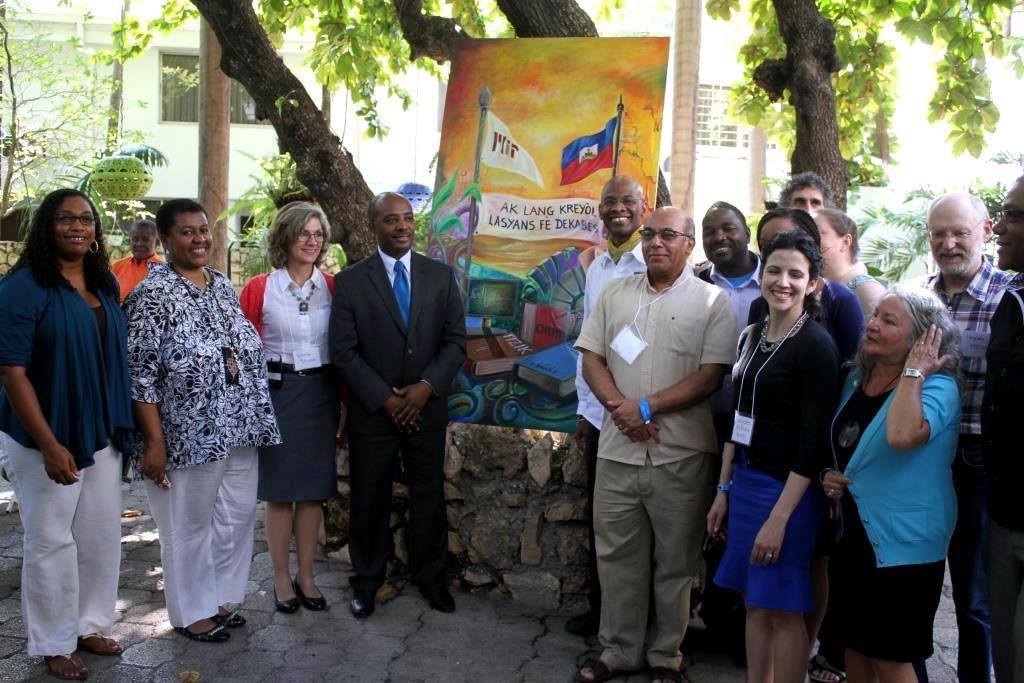
  • Faculty Michel Degraff reports: “During two weeks in June (June 13-24), the MIT-Haiti Initiative team was in the town of Limonade, in Northern Haiti. In collaboration with the Campus Henry Christophe, Limonade, of Haiti’s State University (“CHCL-UEH”), we had a 4-day workshop on Kreyòl-based and active-learning of science and mathematics. The workshop was attended by 43 professors in math, physics, chemistry and biology. We also spent a week of intensive consultation with CHCL-UEH faculty and administration, working on improvement of curricula, active-learning materials and interactive pedagogy in science, mathematics and Haitian Creole. One outcome was the creation of a teaching-and-learning center at CHCL-UEH. This work was funded, in part, by CHCL-UEH, the National Science Foundation and by the U.S. Embassy in Port-au-Prince.” More information about the collaboration and pictures can be found here and here.
  • Michel Degraff also attended the 2016 Meeting of the Society of Caribbean Linguistics, held Aug. 1-6, 2016 at the University of the West Indies in Mona, Jamaica, where he gave a keynote talk, “A Workshop on Language & Liberation: The MIT-Haiti Initiative as case study of ‘Caribbean SPEAKERS to the world,” and took part in a panel on “The Linguist as Public Intellectual.” Michel adds that he “also had the opportunity to discuss with authorities at Jamaica’s Ministry of Education on the importance of Jamaican Creole for improving education outcomes in Jamaica.” Pictures of the conference can be found here, and interviews given by Michel can be found here and here.

MIT Linguists teaching abroad

Sabine Iatridou taught at the New York Institute (organized by Prof. John Bailyn of Stony Brook University - hence the “New York” part) in St. Petersburg. David Pesetsky taught a one-week class on Clause Size (and the theory of “Exfoliation”) at a summer school hosted by the Universidade Nova de Lisboa. Donca Steriade spent July as the Karl-Brugmann-Fellow in Leipzig, Germany, and taught a course on “Cyclicity, Correspondence, Exponence: a unified analysis of cyclic and related phenomena”. Who was Karl Brugmann: more at https://en.wikipedia.org/wiki/Karl_Brugmann.

Norvin Richard’s “Contiguity Theory” published

Our colleague Norvin Richard’s (extraordinarily interesting and far-reaching) new monograph “Contiguity Theory” has just been published by MIT Press!!

MIT-Haiti workshop

The MIT-Haiti Initiative, under the leadership of Michel DeGraff (MIT Linguistics), is announcing its seventh MIT-Haiti workshop on active learning of STEM in Kreyòl. This workshop is the second that’s co-organized by the State University of Haiti (“UEH”), and it will be hosted, June 13-16, 2016, on the Campus Henry Christophe of UEH at Limonade. Deadline for registration is this Friday, May 27. The announcement is online at: http://bit.ly/1TCYcd4

DeGraff in Boston Review

Michel DeGraff contributed a commentary that appeared this week in the Boston Review, on the topic “What is education for?”.

A Ken Wexler celebration!

This weekend, the department held a conference on the occasion of Ken Wexler’s retirement, to honor and celebrate his foundational, lasting contributions to the field. The program can be found here. You can read messages of congratulations from his colleagues and students and also add your own here.

Michel DeGraff in New York

Michel DeGraff participated in a panel on education as part of the launching this weekend (April 28-29, 2016) of the City University of New York’s Haitian Studies Institute, to be hosted at Brooklyn College. Michel’s presentation for the event was titled:

Haitian Studies => Solutions to Haiti’s “language & education problem”.

Some photos from the event, including the program, are available on Michel’s Facebook page.

Morris Halle in the Annual Review of Linguistics

Read Mark Liberman’s paper about Morris Halle in the Annual Review of Linguistics. Here is the abstract:

Morris Halle has been one of the most influential figures in modern linguistics.
This is partly due to his scientific contributions in many areas: insights
into the sound patterns of English and Russian, ideas about the nature of
metered verse, ways of thinking about phonological features and rules, and
models for argumentation about phonological description and phonological
theory. But he has had an equally profound influence through his role as
a teacher and mentor, and this personal influence has not been limited to
students who follow closely in his intellectual and methodological footsteps.
It has been just as strong—or stronger—among researchers who disagree
with his specific ideas and even his general approach, or who work in entirely
different subfields. This appreciation is a synthesis of reflections from
colleagues and former students whom he has formed, informed, and inspired

Sabine Iatridou receives an honorary doctorate

Heartfelt congratulations to our colleague Sabine Iatridou, who received an honorary doctorate from the University of Crete last Wednesday — a great honor!! See the link for the official announcement. Here is the announcement of the event by the university, and here is a link to the coverage in the local paper.

DeGraff at BCLL#3

Faculty member Michel DeGraff gave a 2-hour keynote workshop at the Third Bremen Conference on Language and Literature in Colonial and Postcolonial Contexts.

Adam Albright promoted Full Professor

Our warmest congratulations to Adam Albright on his promotion to the rank of Full Professor!

Never tell me never

Very good news, not about linguistics but about life, from our colleague Jay.

Michel DeGraff’s letter to the New Yorker

Is Haitian a “French patois”?

Read Michel DeGraff’s answer to the New Yorker (Haitian version, original full-length version in English).

Video about Haitian Creole

This video is a short overview of the science and data that show why children’s native languages are necessary for learning how to read. In the case of Haiti, Haitian Creole (“Kreyòl”), as the native language of all Haitians, should be the cornerstone of literacy projects.

In the first part of this video, Prof. Stanislas Dehaene at the Collège de France provides an overview of findings from neuroscience about “pillars” in the human brain that help us learn how to read. In the second part of he video, Michel DeGraff analyzes the implications of these findings for Haiti, especially regarding how Haitian children are learning (or not learning) how to read. One conclusion is that Kreyòl is an indispensable tool for learning to read in Haiti, though it is, by and large, not used as such, with most children being taught in a language that they do not know, namely French. Such efforts to teach Haitian children in French are, by and large, unsuccessful—-unsurprisingly so, given the neuroscience that is explained in this video.

“Why only us?” - New Berwick & Chomsky book to appear

Robert Berwick and Noam Chomsky co-wrote a book about language evolution to appear in January, 2016 from MIT Press. Here is an overview of the questions covered by the book (from the MIT Press website):

We are born crying, but those cries signal the first stirring of language. Within a year or so, infants master the sound system of their language; a few years after that, they are engaging in conversations. This remarkable, species-specific ability to acquire any human language—“the language faculty”—raises important biological questions about language, including how it has evolved. This book by two distinguished scholars—a computer scientist and a linguist—addresses the enduring question of the evolution of language.

Robert Berwick and Noam Chomsky explain that until recently the evolutionary question could not be properly posed, because we did not have a clear idea of how to define “language” and therefore what it was that had evolved. But since the Minimalist Program, developed by Chomsky and others, we know the key ingredients of language and can put together an account of the evolution of human language and what distinguishes us from all other animals.

Berwick and Chomsky discuss the biolinguistic perspective on language, which views language as a particular object of the biological world; the computational efficiency of language as a system of thought and understanding; the tension between Darwin’s idea of gradual change and our contemporary understanding about evolutionary change and language; and evidence from nonhuman animals, in particular vocal learning in songbirds.

Haitian educators and MIT faculty develop Kreyòl-based teaching tools

“Six veteran educators from Haiti — two biologists, two physicists, and two mathematicians — were on campus recently to work closely with MIT faculty to develop and hone Kreyòl-based, technology-enhanced pedagogical tools for STEM education. This interdisciplinary and intercultural exchange was the most recent effort of the MIT-Haiti initiative, founded in 2010 by MIT professor of linguistics Michel DeGraff.”

Read more here.

Chomsky relic

Punchcard from a 1978 National Endowment for the Humanities fellowship that allowed Noam Chomsky to refine and expand his theories of universal grammar. That was the year he spent at the Scuola Normale Superiore in Pisa, which led to his 1981 book “Lectures on Government & Binding”.

Ken Hale papers

A new addition to our departmental website collects a number of papers, both published and unpublished, as well as previously unavailable teaching materials by our legendary colleague and dear friend, the late Ken Hale (1934-2001). To quote from the introduction to the page (and please note our interest in adding more materials):

This page collects many of Ken Hale’s papers as well as some of his unpublished teaching materials that were preserved by his students. The collection includes some papers that are well-known but not very accessible, as well as others that will be new to most readers — along with hectographed handouts from the 1970s and marvels of early word processing that should bring a smile of reminiscence to students and colleagues who were lucky enough to attend Ken’s classes or public lectures.
“We are making these materials available so that the work that went into these papers and handouts will not be lost to the communities of linguists and speakers that Ken’s work so enriched. These papers do not merely document a wonderful man, a great career and a stunningly productive era in the history of linguistics. They also contain ideas, discoveries and puzzles that Ken himself did not develop further that still have the power to excite — to advance the study of human language and languages, and the intellectual wealth that they embody for their speakers.
“We are grateful to Ken’s children Ezra and Caleb for their permission to organize this site, as well as to Ken’s co-authors represented here. We are eager to add to this collection. If you have additional materials to contribute, please contact <see site for email address>.

September LSA Member Spotlight: Kai von Fintel

Kai is the Linguistic Society of America’s gold star linguist of the month (so to speak)! Link here.

MIT at EACL9

The 9th Conference of the European Association of Chinese Linguistics was held in Stuttgart, September 24-26. Professor Kai von Fintel was an invited speaker and gave a presentation entitled How to do conditional things with words and Michael Yoshitaka Erlewine (National University of Singapore; Phd 2014) talked about The semantics of the Mandarin focus marker shì.

image1

Precision by Kai: “I wasn’t really talking to an empty auditorium.”

A message from Michel DeGraff

Dear WHAMIT,

The MIT-Haiti Initiative has produced a 3-minute video on our efforts to promote active learning of STEM in Haiti. This video is part of an online showcase organized by the National Science Foundation. WHAMIT readers can help MIT and Haiti win a “Public Choice” award by voting for this video—-i.e., by sharing or tweeting the video that will be available on Monday, May 11, at 8AM, at this link:

http://resourcecenters2015.videohall.com/posters/519

By voting (between Monday, May 11 and May 15—early and often!), the WHAMIT community can help MIT and Haiti move ahead together, so teachers and students in all social classes in Haiti can do science and math better, in their native Kreyòl with state-of-the-art technology for active learning. That way, Haiti will, indeed, get on the much awaited path of development, with the participation and for the benefit of *ALL* her children. And this breakthrough will also serve as an example for the rest of the world to see that local languages, coupled with technology, can have global impact in improving access and quality in education.

Thank you,

Michel DeGraff

Donca Steriade: Searching for the building blocks of language

The most comprehensive survey of rhyme ever made reveals a new possibility for one of the essential units of language.

“The syllable has long been considered to be the basic building block of language in the area of rhythm. MIT’s Donca Steriade now believes that a different element — known as the ‘interval’ — may be the basic unit of rhythm in human language.”

Read more on the webiste of the MIT School of Humanities, Arts, & Social Sciences (SHASS).

Chomsky and Miyagawa talking about animal communication for Nature

Nature interviews Chomsky and Miyagawa for a program on primate communication and human language. The interview is available on Nature Podcast.

Laurent Lamothe talks about the MIT-Haiti Initiative

Laurent Lamothe (Former Prime Minister of Haiti, 2012-2014) at MIT Sloan School of Management on April 13, 2015, discussing how the MIT-Haiti Initiative is opening up access to quality education in Haiti—-thus, dismantling Haiti’s linguistic apartheid and its barriers against development. The video can be watched here.

Animated video about Chomsky on BBC Radio 4

Gillian Anderson (Agent Scully, now with an English accent) explains Noam Chomsky in an excellent short animated video from BBC Radio 4.

News from Michel DeGraff

Michel DeGraff recently participated to two events related to his role as a socially and politically committed linguist:

Shigeru Miyagawa in MIT News

Shigeru Miyagawa discusses his recent work on the rise of human language, which we mentioned in last week’s Whamit! issue, in MIT News.

Miyagawa’s new paper in Frontiers in Psychology

A new article co-authored by Shigeru Miyagawa was published last week in Frontiers in Psychology, “The precedence of syntax in the rapid emergence of human language in evolution as defined by the integration hypothesis” (Vitor Nóbrega and Shigeru Miyagawa).

Going Heim

The University of Connecticut celebrates Irene Heim!

The UConn Logic group is proud to announce its annual logic workshop. The workshop is organized around a researcher whose work has had a significant and lasting influence on the field. The remaining talks, invited and selected, will be given by critics or contributors to the field who were influenced by the keynote speakers’s work.

2015: Going Heim. Linguistic Meaning Between Structure and Use.

Irene Heim is among the most influential scholars in the study of natural-language semantics and pragmatics. Several of her lasting contributions to the field were contained or foreshadowed in her dissertation “The Semantics of Definite and Indefinite Noun Phrases” (UMass Amherst, 1982). There, Heim demonstrated that Montagovian semantics and Chomskyan syntax, two schools of thought which had developed independently and were deemed at cross-purposes by many, could in fact be unified to mutual benefit. Heim’s dissertation is also one of the first fully developed accounts in what would come to be known as dynamic semantics. With this workshop, we will celebrate Heim’s recent 60th birthday and use the occasion to reflect on the transformative nature of her early work, its continued influence over the years since, and the present state and trajectory of the field of formal semantics and pragmatics.

Location: TBA

Date: May 2-3, 2015

Keynote: Irene Heim (MIT)

Confirmed Speakers:

David Beaver (Texas)

Simon Charlow (Rutgers)

Hans Kamp (Stuttgart/Texas)

Barbara Partee (UMass)

Thomas Ede Zimmermann (Frankfurt)

News about the MIT-Haiti Initiative

In January, the 5th MIT-Haiti Workshop on Active Learning in STEM was held in Haiti. With funding from the National Science Foundation, Dr. Vijay Kumar (Senior Strategic Advisor, MIT Office of Digital Learning) and Professor Michel Degraff have been leading a team of MIT faculty and staff engaged in helping improve STEM education in Haiti through the use of open education resources and digital technology for active learning all in Haitian Creole. This is the first time ever that such resources and pedagogies are being produced and tested in Haitian Creole—Haiti’s national language—with the help of a valiant team of MIT educators and staff, alongside educators and administrators in Haiti. This 5th workshop was the most successful to date with some 80 participants, and it was co-hosted by Haiti’s Ministry of National Education.

michel

You can see more photos of the workshop here.

There’s also a moving video of a group of Haitian artists donating to the MIT-Haiti Initiative a fresco that they painted during the workshop.

The slides that Michel used to introduce the workshop are available on his Facebook page. There’s an English version of these slides for a keynote speech Michel gave on January 4, 2015, for a Haitian Independence Day gala in Randolph, Massachusetts.

And here’s an article, in French, about the workshop.

Michel DeGraff named charter member of the Haitian Creole Academy

The Haitian Creole Academy for the promotion of Haitian Creole was officially inaugurated in Port-au-Prince last week. Professor Michel DeGraff is one of the first 33 members of the Academy, along with two other MIT-Haiti colleagues: Nicolas André of CreoleTrans in Miami and Pierre-Michel Chéry in Port-au-Prince.

Michel DeGraff was also invited to be part of a recently created National Commission on Curricular Reform (see this article in the newspaper Haiti Libre).

Below are more news, photos and videos of the Akademi Kreyòl (some but not all of it in Kreyòl!):

http://web.mit.edu/linguistics/people/faculty/degraff/Depliyan_Akademi_Kreyol_Ayisyen.pdf

https://twitter.com/MichelJMartelly/status/540577732854571009

https://www.facebook.com/permalink.php?story_fbid=786466611421046&id=613370545397321

https://www.facebook.com/michel.degraff/media_set?set=a.10152915961358872.1073741843.791208871&type=1

https://www.youtube.com/watch?v=b8-2VSzcoxc&feature=youtu.be&a

Award to Michel DeGraff from the Haitian Studies Association

Michel DeGraff has received the “Award for Excellence” from the Haitian Studies Association at their 26th annual conference at Notre Dame University this weekend. (Read the citation in the photos below.) Great news, Michel!

http://web.mit.edu/linguistics/people/faculty/degraff/

10646660_832948966725182_8007839313953684981_n

1385753_832949120058500_9018707059059080890_n

Irene’s birthday

Last week, we celebrated Irene Heim’s 60th birthday. On this occasion, a Festschrift was offered to Irene by some MIT students, faculty and alumni to honor her great contribution to the field of formal semantics. Happy birthday, Irene!

Donca Steriade named LSA Fellow

(We do think this merits a special late-summer issue of Whamit!)

We are overjoyed to announce that our colleague Donca Steriade has been named a Fellow of the Linguistic Society of America. Congratulations, Donca!!!

The just-announced class of 2015 LSA Fellows includes two other MIT PhD alums, in addition to Donca (PhD 1982): C.-T. James Huang of Harvard (MIT PhD 1982) (Donca’s classmate, in fact) and Thomas Wasow of Stanford (MIT PhD 1972). Of the 110 LSA Fellows named since the honor was initiated in 2006, 30 - slightly more than a quarter - are MIT PhDs.  Donca is the fifth member of the MIT faculty to be named an LSA Fellow, joining her colleagues Irene Heim and David Pesetsky and Institute Professors emeritus Morris Halle and Noam Chomsky.

Congratulations to Donca, Jim and Tom! Congratulations as well to the other newly named 2015 Fellows: John Baugh, Lyle Campbell, Andries Coetzee, Pat Keating, Donna Jo Napoli, Robin Queen, and Bernard Spolsky

A few links:

a 2010 news article about Donca Steriade and Morris Halle
Donca’s web page
the full list of 2015 Fellows:  http://www.linguisticsociety.org/news/2014/08/25/announcing-lsa-fellows-class-2015

Miyagawa paper in Lingua

Shigeru Miyagawa’s new article, “A feature-inheritance approach to root phenomena and parametric variation”, has just appeared in the June issue of Lingua. It is jointly authored with Ángel L. Jiménez-Fernández (University of Seville). The article compares topic constructions in Japanese, Spanish, and English.

Norvin Richards @ UCLA

While we were trudging through snow, Norvin traveled to UCLA this week, where he gave a colloquium on “Comtiguity and Pied-Piping”.

Roger Schwarzschild to join MIT Linguistics faculty

We are delighted to be able to publicly announce that Roger Schwarzschild will be joining the MIT Linguistics faculty starting this Fall as Professor of Linguistics.

Roger received his PhD from UMass Amherst in 1991. He has taught at Bar-Ilan University and the Hebrew University of Jerusalem, and since 1995 has been a member of the Linguistics faculty at Rutgers. Roger is one of the most creative and brilliant semanticists in the world. He has made profound contributions in many areas, including pluralities, focus, the semantics of indefinites, and most recently measure terms and comparatives. Much of his work is also devoted to the ways in which semantics interacts with other aspects of language, including pragmatics, syntax and phonology. Roger is known as one of the best explainers in the field: a great speaker and dedicated teacher. We consider ourselves lucky beyond words that Roger will be joining us, and look forward to welcoming him to MIT next Fall!

Michel DeGraff promoted to Full Professor

Heartiest congratulations to our colleague Michel DeGraff on his promotion to the rank of Full Professor!!

Pesetsky book featured in MIT News article

David Pesetsky and his recent LI monograph on Russian case morphology were featured in an MIT News Office article by Peter Dizikes, Cold case: A linguistic mystery yields clues in Russian.

MIT Linguists in Rome this weekend

David Pesetsky gave a talk on language and music at Rome’s 2014 Festival of Sciences on January 26, based on his joint work with Jonah Katz (PhD 2010). Noam Chomsky was also in attendance, giving talks about politics and linguistics on January 24 and 25. More information here and here.

Latest book by Pesetsky published

David Pesetsky’s book “Russian Case Morphology and the Syntactic Categories” has just been published in the Linguistic Inquiry Monographs.

Welcome back, Danny!

We are delighted to share the news that Danny Fox will be returning to MIT as a full-time faculty member next Fall, after three years at the Hebrew University of Jerusalem, during which he helped build Hebrew University’s groundbreaking new Language, Logic and Cognition Center. Welcome back, Danny!!

New Visiting Scholars and Visiting Students for Fall 2013

Visiting Scholars

  • Gaja Jarosz (Yale University) studies language learning from a computational perspective. Her research employs computational and statistical methods to develop models of phonological acquisition and to examine the primary learning data and its properties. One major focus of her recent work is the development of more robust computational models of phonological learning that make fewer simplifying assumptions about the nature of the input, with a particular emphasis on statistical models that can effectively cope with hidden structure, noise, and other sources of ambiguity.
  • Masashi Nomura (Chukyo University) works on case and agreement, clausal architecture, locality, cyclicity and optionality.
  • Dennis Ott (University of Groningen) works on theoretical and experimental syntax, in particular ? movement, locality, ellipsis and morphosyntax. He also works on the formal foundations of linguistic theory and the philosophy of language and linguistics.
  • Massimo Piattelli-Palmarini (University of Arizona) works on cognitive science, language and mind, biological foundations of language, language evolution, judgment and decision-making.
  • Gwang Rak Son (Kyungpook National University) works on the interaction between syntactic structure and prosodic structure (focus, topic, wh–questions, intervention effects, quantifiers, etc.); syntactic theory within generative grammar, including, but not being limited to, minimalism; interpretational mechanisms related to specificity in English, Asian, and Slavic languages; scrambling phenomena of East Asian, Germanic, and Slavic languages; neuroimaging of syntax and syntactic processing (ERP/EEG effects of syntactic processing); comparative syntax and comparative studies of language development; and the neuroscience of phonetics and phonology.
  • Masayuki Wakayama (Paichi Shukutoku University) says: “My research concerns how language variation should be explained theoretically with a special focus on transitivity and word order variation. In addition, I am also interested in a correlation between human development and language evolution.”
  • Wendy Wu (Shanghai International Studies University) works on the relationship between foreign language production and perception, using ERP and behavioral investigations of cross-linguistic perception; production and perception of different lexical strata in Japanese; phonology-morphosyntax interactions in Makassar languages (Austronesian languages of South Sulawesi, Indonesia); the quality and position of vowels inserted in loanwords and vowel epenthesis in Arabic dialects.

Visiting Student

  • Eduard Artés Cuenca (Universitat Autònoma de Barcelona)’s research explores the trade-off between phonology and morphology. Specifically, it focuses on “morphological epenthesis”, i.e., a direct relation between morphology and the phonological content of epenthesis. The data analyzed come mainly from Catalan, Italian and Spanish.

Pesetsky named Professor Honoris Causa at the University of Bucharest

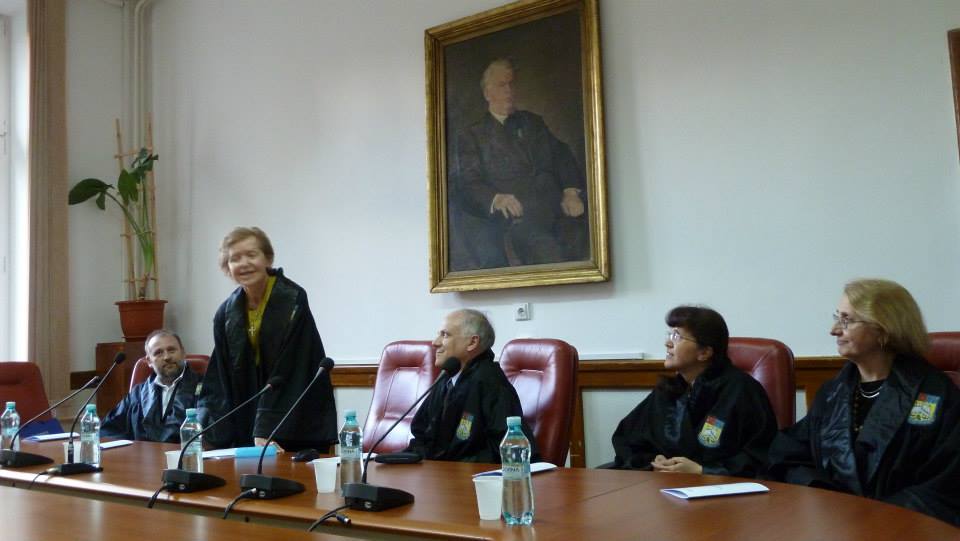
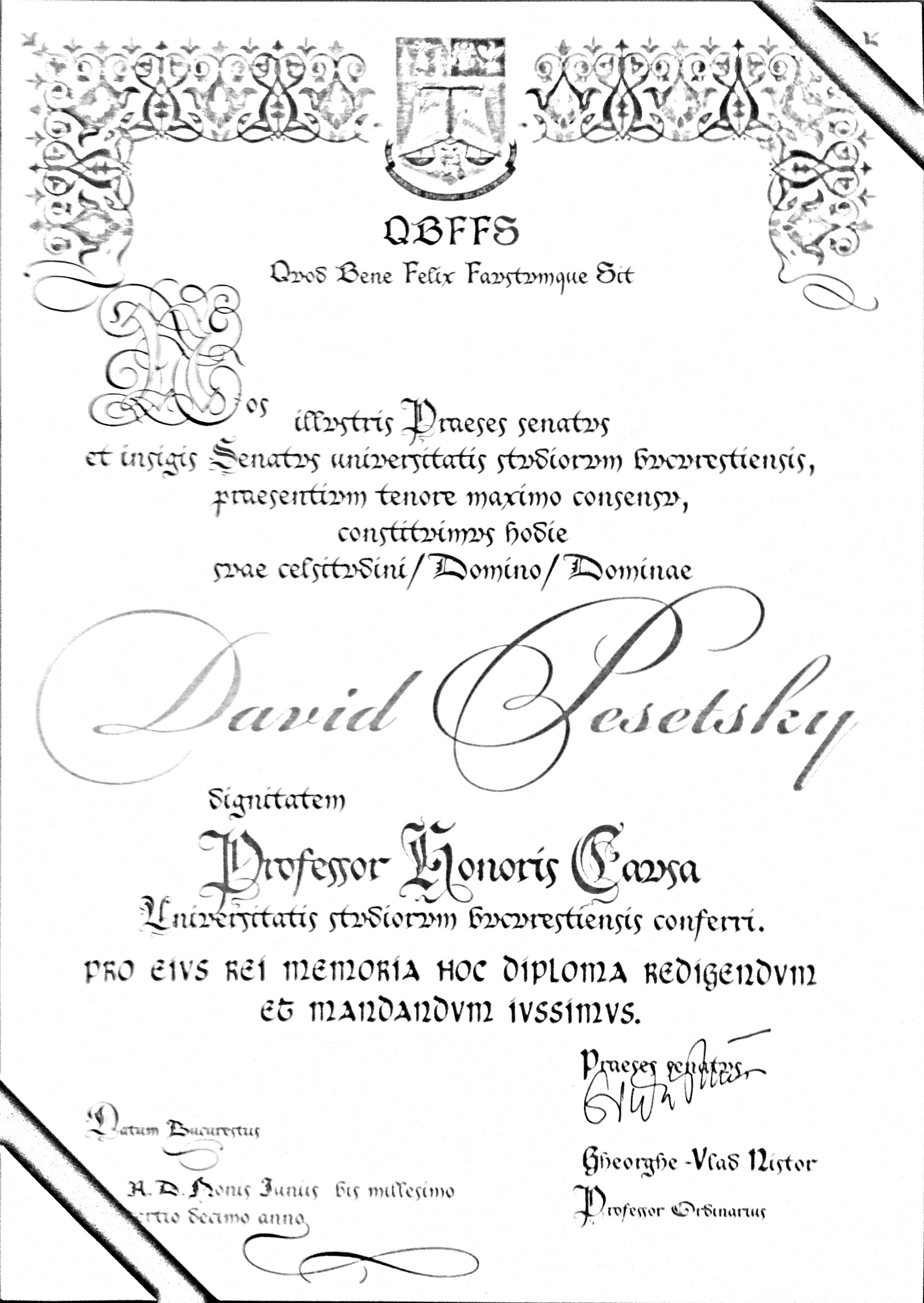
David Pesetsky has been honored with a Professor Honoris Causa degree at the University of Bucharest, while visiting to give an invited talk at the 15th Annual Conference of the English Department. A photo of the happy event, and a picture of the (impressively Latin) diploma are below. Felicit?ri, David!

941946_503618366376243_515147090_n

IMG_0057

New paper by Gibson and colleagues

A new paper by Ted Gibson with Leon Bergen and Steve Piantadosi called “Rational integration of noisy evidence and prior semantic expectations in sentence interpretation” has appeared in PNAS.  If the paper itself is not accessible from your location, you can read an abstract here and some discussion here.

Steriade in Oxford

Donca Steriade will give a talk at Oxford University on Monday, May 20 (today), at the Faculty of Linguistics, Philology and Phonetics, entitled “Vowel-to-Vowel Intervals as Rhythmic Units: Evidence From the Typology of Rhyming Domains”.

Hackl on the Syntax-Semantics Interface in Lingua

An article by Martin Hackl on the Syntax-Semantics Interface has appeared in a special June issue of the journal Lingua.  The purpose of the special issue, as summarized by its editor, Luigi Rizzi, is “to present some fundamental ideas and empirical results of modern syntactic research, and make them available to the scientific communities interested in the study of language as a cognitive capacity” - an especially important task at a time when interest in linguistic questions is increasing within cognitive science.

Pesetsky@FASL 22

The weekend before last, David Pesetsky journeyed to McMaster University in Hamilton, Ontario, where he was a keynote speaker at the 22nd annual conference on Formal Approaches to Slavic Linguistics (FASL 22).  In his talk, entitled “Dvuxètapny case assignment and Richards’ conjecture: the Tangkic language Russian, and the Slavic language Lardil”, he argued that the proposal of a deep kinship between Russian and Lardil case marking proposed by Norvin Richards in the article blurbed here runs even deeper.  FASL 22 was brilliantly organized by our own Ivona Ku?erová (PhD 2007), with a great team of McMaster students.

Thank you, Maziar!

book presentation

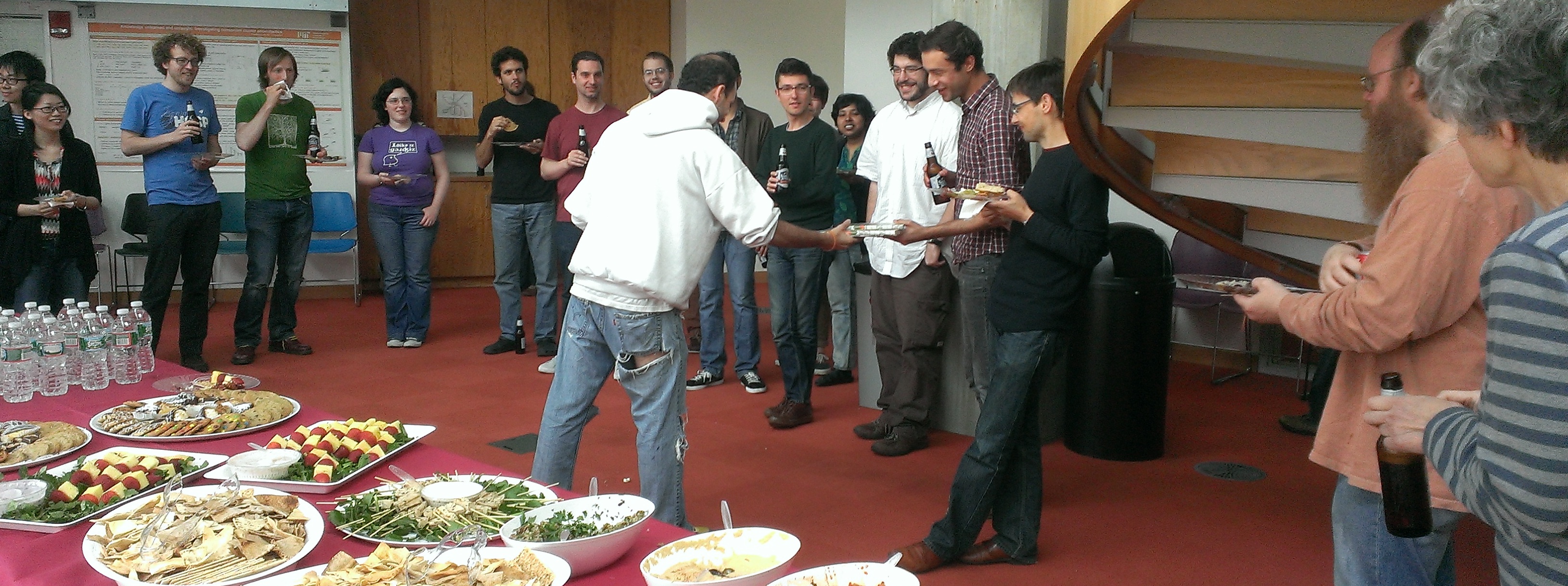
Last Wednesday, the department said our enthusiastic but tearful good-bye to Maziar Toosarvandani, who has been an active, much appreciated member of the department for the past two years as an American Council of Learned Societies New Faculty Fellow — and is now taking up an Assistant Professor position at UC Santa Cruz (as reported here). The grad students presented Maziar with two books about MIT and the Stata Center to remember us by, sentimental speeches were made, N. Paiute nominals and the Persian ezafe construction were discussed, and lots of great food was consumed!

IMAG1012 cropped

photo credit: Snejana Iovtcheva

MIT News article on Wexler’s work on autism and grammar

Ken Wexler’s recently-published work on grammar and autism was featured by the MIT news office.

Steriade at Berkeley

Donca Steriade is at UC Berkeley this week, giving a trio of lectures on Greek, Latin, and Romance phonology. The first, given in their departmental colloquium series, is entitled “The role of free bases in cyclic phonology;” her second and third lectures discuss “The cycle without containment.”

Pesetsky delivers Pinkel Lecture at UPenn

On Friday, David Pesetsky delivered the 15th annual Pinkel Lecture at the Institute for Research in Cognitive Science at UPenn. He presented joint work with Jonah Katz on Language and music: same structures, different building blocks.
Toosarvandani to Santa Cruz

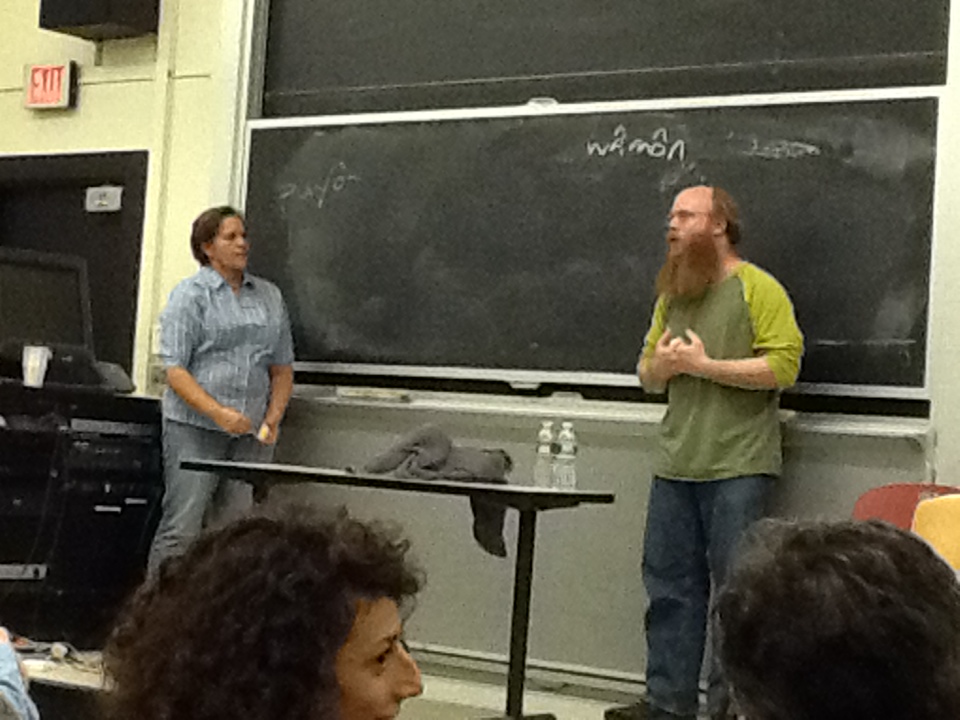
Maziar Toosarvandani, who has been an exciting presence in our department for the past two years as an American Council of Learned Societies New Faculty Fellow, is concluding his fellowship this Spring, and has accepted a tenure-track position as Assistant Professor of Linguistics at UC Santa Cruz. During his time at MIT, Maziar taught both semantics and syntax classes, a seminar on the syntax and semantics of the Iranian languages, and two undergraduate field methods (on Zazaki and Uyghur) - while continuing his own research on Southern Paiute. Congratulations on your new position, Maziar - we will miss you!!

Shigeru Miyagawa paper summarized in Science

A summary of Miyagawa, Berwick, and Okanoya’s Frontiers in Psychology article, “The emergence of hierarchical structure in human language,” appeared in Science (March 8, 1132-1133). The brief piece was based on the news article Science carried on their news website.

Richards paper on Lardil case-stacking published

Norvin Richards’ paper “Lardil ‘Case Stacking’ and the Timing of Case Assignment” has appeared in the latest issue of Syntax.  Highly recommended to everyone interested in case or the grammar of Lardil (Tangkic, Australia)!

Miyagawa, Berwick and Okanoya paper in Frontiers of Psychology

A paper by Shigeru Miyagawa, Bob Berwick and Kazuo Okanoya on the evolution of syntax has just appeared in the journal Frontiers of Psychology. The paper, entitled “The emergence of hierarchical structure in human language”, was featured in a write-up by the MIT News office, and can be found on-line on the Frontiers of Psychology website.

We propose a novel account for the emergence of human language syntax. Like many evolutionary innovations, language arose from the adventitious combination of two pre-existing, simpler systems that had been evolved for other functional tasks. The first system, Type E(xpression), is found in birdsong, where the same song marks territory, mating availability, and similar “expressive” functions. The second system, Type L(exical), has been suggestively found in non-human primate calls and in honeybee waggle dances, where it demarcates predicates with one or more “arguments,” such as combinations of calls in monkeys or compass headings set to sun position in honeybees. We show that human language syntax is composed of two layers that parallel these two independently evolved systems: an “E” layer resembling the Type E system of birdsong and an “L” layer providing words. The existence of the “E” and “L” layers can be confirmed using standard linguistic methodology. Each layer, E and L, when considered separately, is characterizable as a finite state system, as observed in several non-human species. When the two systems are put together they interact, yielding the unbounded, non-finite state, hierarchical structure that serves as the hallmark of full-fledged human language syntax. In this way, we account for the appearance of a novel function, language, within a conventional Darwinian framework, along with its apparently unique emergence in a single species.

MIT at AAAS 2013

Last weekend, the annual meeting of the American Association for the Advancement of Science took place in Boston, including several talks and panels devoted to linguistics, with MIT faculty and alumni well-represented.  Our own Michel DeGraff presented his paper “A Null Theory of Creole Formation” in a session on historical syntax that formed part of a day of sessions on the Biology and Evolution of Human Language, which also featured papers by Tony Kroch (PhD 1974) and Mark Liberman (PhD 1973).  Earlier in the day, a session on The Bases of Human Language in Human Biology included talks by Stephen Anderson (PhD 1968) and David Poeppel (BCS PhD 1995).

Michel DeGraff at AAAS 2012

David Pesetsky inducted as 2013 LSA fellow

At the LSA Annual Meeting in January, David Pesetsky was officially inducted as a 2013 Fellow of the Linguistic Society of America, for “distinguished contributions to the discipline”. David joins an impressive group of MIT faculty who have been elected as LSA fellows, include Irene Heim (in 2012), Morris Halle (in 2006) and Noam Chomsky (in 2007). As David noted at this time last year, the list of fellows also includes four former faculty, and about a sizeable fraction of the current fellows (22 of 84) are alumni of our PhD program.

A photo of the momentous occasion can be found here.

Congratulations, David!!

Shigeru Miyagawa in Belgium

Shigeru Miyagawa gave an invited talk at the Complementizer Agreement Workshop at Ghent University, “Surprising Agreements at C and T.” Other MIT affiliates giving invited talks were Ur Shlonsky, Dominique Sportiche, and Tim Stowell (the latter two at the Subjects Workshop that followed), October 17-19.

Major NSF grant for Michel DeGraff

Congratulations to Michel DeGraff, the Principal Investigator on a $1m grant just awarded by the INSPIRE program of the National Science Foundation for research to be conducted at MIT and in Haiti!  The five-year project, entitled Kreyol-based Cyberlearning for a New Perspective on the Teaching of STEM in local Languages,  ”addresses the issue of how to help those whose mother tongue is a language that does not include scientific and technological terminology to nonetheless learn STEM content and practices well. While research in linguistics and on how people learn suggests that learning in one’s native language will promote deeper learning than learning in another language, no research has specifically been done around this question when the native language does not include scientific and technological terminology.”

Visiting Members for the Fall

We extend our warmest welcome to the visiting scholars and students for this term:

Visiting Scholars

  • Ana Arregui Assistant Professor, University of Ottawa
    Research in semantics and psycholinguistics.

  • Marika Butskhrikidze Associate Professor, College FAMA
    Research in phonology and morphology.

  • Maria Giavazzi Postdoc, Équipe de Neuropsychologie Interventionnelle at the Department of Cognitive Studies of ENS (Paris); MIT Linguistics PhD (2010)
    Research in phonology, phonetics, speech perception and in the cognitive neuroscience of language.

  • Xinzhong Liu Assistant Professor, Dept. of Chinese Literature and Language, Jinan University
    Has an expertise in phonetics of Chinese dialects. His current research is to transcribe and describe the different sounds in Chinese dialects especially in Southern China.

  • Tamina Stephenson Lecturer in Semantics, UMass Amherst; MIT Linguistics PhD (2007)
    Research in semantics and pragmatics.

  • Hisao Tokizaki Professor, Sapporo University
    Research in syntax, phonology, morphology, and their interfaces.

  • Asako Uchibori Professor, Nihon University
    Research in syntax (Japanese, Old Japanese, Japanese Sign Language) and language and the brain (first and second language processing experiments using fNIRS and fMRI).

Visiting Students

  • Dominique Blok Graduate Student at University of Utrecht
    Research description: Will try to create a formal account of Dutch and Flemish conditionals with modal verbs in the antecedent (‘may’ and ‘must’ respectively) that also appear to require a modal verb in the consequent. Will also compare these to similar constructions in English, German, and French.

  • Ivano Ciardelli PhD student at the Université de Bordeaux
    His research interests lie in between logic and language.

  • Ana Lúcia Pessotto dos Santos PhD student at Universidade Federal de Santa Catarina (UFSC)
    Her research focuses on the semantics of the imperfect and the interaction between modality, tense and aspect, including the pragmatic consequences its contribution brings to the meaning of modals and other verbs in PB.

Wayne O’Neil in China

Wayne O’Neil is spending three weeks in China (Mar 28-Apr 18), lecturing on linguistic theory and second-language acquisition, at Shandong University in Jinan for the most part, but also at Beijing Foreign Languages University.

Wayne taught at Shandong University fall term 1982-1983, and since June 1984, he has been an honorary professor of linguistics there. So this trip is a sort of homecoming or reunion.

An award for Shigeru

Our very own Shigeru Miyagawa has won MIT’s President’s Award for OpenCourseWare Excellence (ACE) “for his contributions to the global OpenCourseWare and Open Education movements.” More here. Congratulations Shigeru!!

New book by Shigeru Miyagawa

Shigeru Miyagawa
Today, February 27, is the publication date for Shigeru’s new book Case, Argument Structure and Word Order, in the Leading Linguists series published by Routledge. Here is a description of the book …

Over the years, a major strand of Miyagawa’s research has been to study how syntax, case marking, and argument structure interact. In particular, Miyagawa’s work addresses the nature of the relationship between syntax and argument structure, and how case marking and other phenomena help to elucidate this relationship. In this collection of new and revised pieces, Miyagawa expands and develops new analyses for numeral quantifier stranding, ditransitive constructions, nominative/genitive alternation, “syntactic” analysis of lexical and syntactic causatives, and historical change in the accusative case marking from Old Japanese to Modern Japanese. All of these analyses demonstrate an intimate relation among case marking, argument structure, and word order.

… and here is a nice article about it from the MIT News Office (with one little reporting glitch — can you spot it?).

Congratulations, Shigeru!!

MIT Linguistics in the New Yorker

A recent New Yorker article on myths about “Brainstorming” end with a nice discussion of Building 20, and how linguistics got started at MIT. Our link will take you to the linguistics part of the article.

Nevertheless, he soon grew fond of the building, if only because he was able to tear down several room dividers. This allowed Halle to transform a field that was often hermetic, with grad students working alone in the library, into a group exercise, characterized by discussion, Socratic interrogation, and the vigorous exchange of clashing perspectives. “At Building 20, we made a big room, so that all of the students could talk to each other,” Halle remembers. “That’s how I wanted them to learn.

Omer speaks!

Omer Preminger gave a talk at New York University last Friday on “Agreement in Kichean and Zulu: Filtration vs. Strict Generativity”.

The LSA makes it all official

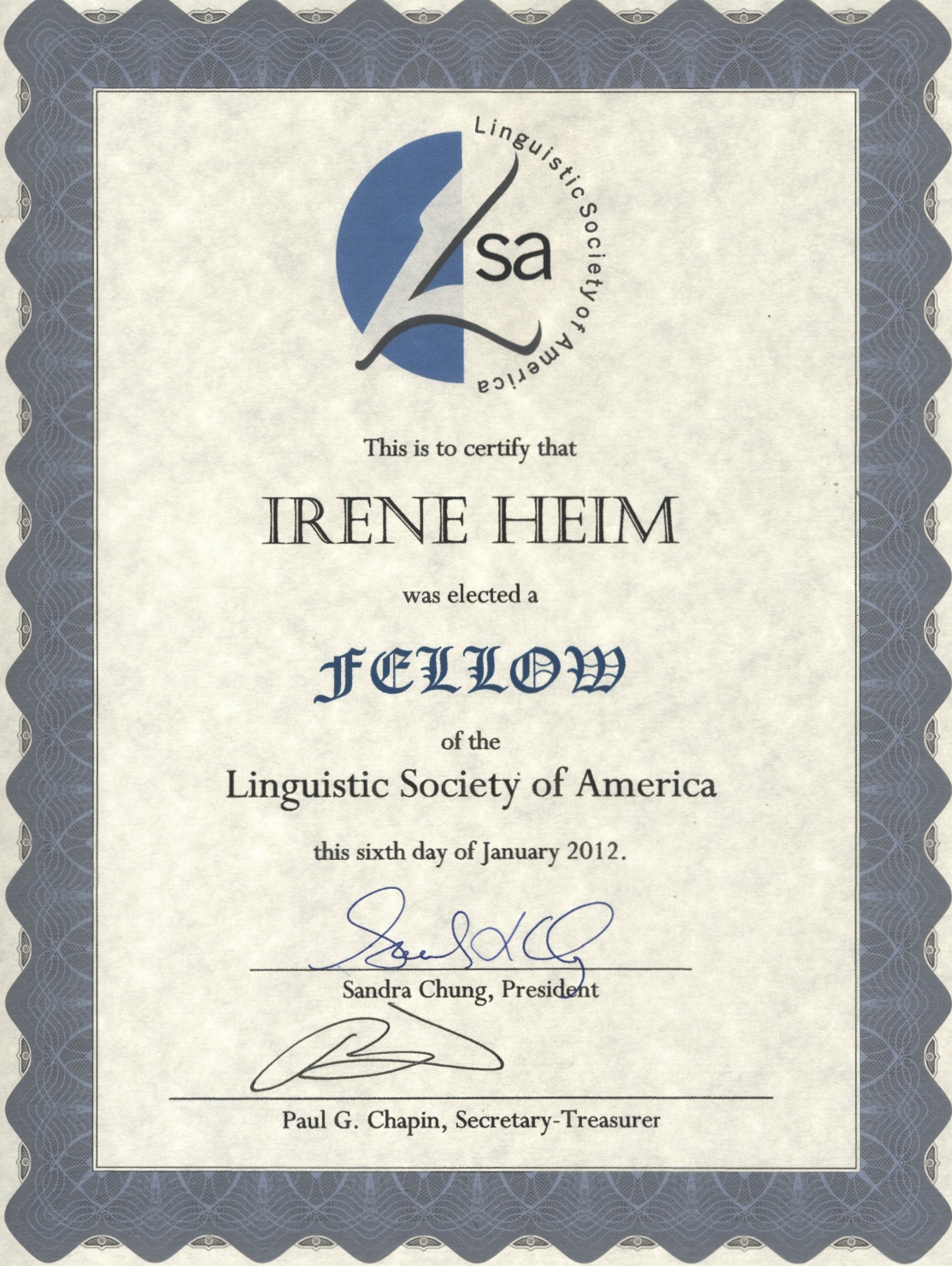
You heard it here first, when Irene was elected a 2012 Fellow of the Linguistic Society of America.  But now it’s official:

Congratulations, Irene!!

This one’s now official too. UMass Amherst may claim him with pride, but so do we!  At the LSA annual meeting in Portland, Oregon last month, Seth Cable (PhD 2007) received the LSA’s second annual Early Career Award. And here’s the (rather fuzzy) picture to prove it:

Congratulations Seth!!

Michel Degraff an LSA delegate to AAAS

Michel Degraff has been named one of two delegates from the Linguistic Society of America to the Science and Human Rights Coalition of the American Association for the Advancement of Science (AAAS).

Wayne O’Neil at AAAS

Wayne O’Neil will present a paper at AAAS-2012 (17-20 February, Vancouver BC): “Two linguists, a teacher, and some middle-school students walk into a room”. Wayne’s paper is part of a three-paper symposium: “Teaching science through language” chaired by Anne Lobeck (Western Washington University).

Morris and Noam in Technology Review

In the latest issue of Technology Review/MIT News Magazine, Morris Halle and Noam Chomsky are featured in “The Office Next Door” by Peter Dizikes, about long working relationships among MIT faculty members.

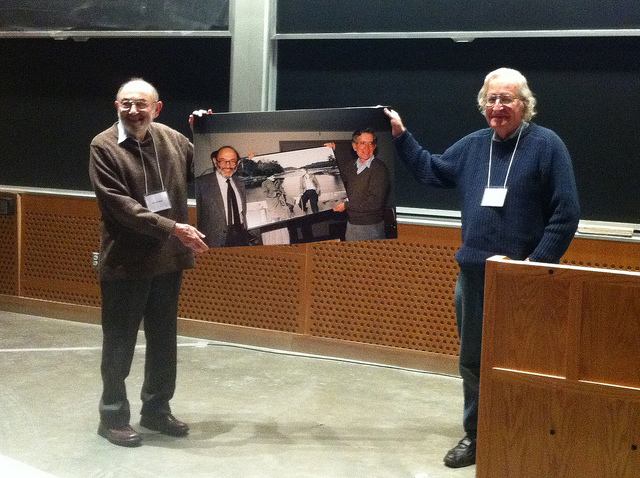
Morris Halle and Noam Chomsky at Ling50. Photo by Kai von Fintel.
At Ling50@MIT, Morris Halle and Noam Chomsky holding a 1988 picture of them holding a picture of them in 1953. Photo credit: Kai von Fintel.

MIT Linguists in Brussels

Omer Preminger is off to Brussels, where he is one of three invited speakers at the 6th Brussels Conference on Generative Linguistics at the beginning of this week, devoted to the topic “Configurations of Agreement”.  Omer’s talk is entitled “Filters vs. Triggers: Deriving the obligatoriness of agreement “.  

Also presenting at the same conference will be postdoc Erik Schoorlemmer and former visiting faculty member Hedde Zeijlstra (who just flew home after joining us for Ling50 last week).

MIT Linguists in Amsterdam

The 18th Amsterdam Colloquium is being held this week at the University of Amsterdam.

  • Irene Heim is an invited speaker, giving a talk entitled “Interpreting reconstruction in interrogative clauses.”
  • Natasha Ivlieva will speak about “Obligatory implicatures and grammaticality”
  • Wataru Uegaki is presenting his paper “Inquisitive knowledge attribution and
    the Gettier problem” 
    as part of the Workshop on Inquisitiveness.
  • Yasutada Sudo, Jacopo Romoli, Martin Hackl and Danny Fox are presenting “Variation of Presupposition Projection in Quanti?ed Sentences” in the poster session.

Amsterdamming alums include:

  • Invited speaker Philippe Schlenker, discussing “The Semantics of Pronouns: Insights and Problems from Sign Language”
  • Friederike Moltmann: “Tropes, Intensional Relative Clauses and the Notion of a Variable Object”
  • Marta Abrusan: “Focus, Evidentiality and Soft triggers”

Wampanoag film screened

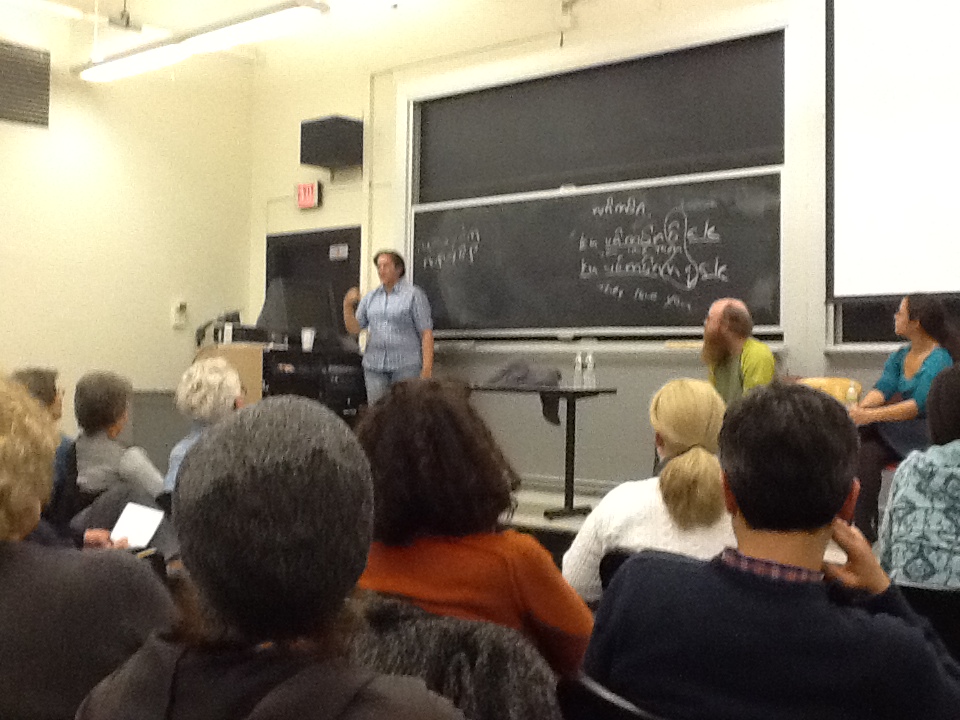
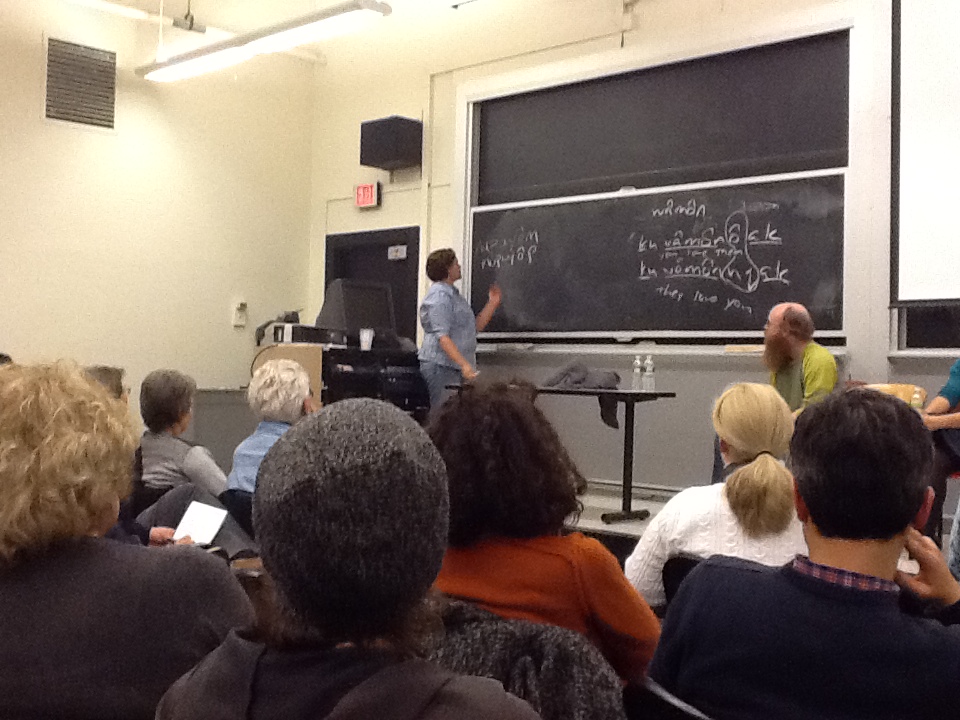
A few photos from the lively discussion after last Thursday evening’s screening of the film We still live here (Âs Nutayuneân). (About 150 people attended!) Amidst a series of great questions about language revival, Universal Grammar, and how new words are incorporated into the Wampanoag lexicon, Jessie Little Doe Baird and Norvin Richards also took time to explain the Wampanoag version of the Algonkian inverse construction to us:


left to right: Jessie, Norvin, and Nitana Hicks

Michael Kenstowicz at USC

Michael Kenstowicz was an invited speaker at USC’s Department of Linguistics last week, presenting “Accent Classes and Lexical Drift in Kyungsang Korean” in their colloquium series. He also met with their PhonLunch group to discuss his paper “Contrasts, Mergers, and Acquisitions in Kyungsang Acccent,” co-authored with Hyesun Cho and Jieun Kim.

Irene Heim elected 2012 LSA Fellow!

David Pesetsky writes:

“Irene Heim has been elected a 2012 Fellow of the Linguistic Society of America. Each year since 2006, the LSA honors several of its members for “distinguished contributions to the discipline”. Irene is the third current MIT faculty member to be honored in this fashion, following in the footsteps of Morris Halle (2006) and Noam Chomsky (2007). Four former faculty are also fellows, and about a third of the current fellows (21 of 75) are alumni of our PhD program.

The induction ceremony will take place at the LSA meeting in Portand on Friday,
January 6, 2012, as part of the Business Meeting.

This is a great honor for Irene, richly deserved. I’m sure you join me in
expressing our warmest congratulations!!”

Gracanin-Yuksek and Miyagawa in Istanbul

Martina Gracanin-Yuksek (Ph.D 2007) and Shigeru Miyagawa were invited speakers at the Workshop on Functional Categories and Parametric Variation, held October 6-7 at Bo?aziçi University, Istanbul. Martina’s talk was “Properties of negation in Croatian,” and Shigeru’s talk title was “Minimal variation.” Meltem Kelepir (Ph.D 2001) was a co-organizer of the meeting.

How I spent my summer (installment 2)

Degraff-children-in-the-classroom-300x199Michel DeGraff writes, “The greater part of my work this Summer was spent in the mountain village of Matènwa in La Gonave, Haiti, working on my NSF-funded project on ‘Kreyòl-based and technology-enhanced learning of math, science, reading and writing.’ (La Gonave is an island off the Haitian mainland.) Much of my time there was spent playing with primary-school kids and helping develop and test computer-based games in Kreyòl to enhance the understanding and practice of elementary mathematics. I also worked on promoting an MIT initiative to help improve higher education in Haiti.”

Some of this work was reported in the international news media this summer, including articles in the Boston Globe, BBC News, Education Portal, and the Voices from Haiti site. A Kreyòl version of that interview can be found halfway down the page at http://www.voicesfromhaiti.com/kreyol.

Faculty summer news

“How I spent my summer vacation” - faculty version:

  • Norvin Richards spent a week in the foothills of the Himalayas, teaching a mini-seminar on the syntax-phonology interface at the 5th LISSIM (Linguistics Summer School in the Indian Mountains).
  • Sabine Iatridou had an Eastern European summer vacation, co-teaching a week-long seminar on “3 Puzzles in Syntax and Semantics” at the New York-St. Petersburg Institute founded by John Bailyn, then moving to the Czech Republic, where she taught two classes at the famous EGG School: a solo class on Binding Theory and a joint class on negation with Hedde Zeijlstra, who we remember fondly as a visiting faculty member here in 2008-2009.
  • Jay Keyser’s book Mens et Mania: The MIT Nobody Knows was published by MIT Press.
  • Wayne O’Neil spent July co-teaching a language acquisition course at the Navajo Language Academy workshop. He writes: “This summer workshop, founded by
    Ken Hale, meets annually on or near the Navajo reservation, bringing together thirty or so Navajo linguists and educators. This summer we
    were on the Northern Arizona University campus in Flagstaff AZ, suffering through college dormitory life and cafeteria food, but the work was good, and the workshop, as usual, produced a fine T-shirt.”

Meet our new visiting faculty

We have four visiting faculty members in linguistics this Fall

Benjamin R. George has just completed his Ph.D. in semantics at UCLA.
He writes that his interests include “question semantics, presupposition, logic, the
semantics-pragmatics interface, and mathematical methods in semantic
theory”.

Rick Nouwen will be visiting us only for the Fall semester. As his website tells us: “I’m a linguist interested in semantics and pragmatics. My research focuses in particular on (i) scalar phenomena in natural language; (ii) multi-dimensionality and projection phenomena in semantics; (iii) pronominal reference; (iv) the overlap between analytical philosophy, logic and linguistics.”

Maziar Toosarvandani joins us as an American Council of Learned Societies New Faculty Fellow. He writes: “I received my PhD from Berkeley in 2010 where I wrote my dissertation on association with focus. More generally, I am interested in formal patterns that arise from the interaction of sentences in discourse and what these patterns tell us about speakers’ competence about syntax as well as their competence about discourse structure. Currently, I am working on a project to understand why the so-called corrective use of the coordinator “but” (as in “Max didn’t find an apartment in Cambridge but in Somerville”) requires the presence of a negative element in its first conjunct. I also do documentary fieldwork on Northern Paiute (a severely endangered Uto-Aztecan language of the western US), which feeds into my theoretical interests. I have recently been exploring how in Northern Paiute, a language that practically lacks syntactic subordinators, speakers combine lexical, syntactic, and world knowledge with knowledge about discourse structure to convey temporal, causal, and other typically “subordinating” relations.”

Omer Preminger received his PhD here at MIT just this summer, and will be splitting his time between our department and Masha Polinsky’s lab at Harvard. He describes his interests as including “syntax, morphology, and everything in between, including but not limited to: agreement, case, ergativity, argument-structure, and wh-movement”. He will be teaching 24.960 (Syntactic Models, graduate) in the fall, and 24.900 (Intro to Linguistics, undergrad) in the spring.

Visiting Scholars and Students

We extend our warmest welcome to the new (and returning) visiting scholars and students to the department:

New Visiting Scholars

  • Khaled Al-Asbahi: Sana’a University.
  • Toni Borowsky: Senior Lecturer, University of Sydney.
    Toni’s research interests are in phonology and phonetics. She is working on language games, and syllable structure related matters.

  • Barbara Citko: Assistant Professor, University of Washington-Seattle.
    Barbara’s research interests are: syntactic theory, syntax of relative clauses, wh-questions, multidominance, syntax of Slavic languages (Polish in particular).

  • Young-Sun Kim: Hanshin University.

New Visiting Students

  • Laura McPherson: 3rd year PhD student at UCLA.
    Her primary research interests are phonology and morphology, particularly grammatical tone and other areas of phonology-syntax interface. She is currently working on a reference grammar of Tommo So, a Dogon language of Mali.

  • Jeffrey Watumull: PhD student at the University of Cambridge.
    Jeffrey’s research interests are “in general, mathematical biolinguistics—a research program to discover the mathematical properties universal to human syntax and their possible homologues/analogues in nonhuman animals; in particular, revamping the Chomsky Hierarchy in terms of strong generative capacity and formulating optimal decision procedures for traversing parameter hierarchies.”

A grand “stepping down” bash to honor Department head Irene Heim

Irene
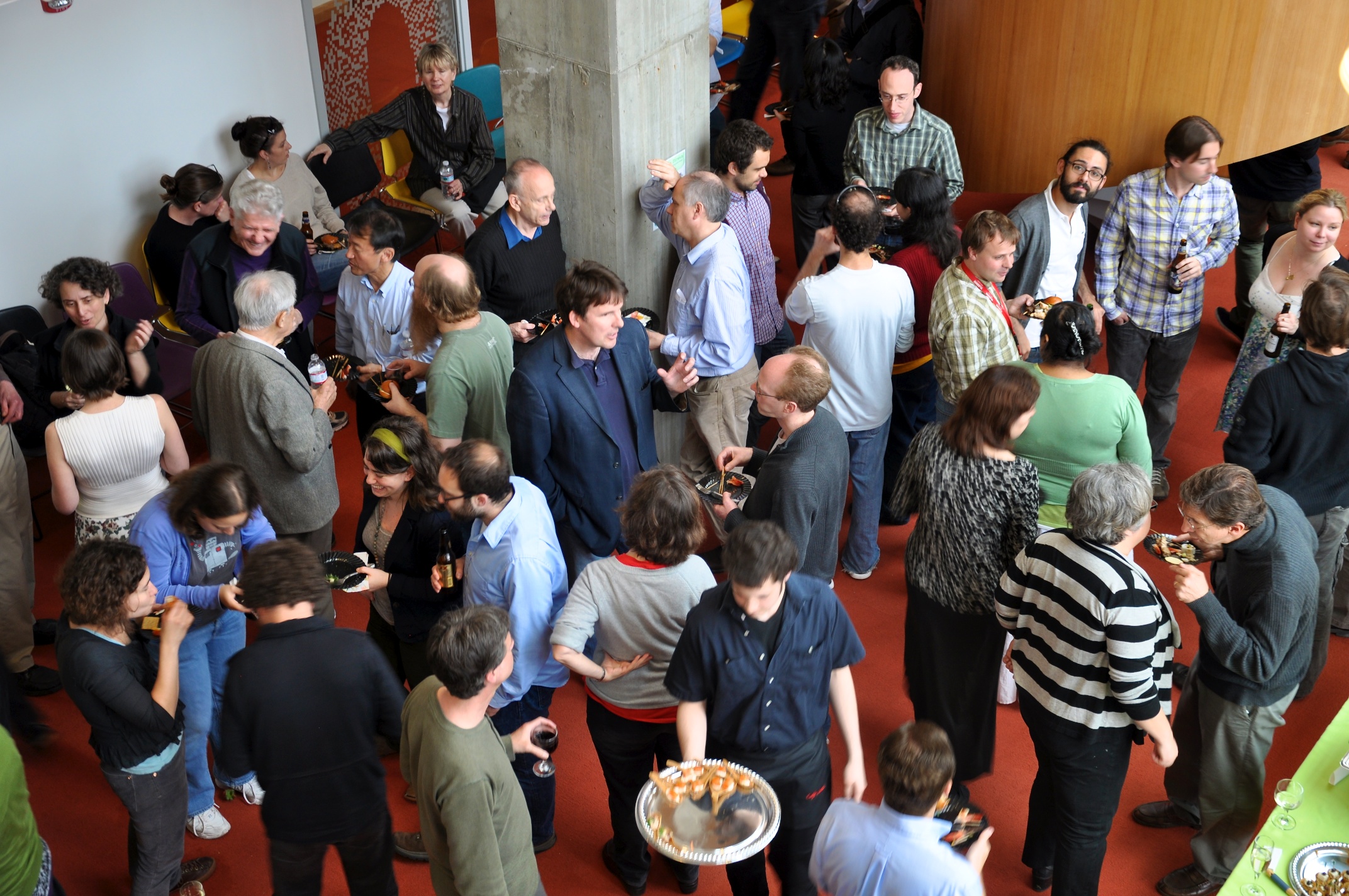
To celebrate Irene’s outstanding achievements as Head of the Department of Linguistics and Philosophy for the past three years (which followed three great years as Section Head of Linguistics), the department threw a spectacular gala party last Monday.
party!
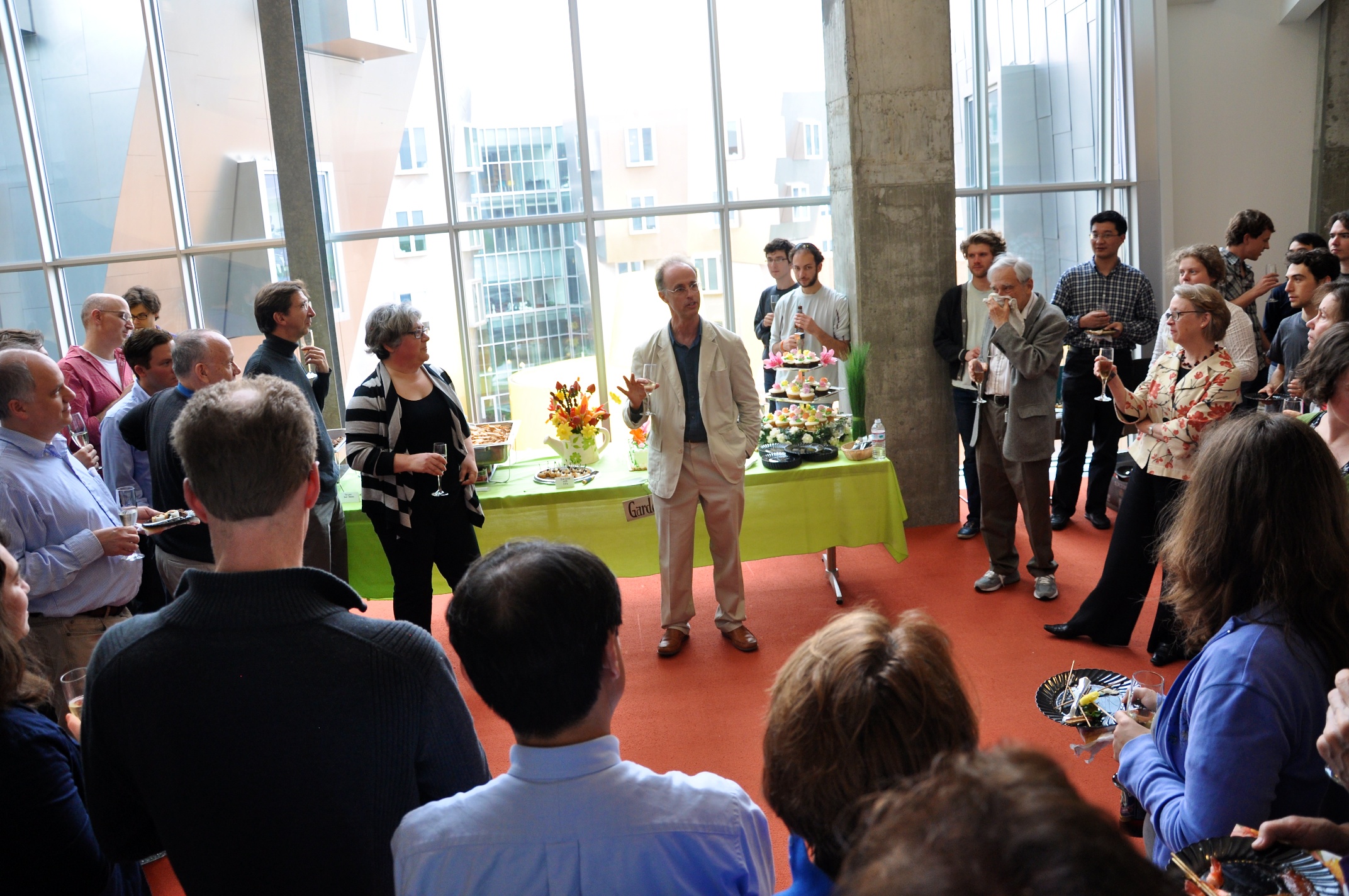
Irene’s work as section head was lauded by Dean Deborah Fitzgerald, incoming department head Richard Holton, incoming linguistics section head David Pesetsky and the department Administrative Officer Mary Grenham — as well as by several tons of great food and a big cake.

speeches!

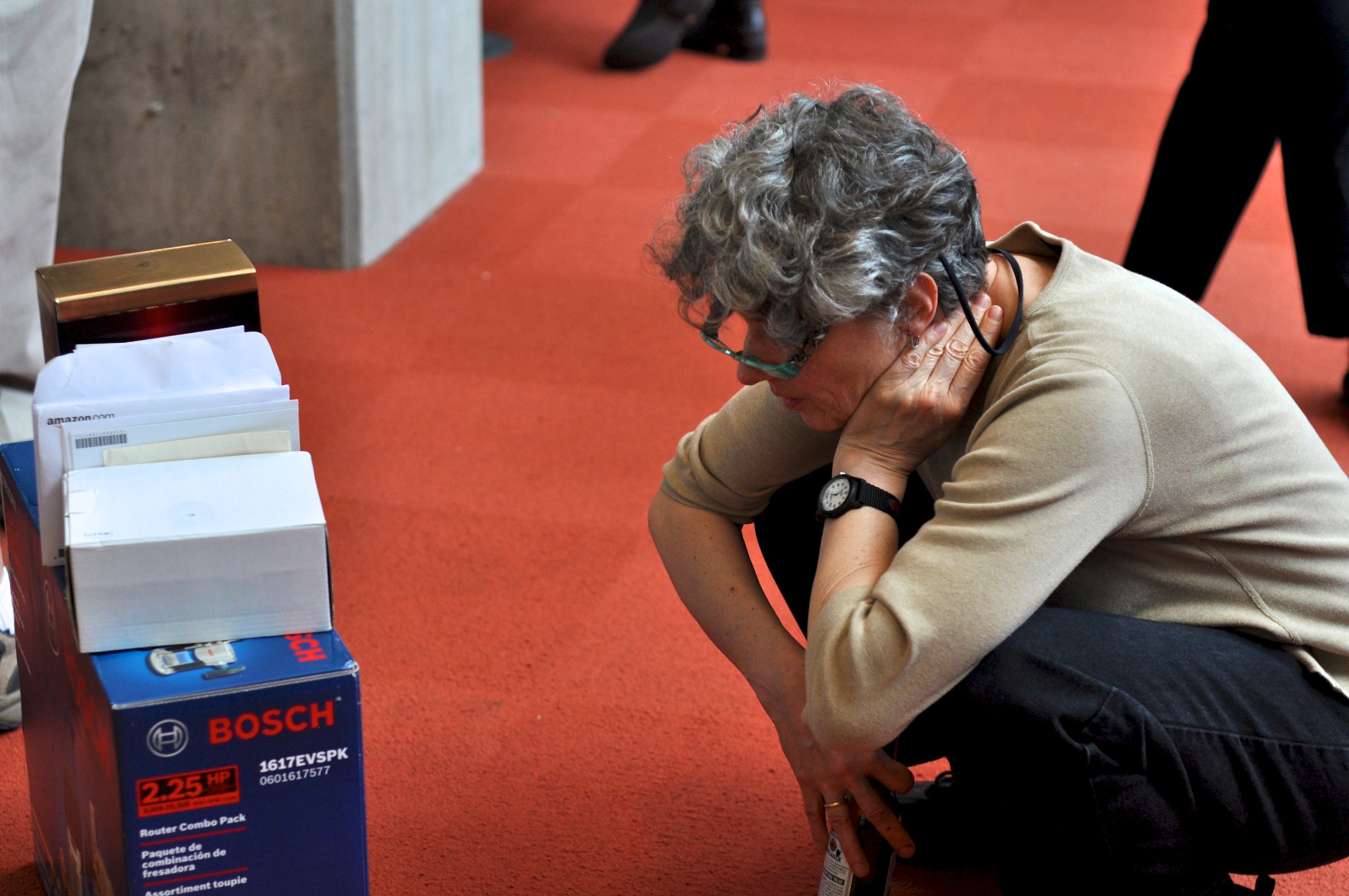
The party had a “gardening theme” (there were smoked salmon treats in edible spades) and Irene received several presents from a grateful department, including the traditional Bosch 1617EVSPK 12 Amp 2-1/4-Horsepower Plunge and Fixed Base Variable Speed Router Kit with 1/4-Inch and 1/2-Inch Collets, without which no term as department head could be complete. (Spies told us that this is what Irene most wanted!)

Irene ponders her presents

But the most memorable laudatio, and the culmination of the grand event, was provided by a band of linguistically minded ukulele players who wandered in off the street and decided to play for us on the spur of the moment:


L to R: Iain Giblin, Sam Steddy, Coppe van Urk, mitcho Erlewine, Edwin Howard

photo credits: mitcho Erlewine & Hrayr Khanjian

A champion of Creole

The MIT News Office had a great article about Michel DeGraff last week: “A champion of Creole”.
Michel DeGraff

MIT News Article about Wayne O’Neil

“Looking beyond English: MIT professor uses linguistics in an ESL classroom to teach scientific principles, empower a new generation of critical thinkers” is a nice article about Wayne O’Neil and Maya Honda’s work with linguistics in high schools.

Wampanoag film at the Brattle Theater: 4/30 at 2:15pm

On Saturday, April 30th at 2:15 pm, the Brattle Theater will be showing “We Still Live
Here: Âs Nutayuneân”. It’s a film about the revival of the Wampanoag
language, featuring Macarthur-award-winning alumna Jessie Littledoe Baird, as
well as Norvin and Noam.

[Norvin adds: “Several people have reminded me that the day the Wampanoag film is showing at
the Brattle is precisely the day we’re having our open house. So, please come
to the open house instead of going to the film…I’m now talking with the
filmmaker about having a showing at MIT sometime.”]

MIT at the 21st Colloquium on Generative Grammar

Several MIT-affiliated linguists presented at the 21st Colloquium on Generative Grammar, held April 7-9 in Seville, Spain.

  • Pilar Barbosa: invited speaker, Partial pro-drop as null NP-anaphora
  • Shigeru Miyagawa: invited speaker, Minimal Parametric Variation
  • Andrew Nevins and Cilene Rodrigues: “Autonomous” Morphemes are Underlearned in Romance

Linguistics at school

Wayne O’Neil has recently returned from his annual (since 2000) March stay in Seattle, where he and his partner Maya Honda spent several days doing linguistics with David Pippin’s fourth- and fifth-graders at St Thomas School in Medina WA. On this occasion, ‘doing linguistics’ focused on some aspects of English orthography: why, example, civil, solemn, and moral are spelt the way they are. However, Wayne was also required to give a spirited reading of the opening lines of Beowulf as a lead-in to a discussion of the history of the English language.

Some of the work that Wayne and Maya have done in Seattle over the past decade is discussed in Honda, O’Neil, and Pippin’s paper “On promoting linguistics literacy: Bringing language science to the English classroom”, in Kristin Denham and Anne Lobeck (ed.) Linguistics at school: Language awareness in primary and secondary education, 175-188 (Cambridge University Press, 2010).

Jay Keyser interviewed on WGBH re MIT hacking culture

Jay Keyser was interviewed last week on the Callie Crossley Show on WGBH. Full audio of the 24 minute interview is available on the show’s website. Here’s a direct link to the mp3 stream.

The show’s description:

>The history of hacks and pranks at MIT dates back almost as far as the venerable institution itself. Students with expertise in engineering, computer science, robotics, and math — and presumably with a little extra time and brainpower to spare — have taken pranksterism to the level of high art. Their hijinks have included a firetruck, police cruiser, and biplane replica, alternately hoisted atop MIT’s Great Dome; a fully appointed room — including a billiards table, a cat, chairs, and an illuminated lamp — hung upside down from the Media Lab; numerous interruptions staged during the annual Harvard - Yale football game; and a cross-country hacking war with rival institution, Caltech. MIT Professor Emeritus Jay Keyser, has seen a lot of it in his time, and he’ll talk about the school’s secret hacking society, the best hacks, and why bright students at a world-class institution can still find time to put one over on faculty.

Mentioned during the interview is Jay’s forthcoming new book: Mens et Mania: The MIT Nobody Knows.

Our traveling linguists

Last week, on March 4, Donca Steriade gave a colloquium talk on “Rhyming Evidence for Intervals” at UCLA. That same week, David Pesetsky gave a series of talks at Newcastle University (including a public lecture on his joint work with Jonah Katz on the relation of music and language). Last Friday, Norvin Richards spoke on the topic of “Generalized Contiguity” in the CrISP Distinguished Visitors Series at UC Santa Cruz. Finally, this week, Sabine Iatridou will be teaching a short course at the University of Athens.

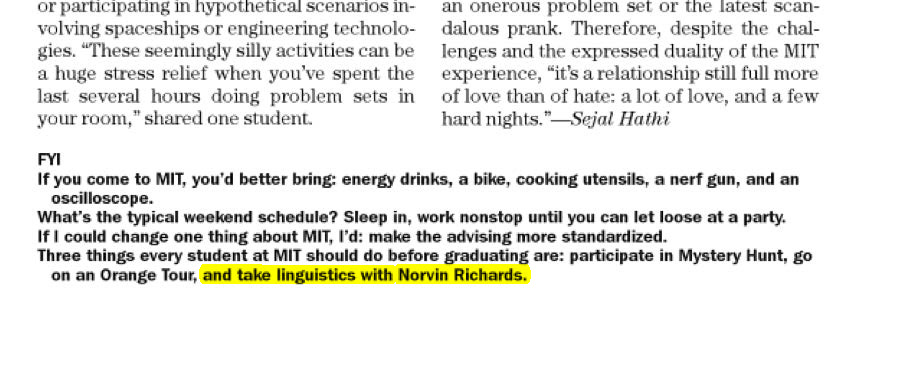
“Three things every student at MIT should do before graduating”

From the chapter on MIT in the Yale Daily News Insider’s Guide to Colleges 2011:

nr

Most (= more than half?) of your base are belong to us

Two excellent articles about the research that Martin Hackl and his students are currently conducting in Martin’s Experimental Syntax and Semantics Lab
were published here on the website of the School of Humanities, Arts, and Social Science and here on the MIT website!

Interview with David Pesetsky

There’s a nice interview with David Pesetsky on the MIT News website (triggered by his being named a fellow of the American Association for the Advancement of Science (AAAS), which we reported on recently). David talks about universal grammar and about the relationship between language and music.

MIT at the LSA

MIT had a strong presence at this year’s LSA meeting, held in Pittsburgh, January 6-9. The following faculty, students, and recent graduates gave presentations:

- Bronwyn Bjorkman: The syntax of inverted conditional antecedents

- Jessica Coon (Harvard): Prepositions and the perfective: Deriving aspect-based split ergativity

- Jessica Coon and Omer Preminger: Transitivity in Chol:
A new argument for the Split VP Hypothesis

- Kai von Fintel (with David Beaver): Semantics
and pragmatics: The creation of an open access journal

- Suzanne Flynn (with Janet Cohen Sherman,
Alex Immerman, Barbara Lust, James Gair, Jordan
Whitlock, and Diane Rak): Language in aging and
dementia: A pilot study

- Gillian Gallagher (NYU): Auditory features: the case from laryngeal cooccurrence restrictions

- Peter Graff (with Max Bane and Morgan Sonderegger): Phonetic convergence among reality television contestants

- Peter Graff (with Gregory Scontras and Noah D. Goodman): Plural comparison and collective predication

- Peter Graff (with Jeffrey Lim and Sophie Monahan): The determiner complexity hierarchy

- Jonah Katz (Centre national de la recherche scientifique): English duration patterns mirror perceptual asymmetries

- Giorgio Magri (École Normale Supérieure): Towards a non-universal approach to the problem of the acquisition of
phonotactics in Optimality Theory

- Tara McAllister (Montclair State University): Patterns of gestural overlap account for positional fricative
neutralization in child phonology
- Pritty Patel: Binding conditions and alienable vs. inalienable possession
- Kirill Shklovsky: Tseltal unnegatives

Pesetsky named AAAS fellow

Congratulations to David Pesetsky, who has been named a fellow of the American Association for the Advancement of Science (AAAS)! From the MIT press release, “fellows are recognized by their peers for their scientifically or socially distinguished efforts to advance science or its applications.” Pesetsky was chosen for “his innovative and critical research on syntactic theory, connecting it to issues in phonology, morphology, reading, language acquisition and neuroscience, and for his contributions to linguistic education at many levels.” Read more about the appointment here.

DeGraff receives NSF grant for work in Haiti

Michel DeGraff has been awarded a National Science Foundation grant to pursue work for Haiti thoughout the academic year 2010—2011. He writes:

My NSF project title is: “Kreyòl-based and technology-enhanced teaching of reading, writing, math and science in Haiti.” I will help develop, refine and evaluate innovative Kreyòl-based and technology-enhanced educational materials and methods for Haitian classrooms. These materials and methods will be tested in situ in Haiti.

I will thus be on leave during the year to work on this project, which started earlier this year, especially during trips to Haiti over the Summer.

This project seems particularly timely in the context of the post-earthquake reconstruction of Haiti’s school system. Some of the rationale for it is explained in a couple of articles, in the Boston Globe (in U.S.) and in Le Nouvelliste (Haiti). Both articles discuss Haiti’s language barrier:


I hope my NSF project and related efforts will help break down this barrier.

Congratulations, Michel!

Adam Albright promoted to Associate Professor with Tenure

Adam Albright’s promotion to tenure has been approved by MIT’s Executive Committee. Congratulations, Adam!!

New Media Projects For Haiti

Michel DeGraff was in Haiti the week before last (April 25 — May 1st) with Professors Dale Joachim and Barry Vercoe from the Media Lab and with seven students from the new Media Lab class “New Media Projects For Haiti.” The students had four projects to further develop and test in Haiti:

1. “Uplifting expressions”: Theater, music, dance and craft as therapy for children’s post-traumatic stress disorder (Asha Martin and Clinton Scroggins)
2. Health education in post-earthquake Haiti (Amritaa Ganguly)
3. Low-cost water testing (Anila Sinha, Jess Kim and Kathy Li)
4. “Pedal Power”: Lost-cost system to produce electricity by pedaling (Marvin Arnold and Daryl Fairweather)

Two of the students (Jess Kim and Amritaa Ganguly) have blogged about their experiences in Haiti:

von Fintel & Stalnaker in Nebraska

This week (April 16 & 17), there is [a conference on epistemic modals at the University of Nebraska-Lincoln](http://www.unl.edu/philosop/speaker/speaker/ChambersConference.shtml). MIT speakers: Kai von Fintel (presenting with co-author Thony Gillies, Rutgers), Bob Stalnaker, and MIT philosophy alum Eric Swanson.

The sound and the query

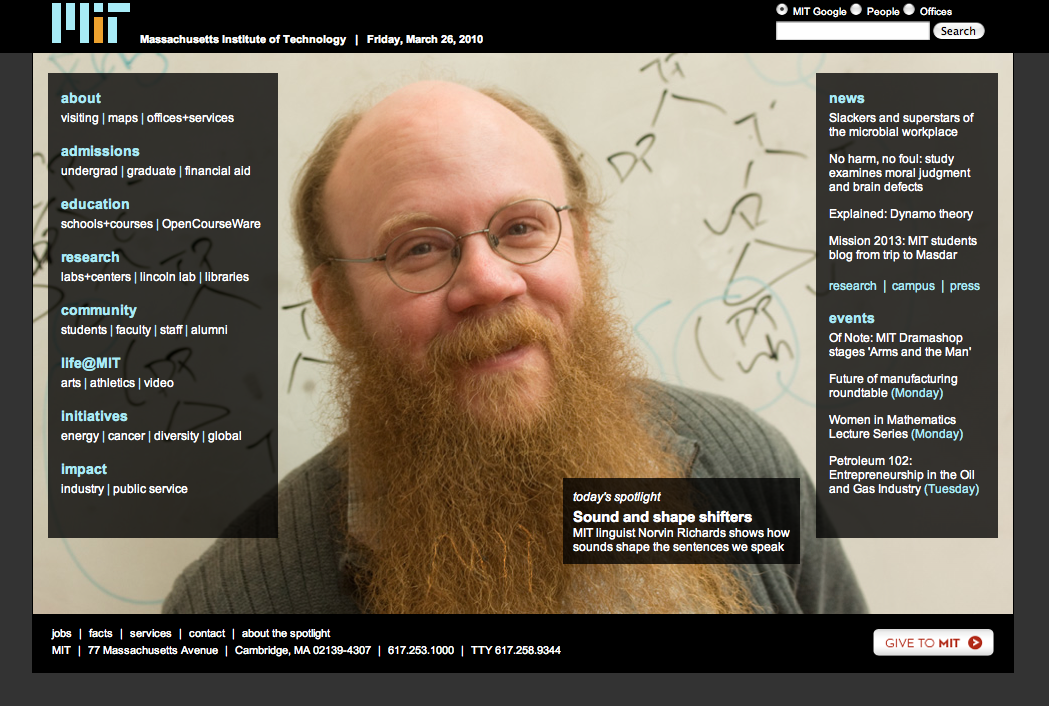
The MIT News site has [a very nice article](http://web.mit.edu/newsoffice/2010/uttering-trees-0326.html) about Norvin’s book [Uttering Trees](http://mitpress.mit.edu/catalog/item/default.asp?ttype=2&tid=12146) (MIT Press). The article appeared last Friday and on that day, the MIT home page was fully Norvin-themed:

norvin-MIT-spotlight.tiff