Archive for the ‘Announcements’ Category
Workshop in honor of Shigeru Miyagawa (Thursday, 10/18)
MIT Linguistics is proud to host a special workshop in honor of Shigeru Miyagawa on Thursday, October 18.
Invited speakers are Danny Fox, Heidi Harley, Sabine Iatridou, Masa Koizumi, Jaklin Kornfilt
and Norvin Richards. Program details and room locations can be found at https://wafl14.mit.edu/ program-miyagawa-workshop.
WAFL 2018 @ MIT this weekend
MIT Linguistics is delighted to host the 14th Workshop on Altaic Formal Linguistics (WAFL) this coming weekend, October 19-21.
WAFL is a semi-annual workshop that brings together research concentrating on Altaic languages, which include Turkic, Mongolic, and Tungusic languages, as well as Korean, Japanese, Ryukyuan, and Ainu.
The invited speakers are Junko Ito, ?sa Kerem Bay?rl?, Deniz Özy?ld?z (invited student speaker), Miok Pak, Paul Portner, Raffaella Zanuttini, and Junko Shimoyama.
Program details and room locations can be found at https://wafl14.mit.edu/ program.
MIT at NELS 2018
This year, NELS took place at Cornell University, from October 5th to 7th. MIT was well represented with talks and posters by currents students and faculty:
- Danfeng Wu (3rd year), A copy-based approach to either in either … or … sentences
- Frank Staniszewski (3rd year), Wanting, acquiescing and neg-raising
- Carolyn Spadine (5th year), Control in illocutionary adjuncts as a diagnostic for discourse arguments
- Luis Alonso-Ovalle and Vincent Rouillard (2nd year), Number inflection, Spanish bare interrogatives and higher-order quantification
- Norvin Richards (faculty), Detecting contiguity-prominence
- Maa Mo?nik (4th year), Existential belief and embedded epistemic modals
- Suzana Fong (4th year), Spec-CP as an A-position: an argument from Mongolian
- Naomi Francis (5th year), Imperatives under even
- Ömer Demirok (5th year), Deniz Ozyildiz and Balkiz Ozturk, Complementizers in Laz are attitude-sensitive
- Colin Davis (4th year), Possessor extraction in English
- Keny Chatain (3rd year), Wide-scope distributivity
- Tanya Bondarenko (2nd year) and Colin Davis (4th year), Parasitic gaps diagnose concealed pied-piping in Russian
- Itai Bassi (4th year), Fake Indexicals are not so fake: on the grammar of variable binding
- Rafael Abramovitz (4th year), Successive-cyclic wh-movement feeds dependent case competition
Recent and less recent alums were also presenting papers and posters: Michelle Yuan (UChicago), Ezer Rasin (Leipzig University), Benjamin Bruening (University of Delaware), Julie Legate (UPenn), Karlos Arregi (UChicago), Hadas Kotek (Yale).
MIT participants couldn’t be taken a proper picture of (credit: Rajesh Bhatt)
The MIT-Haiti Initiative in Nature!
An article in Nature on opening up access to STEM education world wide, especially for economic development in the Global South, mentions the MIT-Haiti Initiative led by MIT Linguistics professor Michel DeGraff, along with fellow MIT colleagues Vijay Kumar (MIT Open Learning) and Haynes Miller (MIT Mathematics). Read the article here.
MIT at AMP 2018
The 6th installment of the Annual Meeting on Phonology, AMP 2018, took place at UCSD from October 5th to 7th. Presentations by current MIT students and faculty included:
- Erin Olson (5th year): Pitch and vowel duration make schwa invisible to Passamaquoddy stress
- Adam Albright (faculty): English vowel reduction is conditioned by duration, not stress
- Edward Flemming (faculty): Systemic markedness in sibilant inventories
Several recent alums also presented: Gillian Gallagher (NYU), Sam Zukoff (Princeton University), and Feng-fan Hsieh (Chang National Tsing Hua University).
LSA honor for Colin Davis
Congratulations to fourth-year student Colin Davis, whose abstract for the Linguistic Society of America annual meeting “English Possessor Extraction” was the second-place winner of the LSA’s award for “best abstract submitted by a student” for the conference! Read here: https://www.linguisticsociety.org/
/2019-student-abstract-w
Congratulations to fourth-year student Colin Davis, whose abstract for the Linguistic Society of America annual meeting “English Possessor Extraction” was the second-place winner of the LSA’s award for “best abstract submitted by a student” for the conference! Read here: https://www.linguisticsociety.org/ /2019-student-abstract-w
Syntax Square 10/10 (Wednesday!) - Sasha Alexeyenko
Speaker: Sasha Alexeyenko (Goettingen/MIT)
Title: (Dis)obeying the Head Final Filter: linearization or agreement?
Date and Time: *Wednesday*, October 10, 1-2pm
Location: 32-D461
Abstract:
Modifiers in many languages are subject to a well-known constraint that disallows them to be not head-final (cf. “*a proud of his son father” despite “John is proud of his son”). This constraint, which, following Williams (1982), is commonly referred to as the Head Final Filter on pre-nominal modifiers (HFF), is often believed to be universal, and in fact a version of it features as Greenberg’s (1963) Universal 21. Although there are several accounts available in the literature that attempt to derive this constraint (Abney 1987, Escribano 2004, Sheehan 2017, a.o.), none of them appears to be fully satisfactory in terms of data coverage, given that HFF does not always apply both within a language (cf. “an easy to read text” in English) and cross-linguistically, as a number of languages do not obey to it, including Bulgarian, Latin, Modern Greek, Polish, Russian, and Ukrainian. This talk will first present the results of our ongoing data collection, which seem to suggest that a reformulation of the empirical generalization is necessary, such that HFF is stated in terms of agreement richness, rather than head finality. It will then propose an alternative analysis, which covers a subset of the data and models the adjacency requirement of adnominal modifiers w.r.t. their modifiees as a result of constraints on linearization of agreement morphology. In the final part of the talk, I will discuss some possible ways to go about the remaining parts of the data, which involve zero exponence.
Location: 32-D461
Abstract:
ESSL/LacqLab Meeting Talk: Yadav Gowda and Elise Newman (MIT)
Speakers: Yadav Gowda and Elise Newman (MIT)
Title: Polarity Sensitivity of Even in Early Child Grammar
Date and Time: Friday, 10/12 2-3pm
Location: 32-D831
Abstract:
This study explores non-adult-like behavior in children’s comprehension of the scalar focus particle even, which triggers a polarity-sensitive likelihood inference (least-likely presupposition in positive sentences, most-likely presupposition in negative sentences; Karttunen&Peters79):
-
Even Alex sang.
Inferred: Alex was least-likely to sing.
-
Even Alex didn’t sing.
Inferred: Alex was most-likely to sing.
We probe childrens comprehension of even with a forced choice task. Children are shown stories about 3 characters of different sizes (not identified by name) attempting to do some task, which scales in difficulty by their size. The story ends when all the characters either succeed or fail, and the experimenter says, Even X was(nt) able to [do the task]!. Participants are then asked to identify X and provide a justification for their answer.
We observe a polarity effect: children exhibit more adult-like interpretations in negative environments than in positive environments. This asymmetry interacts with age: younger children (3-4ya) exhibit a more pronounced asymmetry than older children (5-6ya), struggling more to understand even in positive contexts, and often choosing the middle character (i.e. neither least- nor most-likely). Additionally, their justifications show that they use scalar reasoning when choosing extrema characters but not when choosing middle characters.
Child performance on this task and their justifications for their answers suggest two things: 1) they treat even as an NPI at some stage of development (Rooth 1985, Tieu 2010), and 2) they use scalar reasoning to evaluate even before they have learned the adult interpretation. This suggests an expansion of the hypothesis space for scalar focus particles.
Speakers: Yadav Gowda and Elise Newman (MIT)
Title: Polarity Sensitivity of Even in Early Child Grammar
Date and Time: Friday, 10/12 2-3pm
Location: 32-D831
Abstract:
This study explores non-adult-like behavior in children’s comprehension of the scalar focus particle even, which triggers a polarity-sensitive likelihood inference (least-likely presupposition in positive sentences, most-likely presupposition in negative sentences; Karttunen&Peters79):
Inferred: Alex was least-likely to sing.
|
Inferred: Alex was most-likely to sing.
|
We probe childrens comprehension of even with a forced choice task. Children are shown stories about 3 characters of different sizes (not identified by name) attempting to do some task, which scales in difficulty by their size. The story ends when all the characters either succeed or fail, and the experimenter says, Even X was(nt) able to [do the task]!. Participants are then asked to identify X and provide a justification for their answer.
We observe a polarity effect: children exhibit more adult-like interpretations in negative environments than in positive environments. This asymmetry interacts with age: younger children (3-4ya) exhibit a more pronounced asymmetry than older children (5-6ya), struggling more to understand even in positive contexts, and often choosing the middle character (i.e. neither least- nor most-likely). Additionally, their justifications show that they use scalar reasoning when choosing extrema characters but not when choosing middle characters.
Child performance on this task and their justifications for their answers suggest two things: 1) they treat even as an NPI at some stage of development (Rooth 1985, Tieu 2010), and 2) they use scalar reasoning to evaluate even before they have learned the adult interpretation. This suggests an expansion of the hypothesis space for scalar focus particles.
MIT @ GALANA
GALANA (Generative Approaches to Language Acquisition North America) was hosted at Indiana University in Bloomington this past weekend. MIT 3rd year students Yadav Gowda and Elise Newman presented their joint work with Leo Rosenstein and Martin Hackl on the acquisition of scalar focus particles; Polarity Sensitivity to Even in Early Child Grammar.
LingPhil Reading Group 10/01 on Quine (1956)
Harrison Smith-Jaoudi will kick off LPRG’s de re/de dicto/de se series with the pioneering Quine (1956) on “Quantifiers and Propositional Attitudes”. The meeting will take place on Monday October 1st in the 8th floor seminar room, i.e. the usual time & place.
Title : Quantifiers and Propositional Attitudes
Author : Willard Van Orman Quine
MorPhun 10/1: Vincent presents Zukoff 2016
Speaker: Vincent Rouillard (MIT)
Title: Vincent presents Zukoff 2016
Date and time: Monday 10/1, 5-6pm
Location: 32-D831
Abstract:
We’re glad to announce our next MorPhun meeting, which will take place on Monday 10/01 at 5pm. Vincent Rouillard will lead our discussion about Sam Zukoff’s (2016) paper The Mirror Alignment Principle: Morpheme ordering at the morphosyntaxphonology interface (link here: http://web.mit.edu/szukoff/www/pdfs/MITWPL.pdf ).
Sam’s paper (which originated in one of his GPs) a new proposal regarding the nature of morpheme ordering, based on the operation of the Mirror Alignment Principle (MAP) at the morphology phonology interface. The MAP is an algorithm that translates hierarchical structural relations (asymmetric c-command) between morphosyntactic terminals into ranking domination relations between ALIGNMENT constraints on the exponents of those morphosyntactic terminals in the phonological component of the grammar (namely in CON). This algorithm provides a principled means of capturing so-called Mirror Principle effects (Baker 1985, 1988), whereby the order of morphemes in a complex word mirrors the order of syntactic derivation and hierarchical morphosyntactic structure.
LF Reading Group 9/26 - Todor Koev (Universität Konstanz/MIT)
Speaker: Todor Koev (Universität Konstanz/MIT)
Title: Strong Beliefs, Weak Commitments
Date and time: Wednesday, October 1st, 1-2 pm
Location: 32-D461
Abstract:
The standard Hintikkan semantics views “believe” as a universal quantifier over possible worlds, stating that the prejacent is true across all the attitude holder’s doxastic alternatives (Hintikka 1969). However, this semantics (i) fails to capture the fact that “believe” is a gradable predicate (e.g. “partially believe” v. “fully believe”) and (ii) makes no predictions about the degree of certainty of the belief agent. To remedy these problems, I propose a probabilistic semantics along the general lines of Kennedy & McNally’s (2005) analysis of gradable adjectives. I argue that “believe” is a strong modal, i.e. it is a maximum-degree predicate. While belief attributions can sometimes be interpreted as hedges (e.g. “I believe it’s raining, but I’m not sure it is”), I argue (contra Hawthorne et al. 2016) that such weak uses are not the default as they canonically arise with first-person present-tense unembedded forms and under the right pragmatic conditions, i.e. when the belief component is not relevant to the question under discussion. Following up on a suggestion made in Chemla (2008), I propose that the weak sense of “believe” arises as an antipresupposition, i.e. as a scalar inference derived through competition with a presuppositionally stronger “know”-competitor. A weak interpretation amounts to a situation in which the speaker expresses full subjective confidence in the prejacent but reneges on publicly committing to it.
Speaker: Todor Koev (Universität Konstanz/MIT)
Title: Strong Beliefs, Weak Commitments
Date and time: Wednesday, October 1st, 1-2 pm
Location: 32-D461
Abstract:
Phonology circle - Edward Flemming, Adam Albright (10/1); Filipe Kobayashi (10/3)
This week we will have two meeting of Phonology Circle: Monday (10/1) and Wednesday (10/3). The meeting on Wednesday in the usual time slot (5pm-6:30pm) and location (8th floor seminar room). The meeting on Monday will be held at 12:30pm-2pm in the 4th floor seminar room. Details are below.
Monday meeting - two poster presentations:
Poster 1: Edward Flemming. Title: Systemic markedness in sibilant inventories (click here for abstract)
Poster 2: Adam Albright. Title: English vowel reduction is conditioned by duration, not stress (click here for abstract)
Date/Time: Monday, October 1, 12:30-2pm
Location: 32-D461 (4th floor seminar room)
Wednesday meeting - discussion of a paper:
Leader of discussion: Filipe Hisao de Salles Kobayashi (MIT)
Title: Hayes and Wilsons (2008) A Maximum Entropy Model of Phonotactics and Phonotactic Learning
Date/Time: Wednesday, October 3, 5:00-6:30pm
Location: 32-D831
Abstract:
The study of phonotactics is a central topic in phonology. We propose a theory of phonotactic grammars and a learning algorithm that constructs such grammars from positive evidence. Our grammars consist of constraints that are assigned numerical weights according to the principle of maximum entropy. The grammars assess possible words on the basis of the weighted sum of their constraint violations. The learning algorithm yields grammars that can capture both categorical and gradient phonotactic patterns. The algorithm is not provided with constraints in advance, but uses its own resources to form constraints and weight them. A baseline model, in which Universal Grammar is reduced to a feature set and an SPE-style constraint format, suffices to learn many phonotactic phenomena. In order for the model to learn nonlocal phenomena such as stress and vowel harmony, it must be augmented with autosegmental tiers and metrical grids. Our results thus offer novel, learning-theoretic support for such representations. We apply the model in a variety of learning simulations, showing that the learned grammars capture the distributional generalizations of these languages and accurately predict the findings of a phonotactic experiment.
Ling-Lunch 10/4 - Sascha Alexeyenko (Goettingen)
Date and time: Thursday, 10/4, 12:30-1:50pm
Location: 32-D461
Speaker: Sascha Alexeyenko (Goettingen)
Title: On Events, Habituals, and Generalized Quantifiers
Abstract:
The goals of this talk are two-fold. Its primary aim is to provide a proper treatment of habituals within the framework of event semantics, which would (a) allow a unified analysis of the habitual and the progressive as varieties of the imperfective, (b) work both for “bare habituals” and for “quantified habituals”, and (c) model the scope behavior of indefinites in habituals of both types. In addition, the talk will also show that an analysis of habituals that meets these desiderata can’t be implemented in combination with a classic GQ analysis of quantificational NPs and, thus, will provide a further argument in favor of event-based approaches to quantification.
Date and time: Thursday, 10/4, 12:30-1:50pmLocation: 32-D461Speaker: Sascha Alexeyenko (Goettingen)Title: On Events, Habituals, and Generalized QuantifiersAbstract:
The goals of this talk are two-fold. Its primary aim is to provide a proper treatment of habituals within the framework of event semantics, which would (a) allow a unified analysis of the habitual and the progressive as varieties of the imperfective, (b) work both for “bare habituals” and for “quantified habituals”, and (c) model the scope behavior of indefinites in habituals of both types. In addition, the talk will also show that an analysis of habituals that meets these desiderata can’t be implemented in combination with a classic GQ analysis of quantificational NPs and, thus, will provide a further argument in favor of event-based approaches to quantification.
CompLang 10/4 - Meilin Zhan (MIT BCS)
CompLang is kicking off the semester this Thursday. CompLang is an interdisciplinary language discussion group organized by the Brain and Cognitive Center (BCS) at MIT and composed of linguists, cognitive scientists, and computer scientists. It is an informal group intended to foster communication among a broad and diverse group of people interested in language. Currently we are still looking for presenters for this semester. While presentation of research is certainly welcome, even introductory materials for people with little background in linguistics would be fine - people outside of linguistics are curious what kinds of questions we are thinking about! The presentation does not have to be related to computation either. If you are interested in getting feedback from a diverse audience and want to practice communicating linguistic concepts in simple and accessible terms, please get in touch with Danfeng! And click here if you want to be added to the comp-lang mailing list.
Speaker: Meilin Zhan (MIT BCS)
Title: Comparing theories of speaker choice using classifier production in Mandarin Chinese
Date and time: Thursday, October 4, 5-6pm
Location: 46-5165 (BCS)
Abstract:
Speakers often have more than one way to express the same meaning. What general principles govern speaker choice in the face of optionality when near semantically invariant alternation exists? Studies have shown that optional reduction in language is sensitive to contextual predictability, where the more predictable a linguistic unit is, the more likely it gets reduced. Yet it is unclear whether speaker choice is geared toward audience design, or toward facilitating production. Here we argue that for a different optionality phenomenon, namely classifier choice in Mandarin Chinese, Uniform Information Density and at least one plausible variant of availability-based production make opposite predictions regarding the relationship between the predictability of the upcoming material and speaker choices. In a corpus analysis of Mandarin Chinese, we show that the distribution of speaker choices supports the availability-based production account, and not Uniform Information Density.
Snejana Iovtcheva defends
Our congratulations to Snejana Iovtcheva, who defended her dissertation last Wednesday, entitled The Datives in Bulgarian! Here’s Snejana’s one-sentence description of her dissertation work: “I offer a detailed syntactic study of the constructions that involve a dative clitic in Bulgarian and I propose that these constructions represent one uniform structural frame that involves a high peripheral applicative head.”
LingPhil Reading Group 9/24 - on Rothschild and Spectre (2016)
Nathaniel Schwartz will be presenting a very recent paper by Rothschild and Spectre (2016) on knowing conditionals. The meeting will take place on Monday 24th in the 8th floor seminar room, i.e. the usual time & place.
Title : A Puzzle about Knowing Conditionals
Authors : Daniel Rothschild and Levi Spectre
Abstract :
We present a puzzle about knowledge, probability and conditionals. We show that in certain cases some basic and plausible principles governing our reasoning come into conflict. In particular, we show that there is a simple argument that a person may be in a position to know a conditional the consequent of which has a low probability conditional on its antecedent, contra Adams thesis. We suggest that the puzzle motivates a very strong restriction on the inference of a conditional from a disjunction.
MorPhun 9/24: Boer on Old Chinese Morphology
Speaker: Boer Fu (MIT)
Title: Sagart & Baxter’s book on Old Chinese
Date and time: Monday 9/24, 5-6pm
Location: 32-D831
Abstract:
Chinese has been known as a language that does not employ any morphology apart from compounds. Each monosyllabic morpheme can stand as a word on its own, and interact with each other syntactically. But the language has not always been like this. Derivational prefixes, suffixes, and infixes have once been productive in Old Chinese. In this talk, I will draw examples from Sagart & Baxters 2014 phonological reconstruction of Old Chinese to illustrate their variety and relations to the writing system. I will also discuss the loss of affixation and its role in the emergence of tonal contrast in Middle Chinese. The implication on the reconstruction of Proto-Sino-Tibetan will be discussed briefly as well.
Speaker: Boer Fu (MIT)
Title: Sagart & Baxter’s book on Old Chinese
Date and time: Monday 9/24, 5-6pm
Location: 32-D831
Abstract:
Syntax Square 9/25 - Ljiljana Progovac (Wayne State University/MIT)
Speaker: Ljiljana Progovac (Wayne State University/MIT)
Title: The absolutive vP-less basis of se middles in Serbian: A split accusative language?
Date and time: Tuesday September 25, 1-2pm
Location: 32-D461
Abstract:
I pursue a unified account of se in its various manifestations in Serbian, including, but not limited to, passive-like, middle-like, reflexive, reciprocal (all of them referred to as middles), given that coordination tests establish that these various readings are not syntactically distinct. The idea is that these middle se structures in Serbian (1) avail themselves of only one syntactic argument, a proto-participant in the event (2), often giving rise to massive vagueness, especially when not pragmatically constrained. The only argument in se middles is further proposed to be absolutive-like, in the sense that it does not grammatically discriminate subjects from objects, or agents from patients, the pattern also found with absolutives in syntactically ergative languages such as Tongan, as will be illustrated.
(1) Deca se tuku/grle/prskaju!
children SE hit/hug/sprinkle
The children are hitting/hugging/sprinkling each other. ?The children are hitting/ hugging/ sprinkling themselves. The children are hitting/hugging/sprinkling somebody (else.) The children are hitting/hugging/sprinkling me! One spanks/hugs/?sprinkles children.
(2) ?e [H(e) ? Participant (Children,e)]
This analysis ties into my work on language evolution (e.g. Progovac 2015, 2016), where I have reconstructed a vP-less and TP-less (intransitive and tenseless) small clause stage in the evolution of language/syntax, with only one (absolutive-like) argument per verb/clause. Arguably, this absolutive-like proto-layer provides a common foundation/denominator for building transitivity, either by adding an ergative argument on the top, or an accusative argument on the bottom, not inconsistent with the postulates of Dependent Case Theory (e.g. Yip et al. 1987; Marantz 1991; McFadden 2004; Baker 2015).
Previous proposals have noted that se in Serbian can be analyzed as neither an argument, nor a reflexive pronoun, but is instead some kind of grammatical marker (e.g. Franks 1995; Marelj 2004; Progovac 2005). A unified account of se in Serbian requires seeing se as flagging a different, parallel type of grammar in a language whose dominant grammar is accsative, suggesting that Serbian may be a split accusative language, on analogy with split ergative languages. Finally, this approach makes some specific testable predictions regarding the processing of se middles, in contrast to their transitive (vP) counterparts, and the fMRI experiments we conducted have yielded some promising initial results (Progovac et al. 2018).
Speaker: Ljiljana Progovac (Wayne State University/MIT)
Title: The absolutive vP-less basis of se middles in Serbian: A split accusative language?
Date and time: Tuesday September 25, 1-2pm
Location: 32-D461
Abstract:
(1) Deca se tuku/grle/prskaju!
children SE hit/hug/sprinkle
The children are hitting/hugging/sprinkling each other. ?The children are hitting/ hugging/ sprinkling themselves. The children are hitting/hugging/sprinkling somebody (else.) The children are hitting/hugging/sprinkling me! One spanks/hugs/?sprinkles children.
(2) ?e [H(e) ? Participant (Children,e)]
This analysis ties into my work on language evolution (e.g. Progovac 2015, 2016), where I have reconstructed a vP-less and TP-less (intransitive and tenseless) small clause stage in the evolution of language/syntax, with only one (absolutive-like) argument per verb/clause. Arguably, this absolutive-like proto-layer provides a common foundation/denominator for building transitivity, either by adding an ergative argument on the top, or an accusative argument on the bottom, not inconsistent with the postulates of Dependent Case Theory (e.g. Yip et al. 1987; Marantz 1991; McFadden 2004; Baker 2015).
Previous proposals have noted that se in Serbian can be analyzed as neither an argument, nor a reflexive pronoun, but is instead some kind of grammatical marker (e.g. Franks 1995; Marelj 2004; Progovac 2005). A unified account of se in Serbian requires seeing se as flagging a different, parallel type of grammar in a language whose dominant grammar is accsative, suggesting that Serbian may be a split accusative language, on analogy with split ergative languages. Finally, this approach makes some specific testable predictions regarding the processing of se middles, in contrast to their transitive (vP) counterparts, and the fMRI experiments we conducted have yielded some promising initial results (Progovac et al. 2018).
Phonology Circle 9/26 - Erin Olson (MIT)
Speaker: Erin Olson (MIT)
Title: Pitch and vowel duration make schwa invisible to Passamaquoddy stress
Date/Time: Wednesday, September 26, 5:00-6:30pm
Location: 32-D831
Abstract:
This is a practice presentation for a poster to be presented at AMP.
Speaker: Erin Olson (MIT)
Title: Pitch and vowel duration make schwa invisible to Passamaquoddy stress
Date/Time: Wednesday, September 26, 5:00-6:30pm
Location: 32-D831
Abstract:
This is a practice presentation for a poster to be presented at AMP.
Ling Lunch 9/27 - Itai Bassi (MIT); Keny Chatain (MIT)
We again have 2 presentations as practice talks for NELS:
Speaker: Itai Bassi (MIT)
Title: Fake Indexicals: the grammar of variable binding
Date and time: Thursday, 9/27, 12:30-1:50pm
Location: 32-D461
Abstract:
In (1), ’my’ can function as a bound variable and doesn’t have to refer to the speaker - it is a “Fake Indexical”. Fake Indexicality has been used in recent decades as a probe into investigating how the logical mechanism of variable binding interacts with syntactic and morphological mechanisms in natural language. In the first part of the talk I will motivate and present an analysis of (1) (building on Bassi and Longenbaugh 2017) on which the “fake” indexical is a true indexical, and more generally that bound-variable pronouns always have their phi-features interpreted in this construction. I will show new evidence from English that supports this analysis over existing accounts within the “minimal pronoun” approach (Kratzer 2009, Wurmbrand 2017) which take bound pronouns to have features only on the surface, without being interpreted.
(1) I am the only one who takes care of my children (based on Partee 1989)
bound reading: for every x other than me, x can’t take care of x’s children
In the second part of the talk I will turn to some cross-linguistic variation in this domain. In German a bound indexical reading analogous to (1) is not available, (2); but it is available if the pronoun is embedded deeply enough, (3) (Kratzer 2009). Following insights by Wurmbrand and Kratzer, I suggest that the difference between English (1) and German (2) lies in the absence or presence of gender marking on relative pronouns. I’ll propose that variable-binding obligatorily translates to agreement between the binder and the bindee, which leads to a spell-out crash in (2) but not in (1) because of a ban on realizing 1st person on gender-marked (relative) pronouns. This agreement operates only locally, stopping at a CP boundary, which explains the difference between (2) and (3). Cross-linguistic predictions will emerge from the details of the analysis which I will try to substantiate using novel data from French and Hebrew.
(2) Ich bin die einzige die meine Kinder versorgt (bound reading impossible)
I am the.F only who.F my children takes.care.of
(3) Ich bin die einzige die [jemand kennt [der meine Kinder versorgt]] (bound reading possible)
I am the.F only who.F [someone knows [who my children takes.care.of]]
———————————————————————-
Speaker: Keny Chatain (MIT)
Title: Wide-scope distributivity
Date and time: Thursday, 9/27, 12:30-1:50pm
Location: 32-D461
Abstract:
In this talk, I analyse data of the form (1-3), where a referential expression is interpreted with wide scope and a distributive interpretation. This data is mysterious under the standard assumption that distributive readings arise from a covert element D operating on predicates, since the relevant predicate in (1-3) can only be formed by an island-escaping movement.
1. Context: I just got the results from our new experimental drug on the 17 participants we recruited.
Sentence: Either the drug made them sick or it made them sleepy (but it didn’t cure anyone).
Reading: Each of the participants was either made sick or sleepy by the drug
2. Context: Four 3D printers are currently working. They are printing different objects and my therefore finish at different times.
Sentence: When the printers are done, they will emit a loud screeching noise.
Reading: for each of the printers, when it is done, it will emit a loud screeching noise.
3. Sentence: Unless Clinton and Trump don’t want me to, I will give them a mic.
Reading: for each of Clinton and Trump, unless he or she wants me to, I won’t give him or her a mic.
I argue that this data motivates the existence of an index-based covert “all”-operator. Since it is based on indices, this operator can be remote from the plurality it distributes over, even separated from it by a scope island, accounting for (1-3). Further evidence for this operator will come from its ability to license dependent plurals (up to intervention effects). Finally, I will show how we can make sense of the restriction on the type of expressions that can show this wide-scope distributivity (i.e. referential expressions), tying it to their anaphoric nature.
In (1), ’my’ can function as a bound variable and doesn’t have to refer to the speaker - it is a “Fake Indexical”. Fake Indexicality has been used in recent decades as a probe into investigating how the logical mechanism of variable binding interacts with syntactic and morphological mechanisms in natural language. In the first part of the talk I will motivate and present an analysis of (1) (building on Bassi and Longenbaugh 2017) on which the “fake” indexical is a true indexical, and more generally that bound-variable pronouns always have their phi-features interpreted in this construction. I will show new evidence from English that supports this analysis over existing accounts within the “minimal pronoun” approach (Kratzer 2009, Wurmbrand 2017) which take bound pronouns to have features only on the surface, without being interpreted.
In this talk, I analyse data of the form (1-3), where a referential expression is interpreted with wide scope and a distributive interpretation. This data is mysterious under the standard assumption that distributive readings arise from a covert element D operating on predicates, since the relevant predicate in (1-3) can only be formed by an island-escaping movement.
1. Context: I just got the results from our new experimental drug on the 17 participants we recruited.
Sentence: Either the drug made them sick or it made them sleepy (but it didn’t cure anyone).
Reading: Each of the participants was either made sick or sleepy by the drug
2. Context: Four 3D printers are currently working. They are printing different objects and my therefore finish at different times.
Sentence: When the printers are done, they will emit a loud screeching noise.
Reading: for each of the printers, when it is done, it will emit a loud screeching noise.
3. Sentence: Unless Clinton and Trump don’t want me to, I will give them a mic.
Reading: for each of Clinton and Trump, unless he or she wants me to, I won’t give him or her a mic.
I argue that this data motivates the existence of an index-based covert “all”-operator. Since it is based on indices, this operator can be remote from the plurality it distributes over, even separated from it by a scope island, accounting for (1-3). Further evidence for this operator will come from its ability to license dependent plurals (up to intervention effects). Finally, I will show how we can make sense of the restriction on the type of expressions that can show this wide-scope distributivity (i.e. referential expressions), tying it to their anaphoric nature.
MIT Colloquium 9/28: Pavel Caha (Masaryk University)
Speaker: Pavel Caha (Masaryk University)
Title: Phrasal spellout, multiple exponence and bracketing paradoxes
Date and time: Friday 9/28, 3:30-5pm
Location: 32-155
Abstract:
The talk explores a view on the syntax-phonology interface, where every non-terminal that arises by Merge F must be assigned phonological interpretation, or the derivation fails (Starke, 2018). Focusing on comparatives, I compare such an architecture to the standard view proposed in Distributed Morphology (Halle and Marantz 1993), where only terminals are subject to phonological interpretation. I also address the concerns raised against the phrasal-spellout model in Embick (2016).
Speaker: Pavel Caha (Masaryk University)
Title: Phrasal spellout, multiple exponence and bracketing paradoxes
Date and time: Friday 9/28, 3:30-5pm
Location: 32-155
Abstract:
Sylvain Bromberger (1924-2018)
We join our colleagues in the Philosophy side of our department in expressing our sadness at the passing of Sylvain Bromberger last Sunday, September 16. Sylvain was a philosopher with a deep interest in linguistics and linguistic questions. The high-school friend, co-author, and lifelong colleague of Morris Halle, Sylvain was the dedicatee of a linguistics Festschrift from our side of the department (“The View from Building Twenty”, MIT Press), and a constant lively presence at linguistics talks and events as recently as last Spring. He will be greatly missed.
Linguistics and Philosophy Reading Group
The LPRG (Linguistics and Philosophy Reading Group) will hold its first meeting for the fall 2018/spring 2019 terms on September 24 from 1-2pm in the 8th floor seminar room. Everyone interested in either linguistics and philosophy is invited to attend. This year sees the introduction of a new format: unlike previous year, this year’s readings are themed ; this semester in particular will focus on the De Re, De Se, De Dicto distinction. To see a tentative reading list, please consult the LPRG website. If you wish to be informed of the upcoming LPRG events through the LPRG mailing list, get in touch with one of the organizers: Keny Chatain, Maa Mo?nik, Vincent Rouillard, Nathaniel Schwartz, Harrison Smith-Jaoudi.
MorPhun 9/17: Colin on the morphophonology of case in Buryat
Speaker: Colin Davis (MIT)
Title: The morphophonology of case in Buryat
Date and time: Monday 9/17, 5-6pm
Location: 32-D831
Abstract:
In this presentation, I’ll overview some morpho-phonological properties of case in Barguzin Buryat (Mongolic) based on my recent fieldwork. I’ll focus on the accusative and genitive cases, which pattern together in displaying a few interesting phenomena. My analysis is tentative and incomplete, but ideally this presentation will go as follows:
First I’ll argue that a phonological requirement of these case affixes results in the insertion of certain mysterious epenthetic morphemes. Second I’ll argue that the ‘epenthetic’ status of these morphemes is obscured by processes which can subsequently delete the original genitive/accusative marking, thus yielding opaque derivations for many nominal forms. Third I’ll turn to a pattern of plural allomorphy unique to genitive and accusative cases, which I’ll suggest provides a clear counterexample to certain theories of case features and suppletion argued for in recent literature in morphology. Fourth I’ll relate these Buryat facts to analogous patterns in other languages.
Speaker: Colin Davis (MIT)
Title: The morphophonology of case in Buryat
Date and time: Monday 9/17, 5-6pm
Location: 32-D831
Abstract:
LF Reading Group 9/19 - Christopher Baron (MIT)
Speaker: Christopher Baron (MIT)
Title: Measure of Change
Date and time: Wednesday, September 19, 1-2 pm
Location: 32-D461
Abstract:
In this presentation, I’ll discuss Kennedy & Levin’s (2007) paper, “Measure of Change.” The paper discusses so-called Degree Achievements (DAs) like (to) cool,widen, and darken, which describe some kind of change an object undergoes, and which seem to have variable telicity. Kennedy & Levin present and motivate a scalar semantics for DAs, wherein the underlying meaning is a special kind of measure function, systematically related to the measure functions that the adjectival roots of DAs denote, called `measures of change.’ The variable telicity is accounted for on the basis of the structure of the scales that the underlying adjectives make reference to. I’ll discuss some objections and issues for Kennedy & Levin’s analysis as well, in particular some that Piñón (2007) and Kri (2011) raise.
Phonology Circle 9/19 - Chris Yang (MIT)
Speaker: Chris Yang (MIT)
Title: Presenting Serial Markedness Reduction (Jarosz 2014)
Date/Time: Wednesday, September 19, 5:00-6:30pm
Location: 32-D831
Abstract:
A growing body of research provides evidence supporting Harmonic Serialism (HS; McCarthy 2000, 2008a, 2010; Elfner to appear; Pruitt 2010), a serial version of Optimality Theory in which a single ranking of constraints is used iteratively to construct a derivation. This work has led to new insights into several outstanding problems in phonology and has highlighted problematic over-predictions of parallel OT, showing that HS predicts a more restricted range of interactions that better reflects typology. Although HS makes it possible to capture certain generalizations stated at intermediate levels of representation, it does not provide a general solution to phonological opacity. For this reason McCarthy developed a significant elaboration of HS, OT with Candidate Chains (OT-CC; McCarthy 2007), which evaluates complete HS-like derivations in parallel. This paper proposes a novel extension of HS, Serial Markedness Reduction (SMR), which combines advantages of HS and OT-CC. Like OT-CC, SMR includes a family of constraints that enables the modeling of both counterfeeding and counterbleeding opacity. However, SMR significantly streamlines the machinery necessary to model opacity as compared to OT-CC, relying on the gradual optimization inherent to HS to construct a single optimal derivation. The formal and empirical differences between OT-CC and SMR are discussed.
We encourage those attending to read the paper (linked in the title), but by no means is it required!
Fieldwork Reading Group
The Fieldwork Reading Group (FWRG) is being revived this semester! This is a chance for all who are interested in gathering linguistic data via fieldwork to discuss/present/share their work, raw data, elicitation techniques etc.; it also features invited talks by MIT colloquium speakers who do fieldwork. It will be held on Thursdays 5-6pm in 32-D831. If you want to reserve a date to talk about various aspects of your experience in the field, or present fieldwork data, please get in touch with one of the organizers: Tanya Bondarenko (tbond@mit.edu), Colin Davis (colind@mit.edu), Cora Lesure (lesure@mit.edu), and Mitya Privoznov (dpriv@mit.edu).
MIT at Sinn und Bedeutung 2018
Sinn und Bedeutung 23 took place last weekend in Barcelona. 4th year student Maa Mo?nik gave a talk entitled Where Force Matters: Embedding Epistemic Modals (and Attitudes), and 5th year student Hanzhi Zhu gave a talk on ‘Even though’ as ‘even if’. The program was full of MIT alums, former visitors, and friends.
MorPhun 9/10: Filipe presents Stump 1993
Speaker: Filipe Kobayashi (MIT)
Title: Stump 1993 “On rules of referral”
Date and time: Monday 9/10, 5-6pm
Location: 32-D831
Abstract:
In this presentation, I will lead the discussion on Stump’s 1993 classic paper “On Rules of Referral.” As the title indicates, the paper is concerned with rules of referral, a type of rule proposed by Zwicky (1985) to account for certain types of syncretism within the general framework of Word and Paradigm morphology. Stump investigates the properties of such rules and proposes a formal theory of them within the context of his Paradigm Function Morphology. In the discussion, I will mainly focus on the former part of the paper.
LF Reading Group 9/10 - Vincent Rouillard (MIT)
Speaker: Vincent Rouillard (MIT)
Title: Hurford’s constraints and inquisitive semantics
Date and time: Wednesday, September 12, 1-2 pm
Location: 32-D461
Abstract:
In this presentation, I will be discussing Ciardelli and Roelofsen’s 2017 paper ”Hurford’s constraint, the semantics of disjunction, and the nature of alternatives”. This paper compares the treatment of Hurford disjunctions in interrogatives within the frameworks of alternative semantics and inquisitive semantics. The authors argue that the framework of inquisitive semantics, whose basic assumptions will be covered in the presentation, facilitates a unified treatment of Hurford phenomena in both declaratives and interrogatives.
Ling Lunch 9/13 - Julian Lysvik (University of Oslo, MIT)
Speaker: Julian Lysvik (University of Oslo, MIT)
Title: Channel bias in artificial language learning of word-final obstruent voicing
Date and time: Thursday, 9/13, 12:30-1:50pm
Location: 32-D461
Abstract:
This talk outlines an ALL experiment designed to test for learning and production biases in word-final voicing. Previous studies (see summary in Moreton & Pater, 2011) have not shown learning effects of such biases in forced-choice tasks. In my experiment, no bias against word-final voiced obstruents was found. However, a channel bias against intervocalic voiceless obstruents was found in the production task for plurals, which is able to account for the markedness of a synchronic process of final voicing.
Two groups of Norwegian native participants (n = 36) were exposed to one of two artificial languages. Either: final obstruent devoicing (FOD) or final obstruent voicing (FOV). Norwegian has both voiceless and voiced final obstruents, but no FOV or FOD rules. There is no structural difference between these two rules, so there should be no complexity effects. FOV, however, is both typologically nonexistent (Kiparsky, 2006) and harder to produce (Yu, 2013). Participants were exposed to auditory/visual stimuli of singular and plural forms. Plural forms were constructed on the form /C1VC1VC2-u/ and singulars: /C1VC1VC3/. C3 was always voiced in FOV language, and voiceless in FOD. C2 could be either voiced or voiceless in both languages.
The results show no significant difference between accuracy for singulars in the two languages, consistent with a lack of substantive effects as in previous studies. However, the figures show that in production of plurals, participants in the FOV language produced voiced obstruents when the target was voiceless to a larger degree than FOD participants produced voiceless segments when the target was voiced. The consequence of this is that participants in FOD produce the alternating form rusubu ? rusup, a typical devoicing process, as expected. However FOV participants produce rusubu ? rusub, rather than the alternating rusupu ? rusub. Importantly, in the forced-choice task the same participants chose alternating and non-alternating forms equally frequently. I argue that a production channel bias against intervocalic voiceless obstruents can account for this.
Location: 32-D461
Welcome to Fall 2018!
Welcome to the first edition of Whamit! for Fall 2018! After our summer hiatus, Whamit! is back to regular weekly editions during the semester.
Whamit! is the MIT Linguistics newsletter, published every Monday (Tuesday if Monday is a holiday). The editorial staff consists of Adam Albright, Kai von Fintel, David Pesetsky, Itai Bassi, Elise Newman, Keny Chatain and Frank Staniszewski.
To submit items for inclusion in Whamit! please send an email to whamit@mit.edu by Sunday 6pm.
Welcome to visitors!
This semester also witnesses the arrival of a contingent of warmly welcomed visitors.
Visiting Professor
Luka Crnic (Hebrew University of Jerusalem) : I work on semantics and syntax. Some of the topics that I have pursued recently are exceptives and approximatives, degree constructions, and exhaustification.
Visiting Scholars
Sascha Alexeyenko (University of Göttingen) : My work lies at the interface of syntax and semantics of natural languages, and I am also interested in linguistic typology. Somewhat more specifically, the domains I have worked on include event semantics, categorial status of adjectives and adverbs, constraints on linearization, semantics of gradability, genericity, morphosyntax and semantics of nominalizations. My current semantic work concerns quantification in event semantics, looked at from the perspective of habituality. And at the syntactic front, I am currently involved in a cross-linguistic investigation of the Head Final Filter, a constraint on linearization which prohibits intervening material between prenominal modifiers and the nouns they modify.
James Fidelholtz (Benemérita Universidad Autónoma de Puebla)
Juan Gao (Zhengzhou University of Aeronautics)
Todor Koev (Universität Konstanz) : My research program is grounded in formal semantics and pragmatics, and is informed by my interests in experimental linguistics, dynamic semantics, formal syntax, and Slavic and Germanic linguistics. Broadly speaking, I am interested in how grammar and discourse structure parameters constrain linguistic meaning and I have worked on topics such as parentheticality, evidentiality, modality, indefiniteness, at-issueness, projection, and adverbial modification. The methodologies I use to gain insights into these topics include traditional and experimental techniques of data collection as well as formal tools from logic and probabilistic reasoning. My far-reaching goal is to establish a reliable and predictive theory of the various factors (operator scope, projectivity, evidence source, information status, etc.) that anchor semantic content, thus refining our understanding of how seemingly independent meaning dimensions are integrated into a coherent whole.
Ljiljana Progovac (Wayne State University)
Sergei Tatevosov (Moscow State University)
Visiting Students
Zohra Fatima (National University of Modern Languages) : My research interests include synatx-semantics interface and experimental approaches to Syntax and Semantics. I am a graduate student from National University of Modern Languages (NUML) Pakistan. I am currently working on the Semantics of temporal reference in Urdu Syntax. I will be staying at MIT for two semesters and working with Prof. Sabine Iatridou.
Julian Lysvik (University of Oslo) : I am a visiting student from the University of Oslo. I am currently investigating phonological biases using Artificial Grammar Learning. In particular I am looking at the bias against word-final voicing. Otherwise I am generally interested in AGL methodologies and acquisition biases.
Shumian Ye (Peking University) : My research centers on syntax-semantics interface, using formal and typological approaches to investigate linguistic universals. I currently work on the meaning and structure of biased polar questions in Chinese, and I’m also interested in negatives and comparatives.
Reading Group Announcements
This semester we are blessed with an abundance of (old and new) reading groups.
- LPRG is the Linguistics and Philosophy Reading Group, held Mondays from 1:00 to 2:00pm in 32-D769. Linguists and philosophers join forces to understand language and linguistics. We read and discuss old and new papers in the field (especially in formal semantics and philosophy of language). For more information visit the website or contact the organizers Christopher Baron or Maa Mo?nik.
- Morphun is a new reading group that centers on topics in morphology. The group will meet from 5 to 6:30 pm on Mondays (the old Phonology Circle slot) in room 32-D831, a.k.a the 8th floor conference room, hopefully on a weekly basis. We encourage discussion of old and new readings in morphology (including recently snatched conference handouts) and informal data sessions. Since this is aimed to be an informal group, we will give priority to these kinds of proposals as opposed to fully-fleshed-out original research ideas. We also wish to emphasize that you can propose a reading without committing to present it yourself, so that someone else can get interested and hopefully take up the task - add your reading idea to the Google document we created. If you want to reserve one or more dates for presentation, please write your request and your reading proposal to either Stan or Filipe.
- Syntax Square exists to facilitate the presentation or discussion of anything relating to syntax. Syntax square will be meeting this semester on Tuesdays from 1-2pm in room 32-D461 (the 4th floor seminar room). As always, we welcome works in progress, presentation of papers on topics of interest, practice talks, etc. There are still plenty of available slots (including next week!): 9/11, 9/18, 10/2, 11/6, 11/13, 11/27, 12/4, 12/11, 12/18. Please contact Colin Davis (colind@mit.edu) and/or Mitya Privoznov (dpriv@mit.edu) if you would like to reserve any of them.
- LF Reading Group (LFRG) is an informal, weekly semantics and semantics/syntax interface group. LFRG will be meeting as usual on Wednesdays 1-2pm, room 32-D461 (the 4th floor seminar room). We welcome work in progress at any stage, practice talks, presentations on papers on topics of interest etc. In order to bring back the traditional reading group idea behind LFRG and not completely treat it as a formal platform for presentation of original research, this semester we reserve the first three meetings for presentations of papers on topics of interest. Note that you can also suggest a paper for one of these meetings even if you do not want to present it yourself. There is currently one slot available: 9/26. Please let Tanya or Dóra know if you would like to present then.
- Phonology Circle will be meeting on Wednesdays (notice the day change!), from 5:006:30pm, in 32-D831 (the 8th floor conference room). Phonology Circle is the weekly phonology meeting group. It is an informal group, so we welcome presentations on all kinds of topics: work in progress at any stage, presentation of new puzzles youd like to discuss, tutorials about particular research tools, as well as practice talks. We also encourage you to consider volunteering to lead a discussion of a paper (we will take care of announcing the suggested reading in advance). Following are the available dates for presentations: 9/5, 9/12, 9/19/9/26, 10/3,10/10, 10/17,10/24, 10/31, 11/7, 11/14, 11/21, 11/28, 12/5, 12,12. Please contact Daniel and Chris if you would like to reserve a spot.
- Ling-Lunch is a series of weekly talks, held on Thursdays from 12:30 to 1:50pm in room 32-D461 (the 4th floor seminar room). Talks can be on any topic in linguistics and everybody is welcome to present their work, though preference is given to members of the MIT Linguistics Department. There are still available dates to present in Ling-Lunch: 10/11, 10/25, 11/8 (and maybe 12/13 if theres ample interest). Contact Cora and Boer to reserve a slot. There’s Ling-Lunch this week! see separate post below.
Course Announcements: Fall 2018
Course announcements in this post:
- 24.943 Syntax of a Language Family (Algonquian)
- 24.949J Language Acquisition
- 24.967 Topics in Experimental Phonology
- 24.979 Topics in Semantics
…………………………………………………………………………………………………………………………………………………………………………
24.943 Syntax of a Language Family (Algonquian)
- Instructor: Richards
- Schedule: R9:30-12:30
- Room: 32-D461
In 24.943 this year we will be learning about the syntax of the Algonquian languages. We will pay particular attention to the Eastern Algonquian languages, which include Passamaquoddy-Maliseet and Wampanoag, but will read literature concentrating on languages outside this group as well.
…………………………………………………………………………………………………………………………………………………………………………
24.949J Language Acquisition
- Instructor: Hackl
- Schedule: T2-5
- Room: 32-D461
24.949/9.601J is a graduate level class on language acquisition, focussing on (typical) first language acquisition. The course provides A) a forum for discussion of foundational questions in language acquisition based on a review of the state of the art in selected topics in the areas of syntax, semantics and pragmatics and B) an opportunity for students to develop an experimental or corpus-based research project which, by the end of the semester, will consist in a well-defined (set of interrelated) question(s), a research plan (description of concrete hypotheses, data acquisition method(s), and data analysis strategies), and (ideally) pilot data. Potential topics include:
- Early clause structure, OI, correlations between inflectional morphology and functional syntax
- A-movement, passives, raising, unaccusative syntax, …
- Argument structure
- Binding Theory
- Quantification, quantifier scope, determiners, …
- Comparatives, adjectives, number
- Prepositions, spatial syntax and semantics
- Modals, modality, evidentials, tense, …
- NPIs, negation
- Acquisition of Presupposition
- Scalar Implicatures
- Learning models, statistical approaches to L1-acquisition, learnability theory
…………………………………………………………………………………………………………………………………………………………………………
24.967 Topics in Experimental Phonology
- Instructor: Flemming
- Schedule: TR2-3:30
- Room: 32-D769/TBA
In the past decade, the field of phonology has increasingly looked to experimental results to confirm and extend its understanding of phonological patterns. In this course, we will examine some of the issues involved in deriving experimentally testable predictions from a theory, designing and running an experiment, and interpreting the results.
The class has several goals:
- Consider the relation between linguistic theory, empirical predictions, and experimental results
- Gain practical knowledge in designing and carrying out experiments in the lab and on-line, and performing data analysis using R
- Gain familiarity with some commonly used experimental paradigms, comparing what they can tell us about the linguistic system
The emphasis this year will be on statistical analysis. The course will be organized around the statistical models that are most applicable to linguistic experiments (in all areas of linguistics):
- Linear models and linear mixed-effects models
- Generalized linear (mixed) models: logistic/probit regression, ordinal logistic regression, log-linear models
The application of these models will be illustrated through case studies selected based on the interests of the participants. Candidate topics include: Perceptual similarity, the P-Map Hypothesis, Universal Grammar/learning biases, phonetic underspecification, and parallel vs. serial sentence processing. Experimental paradigms examined are likely to include production, perceptual identification and discrimination, artificial language learning, phonological and syntactic acceptability judgments.
Note: Please let me know if you plan to attend this class - were still trying to arrange a room, and it would be useful to know how many people we need space for.
…………………………………………………………………………………………………………………………………………………………………………
24.979 Topics in Semantics
- Instructor: Crnic
- Schedule: R2-5
- Room: 32-D461
In this course, we will study Negative Polarity Items. While raising familiar foundational questions for linguistic theory, Negative Polarity Items enter into complex and often revealing interactions with a host of other phenomena in grammar. We will investigate several such interactions, with the goal of advancing our understanding of not only Negative Polarity Items but also these other phenomena. This investigation will help us address the overarching question of the course: Is the classic insight that the distribution of Negative Polarity Items should be described and explained by recourse to a notion of entailment tenable, and if so, how should it be cashed out? Some of the topics that we will touch on during the course are focus, presupposition, exhaustification, quantification, (in)definiteness, modals and attitudes, comparison and superlatives, and questions. Although our main focus will be on Negative Polarity Items in English, we will also attend to some cross-linguistic variation in this domain.
LF Reading Group 9/5 - Tanya Bondarenko (MIT)
Speaker: Tatiana Bondarenko (MIT)
Title: Elizabeth Bogal-Allbritten 2016, 2017: Building attitudes in Navajo and beyond
Date and time: Wednesday, September 05, 1-2 pm
Location: 32-D461
Abstract:
In this talk, I will present Elizabeth Bogal-Allbrittens work on attitude reports of belief and desire in Navajo. Navajo presents an interesting case of expressing several attitudes - think, want, and wish - with one verb: nízin. Elizabeth Bogal-Allbritten shows that there is a correlation between the shape of the complement clause and the attitude expressed. She argues against an analysis where nízin is lexically ambiguous, and also against an analysis where nízin has underspecified meaning that is dependent on the context. In her work she argues that this verb denotes situations of general mental attitude, and that this attitude is constrained by the embedded (modal) material. This analysis suggests that sentences with nízin present a limiting case within the landscape predicted by Kratzers (2006,2013) and Moultons (2009) analysis of English and German attitude reports and verbs of saying. In the end of the talk, I will show some data from Barguzin Buryat, which also has a verb (hanaxa) that can express several attitudes, including think and want, and I will briefly compare it to Navajos nízin.
Ling Lunch 9/6: Richard Faure
Speaker: Richard Faure (Université Côte dAzur, Université Nice Sophia Antipolis, CNRS and Harvard University)
Title:Wh-fronting is not wh-movement in colloquial French
Date and time: Thursday, 9/6, 12:30-1:50pm
Location: 32-D461
Abstract:
French is said to be one of those languages that have the option to form wh-questions with in-situ (1a) or ex-situ whPs (1c). It is also assumed to have optional subject-verb inversion (1d). Moreover, wh-in-situ structures come actually in two guises, with or without a prosodic break before the whP (1a vs. 1b), a fact little addressed in the literature.
(1) a. Il a vu qui?
he has seen who
b. Il a vu | qui?
he has seen who
c. Qui il a vu?
who he has seen
d. Qui a-t- il vu?
who has he seen
Starting with these four patterns, I will show that 1) not every pattern belongs to the same variety of French, 2) wh-in-situ questions with a prosodic break, but not those without it pattern with wh-ex-situ in many respects (a source of much confusion in the previous studies): Intervention effects, expressivity, contrastive contexts. Focusing then on colloquial French and the patterns illustrated by (1a) (with no prosodic break) and (1c), I will show that questions like (1c) do not display all the features of wh-movement (e.g., no superiority effect in multiple questions), and claim that colloquial French is actually a bona fide wh-in-situ language, so that wh-fronting is not wh-movement. Finally I address the question as to what triggers wh-fronting in this variety of French and tentatively suggest that it is an Exclusion feature.
SALT @ MIT and MIT @ SALT
The annual Semantics and Linguistic Theory (SALT) conference took place last weekend (5/18-20) at MIT. A number of current and recent members of our department, in addition to quite a few less-recent ones, gave talks and presented posters. Those include:
Current members -
- Sophie Moracchini (5th-year): “Evaluativity and structural competition”
- Naomi Francis (4th-year): “presupposition-denying uses of even”
- Keny Chatain (2nd-year): “Gaps in the interpretation of pronouns”
- Moshe E. Bar-Lev (visiting student): “An implicature account of homogeneity and non-maximality”
Recent alumni -
- Aron Hirsch (2017) and Luis Alonso-Ovalle: “keep only strong”
- Paul Marty (2017): “Towards an Implicature-Based Account of Disjoint Reference”
- Michael Yoshitaka Erlewine (2014) and Keely New: “The expression of exhaustivity and scalarity in Burmese”
- Wataru Uegaki (2015): “The problem of presupposition projection in question-embedding”
- Wataru Uegaki and Floris Roelofsen: “Do modals take propositions or questions? Evidence from Japanese”
The conference was a great success, not only because of the high quality of presented work, but also due to the wonderful organizing team headed by Kai von Fintel. Thank you Kai and everyone else!
Memorial for Morris Halle


Though the loss of our friend, colleague, and guiding spirit, is unutterably sad, the memorial was quite appropriately a celebration. One by one, Morris’s three children, two grandchildren, former students, co-authors and intellectual fellow travelers spoke, painting a vivid picture of who Morris was and what he contributed to our lives. The event was presided over by Jay Keyser (left), and the last speaker was Noam Chomsky (right), with whom Morris founded our linguistics program, and (many would say) our field in its modern form.
About 240 people attended in person, and the event was webcast. We have received numerous messages from colleagues around the world who watched the event live (some waking up in the middle of the night to do so), and from others who watched it later. The webcast can still be viewed at http://web.mit.edu/webcast/linquistics/halle/ skip to 48 minutes in, the actual beginning. When we find a permanent home for a properly edited version of the video, we will let you know. Every speech was wonderful. Do watch.
(left to right: Cecilia Halle and Casey Rose Halle; John Halle; Donca Steriade)


Though the loss of our friend, colleague, and guiding spirit, is unutterably sad, the memorial was quite appropriately a celebration. One by one, Morris’s three children, two grandchildren, former students, co-authors and intellectual fellow travelers spoke, painting a vivid picture of who Morris was and what he contributed to our lives. The event was presided over by Jay Keyser (left), and the last speaker was Noam Chomsky (right), with whom Morris founded our linguistics program, and (many would say) our field in its modern form.
About 240 people attended in person, and the event was webcast. We have received numerous messages from colleagues around the world who watched the event live (some waking up in the middle of the night to do so), and from others who watched it later. The webcast can still be viewed at http://web.mit.edu/webcast/linquistics/halle/ skip to 48 minutes in, the actual beginning. When we find a permanent home for a properly edited version of the video, we will let you know. Every speech was wonderful. Do watch.Pesetsky ends term as Department Head
After five years, David Pesetsky is stepping down as department head this summer. In his honour, a party was held to celebrate his contributions and achievements as head. Delicious food and drinks were followed by a seemingly endless supply of cake. Danny Fox and Alex Byrne spoke about David’s commitment to his work, to students, and to the department.
Entertainment for the event was a student-led song-and-dance performance featuring (left to right): Danfeng Wu (tap), Milena Sisovics (violin), Verena Hehl (viola), Frank Staniszewski and Mitya Privoznov (piano) and Elise Newman (vocals). To thank him for his service, David received gifts including a book of Russian poetry (one of the first editions of Akhmatova) and some fancy port, which he is unboxing below.
David will be taking a well-deserved sabbatical in the Fall. Thank you for all your hard work as department head, David!
Thanks to Sze-Wing Tang for the photos.
Syntax Square 5/15 - Suzana Fong (MIT)
Speaker: Suzana Fong (MIT)
Title: Bare nominals in Wolof
Date and time: Tuesday May 13, 1-2pm
Location: 32-D461
Abstract:
Even though Wolof is a language with overt determiners, it also allows for nominals to occur without any determiner at all.
(1) Awa defar na oto bi/yi/Ø.
Awa fix NA.3sg car the.SG/the.PL/Ø
‘Awa fixed the car/the cars/a car.’
In this research in progress, I try to explore the syntax and semantics of these bare nominals. The properties considered so far are the following:
(2) Syntactic properties
- Bare nominals can the be the subject of transitive and intransitive verbs.
- They can also be the object of transitive verbs.
- When in subject position, bare nominals are compatible with singular or plural verbal agreement.
- They are also compatible with a singular or plural genitive suffix.
- They are compatible with singular or plural relative clauses.
- They can be referred back to by a singular or plural clitic.
(3) Semantic properties
- Bare nominals cannot be followed up with the question How many? when they are the subject of a singular verb, though this is possible when the verb is plural. Something along these lines holds of bare nominals in object position too.
- They can be the antecedent of a singular reflexive, though not of a plural one.
- They cannot be the argument (subject or object) of a collective predicate.
- They can occur in the existential construction Am na… (‘there is…’), which displays definiteness effects.
- They can scope above or below intensional predicates and an iterative verbal affix.
In order to account for these properties, I tentatively draw a distinction between syntactic and semantic number that is loosely based on Landau (2001)’s analysis of partial control. Specifically, I try to explain the semantic properties in (3) by suggesting that bare nominals in Wolof are semantically singular. However, they would have no syntactic number feature. Coupled with a fallible (Preminger 2014) version of feature checking (Chomsky 1995), this proposal could be consistent with the syntactic properties in (2).
Speaker: Suzana Fong (MIT)
Title: Bare nominals in Wolof
Date and time: Tuesday May 13, 1-2pm
Location: 32-D461
Abstract:
Even though Wolof is a language with overt determiners, it also allows for nominals to occur without any determiner at all.
(1) Awa defar na oto bi/yi/Ø.
Awa fix NA.3sg car the.SG/the.PL/Ø
‘Awa fixed the car/the cars/a car.’In this research in progress, I try to explore the syntax and semantics of these bare nominals. The properties considered so far are the following:
(2) Syntactic properties
- Bare nominals can the be the subject of transitive and intransitive verbs.
- They can also be the object of transitive verbs.
- When in subject position, bare nominals are compatible with singular or plural verbal agreement.
- They are also compatible with a singular or plural genitive suffix.
- They are compatible with singular or plural relative clauses.
- They can be referred back to by a singular or plural clitic.
(3) Semantic properties
- Bare nominals cannot be followed up with the question How many? when they are the subject of a singular verb, though this is possible when the verb is plural. Something along these lines holds of bare nominals in object position too.
- They can be the antecedent of a singular reflexive, though not of a plural one.
- They cannot be the argument (subject or object) of a collective predicate.
- They can occur in the existential construction Am na… (‘there is…’), which displays definiteness effects.
- They can scope above or below intensional predicates and an iterative verbal affix.
In order to account for these properties, I tentatively draw a distinction between syntactic and semantic number that is loosely based on Landau (2001)’s analysis of partial control. Specifically, I try to explain the semantic properties in (3) by suggesting that bare nominals in Wolof are semantically singular. However, they would have no syntactic number feature. Coupled with a fallible (Preminger 2014) version of feature checking (Chomsky 1995), this proposal could be consistent with the syntactic properties in (2).
LF Reading Group 5/16 - Sophie Moracchini (MIT)
Speaker: Sophie Moracchini (MIT)
Title: Evaluativity and structural competition
Date and time: Wednesday, May 16, 1-2pm
Location: 32-D461
Abstract:
In this talk, I investigate the morpho-semantics of the degree constructions in (1). Some of these constructions are known to give rise to presuppositions of evaluativity that do not follow from the traditional semantics assumed for degree constructions: when such presuppositions arise, the adjective’s interpretation seems to depend on a standard of comparison, whose value is fixed by the context of utterance (Rett 2008, 2014 and Breakstone 2013).
(1) a. Jane is taller than Tom is.
b. Jane is less tall than Tom is.
c. Jane is less short than Tom is. (Presupposition: Jane/Tom count as `short’ in the context.)
d. Jane is more short than Tom is. (Presupposition: Jane/Tom count as `short’ in the context.)
I will argue with Rett (2008, 2014) that evaluativity is contributed by an independent and optional morpheme `EVAL’, and that it is sometimes obligatory because of a semantic competition.
My goal is to state precisely what the competition is based on. I will show that a decompositional approach of degree expressions (that follows from Heim’s 2001,2008 and Büring’s 2007 Syntactic Negation Theory of Antonymy) introduces the right metric for competition: structural complexity. I will then formulate an LF-Economy Principle (adapted from Meyer 2013, Marty 2017) which rules out structures whenever their logical meaning is expressible by means of a structurally simpler alternative. By this principle, in absence of EVAL, (1c.) and (1.d) are ruled out by (1.a) by virtue of being structurally redundant. I also discuss additional aspects of EVAL’s distribution that can be explained by independently motivated claims about morphology, and I show how the inclusion of EVAL is either forced by the LF-Economy principle or ruled out by a PF-filter.
Speaker: Sophie Moracchini (MIT)
Title: Evaluativity and structural competition
Date and time: Wednesday, May 16, 1-2pm
Location: 32-D461
Abstract:
In this talk, I investigate the morpho-semantics of the degree constructions in (1). Some of these constructions are known to give rise to presuppositions of evaluativity that do not follow from the traditional semantics assumed for degree constructions: when such presuppositions arise, the adjective’s interpretation seems to depend on a standard of comparison, whose value is fixed by the context of utterance (Rett 2008, 2014 and Breakstone 2013).
(1) a. Jane is taller than Tom is.
b. Jane is less tall than Tom is.
c. Jane is less short than Tom is. (Presupposition: Jane/Tom count as `short’ in the context.)
d. Jane is more short than Tom is. (Presupposition: Jane/Tom count as `short’ in the context.)I will argue with Rett (2008, 2014) that evaluativity is contributed by an independent and optional morpheme `EVAL’, and that it is sometimes obligatory because of a semantic competition.
My goal is to state precisely what the competition is based on. I will show that a decompositional approach of degree expressions (that follows from Heim’s 2001,2008 and Büring’s 2007 Syntactic Negation Theory of Antonymy) introduces the right metric for competition: structural complexity. I will then formulate an LF-Economy Principle (adapted from Meyer 2013, Marty 2017) which rules out structures whenever their logical meaning is expressible by means of a structurally simpler alternative. By this principle, in absence of EVAL, (1c.) and (1.d) are ruled out by (1.a) by virtue of being structurally redundant. I also discuss additional aspects of EVAL’s distribution that can be explained by independently motivated claims about morphology, and I show how the inclusion of EVAL is either forced by the LF-Economy principle or ruled out by a PF-filter.
Ling Lunch 5/17: Edward Gibson (BCS MIT)
Speaker: Edward Gibson (Department of Brain and Cognitive Sciences, MIT)
Title: Meaning explanations of two syntactic islands: Subject islands and Embedded-clause islands
Date and time: Thursday, May 17, 12:30-1:50pm
Location: 32-D461
Abstract:
Syntacticians have long proposed (a) that certain extractions from embedded positions are universally ungrammatical across languages and (b) that their ungrammaticality is not explainable in terms of meaning. These two ideas together imply the existence of syntactic universals in Chomskys Universal Grammar (e.g., Ross, 1967; Chomsky, 1973; and many more recent studies including Sprouse et al (2012) and Sprouse et al (2016)). In this talk, I will present data from studies of two different kinds of syntactic islands that strongly suggest meaning explanations for both, without any need for syntactic universals. First, I report collaborative work with Anne Abeillé, Barbara Hemforth and Elodie Winckel (CNRS, Paris), where we show that extractions out of subject position are actually easier to process than extractions from object position, in both English and French relative clauses, contrary to the claim of the universality of a so-called subject island.
1.
a. Object PP-extracted: The dealer sold a sportscar, of which the baseball player loved the color because of its surprising luminance.
b. Subject PP-extracted: The dealer sold a sportscar, of which the color delighted the baseball player because of its surprising luminance.
The subject extraction (1b) is rated better than the object extraction (1a) in both English and French relative clauses. In contrast, when the extraction is in a wh-question, object-extractions are better than subject extractions for either NP or PP extractions:
2.
a. Object NP-extracted: Which sportscar did the baseball player love the color of because of its surprising luminance?
b. Subject NP-extracted: Which sportscar did the color of delight the baseball player because of its surprising luminance?
Here, (2a) is rated better than (2b) in both English and French. This is one of the first examples of differing judgments across constructions thought to involve syntactic movement in Chomskyan frameworks. In order to account for these phenomena, we propose the Construction-based function-mapping hypothesis: (cf. Erteshick-Shir 1977; Kuno 1987; Goldberg, 2006): The discourse function of the extracted element should prefer to match the discourse function of the construction.
Second, I report collaborative work led by Yingtong Liu of Harvard in collaboration with Rachel Ryskin and Richard Futrell, in which we show that the grammaticality of extractions from embedded clauses as in (1)-(3) is best explained in terms of simple verb subcategorization frequency of the S-complement verb.
1. bridge verb extractions: Who did Mary think / say that Bill saw _
2. factive verb extractions: ?* Who did Mary know / realize that Bill saw _?
3. manner verb extractions: ?* Who did Mary mumble / stammer that Bill saw _?
We propose that the difficulty of these extractions is simply due to their plausibility in experience: the bad ones are just weird events. We can see the same effects in declarative versions; the extra bad ratings of the extracted versions are just scaled extra bad versions. And in context, the extracted versions get much better. The simple meaning-based explanation accounts for the ratings for extracted and unextracted versions, in and out of context. Furthermore, the interactions that others have observed (and that we observe) with respect to rating these types of materials (declarative / wh-question x easy / hard) is probably due to scaling issues in the acceptability scale: ratings are compressed towards the good end of the scale. Overall, we propose, following Ivan Sag and others, that perhaps all islands are meaning- and memory-based, contrary to the UG syntax claim.
Speaker: Edward Gibson (Department of Brain and Cognitive Sciences, MIT)
Title: Meaning explanations of two syntactic islands: Subject islands and Embedded-clause islands
Date and time: Thursday, May 17, 12:30-1:50pm
Location: 32-D461
Abstract:
Syntacticians have long proposed (a) that certain extractions from embedded positions are universally ungrammatical across languages and (b) that their ungrammaticality is not explainable in terms of meaning. These two ideas together imply the existence of syntactic universals in Chomskys Universal Grammar (e.g., Ross, 1967; Chomsky, 1973; and many more recent studies including Sprouse et al (2012) and Sprouse et al (2016)). In this talk, I will present data from studies of two different kinds of syntactic islands that strongly suggest meaning explanations for both, without any need for syntactic universals. First, I report collaborative work with Anne Abeillé, Barbara Hemforth and Elodie Winckel (CNRS, Paris), where we show that extractions out of subject position are actually easier to process than extractions from object position, in both English and French relative clauses, contrary to the claim of the universality of a so-called subject island.
Whamit Summer Semi-Hiatus
Whamit! will be on semi-hiatus over the summer. We will continue to publish breaking MIT Linguistics news as it happens. Weekly posts will resume in the Fall.
Thanks to our editors, contributors, and of course all our readers! See you all in the Fall!
Whamit! will be on semi-hiatus over the summer. We will continue to publish breaking MIT Linguistics news as it happens. Weekly posts will resume in the Fall.
Thanks to our editors, contributors, and of course all our readers! See you all in the Fall!
LF Reading Group 5/9 - Naomi Francis (MIT)
Speaker: Naomi Francis (MIT)
Title: Presupposition-denying uses of even
Date and time: Wednesday, May 9, 1-2pm
Location: 32-D461
Abstract:
This talk explores a puzzle about how even interacts with presupposition-denying discourse moves. Even can be used in declarative sentences that deny presuppositions, but only if it appears below negation (1).
(1) A: Did Kenji’s wife go to the picnic? Presupposes: Kenji has a wife, i.e. is married.
B: He isn’t even married!
B’: #He’s even unmarried!
I present a solution to this puzzle that makes crucial use of the additive presupposition of even. This presupposition requires that, in addition to the prejacent (the sentence that hosts even) being true, at least one of its focus alternatives must be true as well. I propose that the relevant focus alternatives in this context all contain the trigger (Kenji’s wife) for the presupposition that the prejacent denies, meaning that they are incompatible with it. This means that the additive presupposition of even can only be satisfied if the presupposition that Kenji has a wife is appropriately “cancelled” within the alternatives, which I argue is only possible when these alternatives contain sentential negation (1B). Drawing on data from German, Greek, Russian, and Hebrew, I show that the contrast in (1) is not unique to English and that the proposed solution makes good crosslinguistic predicitons.
Speaker: Naomi Francis (MIT)
Title: Presupposition-denying uses of even
Date and time: Wednesday, May 9, 1-2pm
Location: 32-D461
Abstract:
This talk explores a puzzle about how even interacts with presupposition-denying discourse moves. Even can be used in declarative sentences that deny presuppositions, but only if it appears below negation (1).
(1) A: Did Kenji’s wife go to the picnic? Presupposes: Kenji has a wife, i.e. is married.
B: He isn’t even married!
B’: #He’s even unmarried!I present a solution to this puzzle that makes crucial use of the additive presupposition of even. This presupposition requires that, in addition to the prejacent (the sentence that hosts even) being true, at least one of its focus alternatives must be true as well. I propose that the relevant focus alternatives in this context all contain the trigger (Kenji’s wife) for the presupposition that the prejacent denies, meaning that they are incompatible with it. This means that the additive presupposition of even can only be satisfied if the presupposition that Kenji has a wife is appropriately “cancelled” within the alternatives, which I argue is only possible when these alternatives contain sentential negation (1B). Drawing on data from German, Greek, Russian, and Hebrew, I show that the contrast in (1) is not unique to English and that the proposed solution makes good crosslinguistic predicitons.
Ling Lunch 5/10: Sabine Iatridou (MIT)
Speaker: Sabine Iatridou (MIT)
Title: No commands
Date and time: Thursday, May 10, 12:30-1:50pm
Location: 32-D461
Abstract:
In this talk, I will try to establish the existence and cross-linguistic stability of a phenomenon I will call Negation-Licensed Commands. In addition, I will reject several possible solutions, leaving the actual account of this phenomenon as a mystery (for now).
Speaker: Sabine Iatridou (MIT)
Title: No commands
Date and time: Thursday, May 10, 12:30-1:50pm
Location: 32-D461
Abstract:
MIT Joint Colloquium with Philosophy: Daniel Rothschild (UCL)
Speaker: Daniel Rothschild (University College London)
Title: What it takes to believe.
Time: Friday 5/11, 3:30-5pm
Place: 32-155
Abstract:
Much linguistic evidence supports the view that believing something only requires thinking it likely. I assess and reject a rival view, based on recent work on homogeneity in natural language, according to which belief is a more demanding attitude. I discuss the implications of the linguistic considerations about ‘believe’ for our philosophical accounts of belief.
Halle memorial - May 5
Details about the memorial for Morris Halle, including a registration link, can be found at http://linguistics.mit.edu/hallememorialservice/. If you are planning to attend, please register by this Wednesday if possible, so we can anticipate attendance.
Phonology Circle 4/30 - Nabila Louriz & Michael Kenstowicz
Speakers: Nabila Louriz (Hassan-II, Casablanca) and Michael Kenstowicz (MIT)
Title: On the adaptation of vowels in French loanwords into Moroccan Arabic
Date/Time: Monday, 30 April 2018, 5:00-6:30pm
Location: 32-D831
Abstract:
Moroccan Arabic has a simple three-vowel phonemic system /i, u, a/ plus epenthetic schwa. The vowels appear as /e, o, ?/ in the context of an emphatic (pharyngealized) consonant. As shown by examples such as boi?te > /bwaT/ tin can (cf. /bwiyT-a/ diminutive), French loanwords with /o, a/ (and sometimes /e/) are regularly borrowed with pharyngeal consonantsa striking example of enhancement dubbed reverse engineering in Kenstowicz & Louriz (2009). In this presentation we briefly review this finding and then focus on the adaptation of French nasal vowels. Three contexts are considered. Word-medial nasal vowels are adapted as oral vowel plus homorganic nasal consonant: conge? [k???e] holiday appears as /ku??i/. Word-final nasal vowels sometimes appear with a nasal consonant and at other times as a simple vowel with no trace of nasality: Fr bouchon [bu???] bottle stopper > MA /bu?un/ but ba?timent [batima?] building > MA /baTima/. Finally, word-initial vowels are often deleted: infirmier nurse > /f?rmli/. Our discussion focuses on some of the factors that may underlie the variation.
Syntax Square 5/1 - Tanya Bondarenko & Colin Davis (MIT)
Speaker: Tanya Bondarenko & Colin Davis (MIT)
Title: Parasitic gaps, covert pied-piping, and left branch extraction in Russian [FASL practice]
Date and time: Tuesday, May 1st, 1-2pm
Location: 32-D461
Abstract:
A well-known trait of Slavic languages is left branch extraction (LBE), the A’-movement of elements out of the left edge of the nominal phrase. While much of Slavic allows LBE, languages like English do not, requiring pied-piping of the entire nominal phrase instead. This difference presents a puzzle for syntactic theory, which we argue is clarified by the behavior of parasitic gaps (PGs; Engdahl 1983, Nissenbaum 2000) in Russian (Ivlieva 2007). We argue that patterns of PG licensing in LBE derivations teach us that LBE involves covert pied-piping of the containing NP, rather than true extraction out of NP. This result unites the syntax of Russian with non-LBE languages, indicating that both are subject to something like Ross’ (1967/1986) Left Branch Condition (LBC). Consequently, LBE in Russian must be (at least in the cases under discussion) derived by a PF operation like scattered deletion (Fanselow & ?avar 2005, Bokovi? 2015). This finding suggests that the difference between languages that allow so-called LBE, and those that do not, is the availability of this operation at the PF interface in the first group.
Speaker: Tanya Bondarenko & Colin Davis (MIT)
Title: Parasitic gaps, covert pied-piping, and left branch extraction in Russian [FASL practice]
Date and time: Tuesday, May 1st, 1-2pm
Location: 32-D461
Abstract:
Ryan Bennett at MIT
We are pleased to announce that Ryan Bennett will be visiting MIT this week. In addition to a colloquium talk on Friday, he will also be giving a mini course on Wednesday and Thursday, details found below.
Speaker: Ryan Bennett (UCSC)
Title: The sound patterns of Kaqchikel (Mayan): phonology, morphology, phonetics, and the lexicon
Time: 12:30-2:00 , Wednesday 5/2 and Thursday 5/3
Place: 32-D461
Abstract:
In this mini-course, I report on two projects investigating the sound structure of Kaqchikel (Mayan). The first talk analyzes prosodic differences between prefixes in Kaqchikel. Prefix phonotactics provide evidence for abstract, recursively-nested prosodic structure. Importantly, alternative analyses using morphologically-oriented mechanisms to capture this data make problematic predictions about the broader morphology. The second talk considers perceptual confusions between plain and glottalized stops in Kaqchikel, arguing that such confusions owe, in part, to the statistical structure of the language (e.g. phoneme distributions, and their acoustic similarity in spontaneous speech). Connections to sound change are also discussed, along with practical issues in running corpus studies and field experiments with under-documented and under-resourced languages.
MIT Colloquium 5/4: Ryan Bennett (UCSC)
Speaker: Ryan Bennett (UCSC)
Title: Incorporation, focus and the phonology of ellipsis in Irish
Time: Friday 5/4, 3:30-5pm
Place: 32-155
Abstract:
This talk analyzes a pattern of misalignment between syntax, semantics, and phonology in modern Irish. This mismatch turns on the interaction between focus and ellipsis, as realized in clauses with pronominal subjects. We argue that ellipsis can be over-ridden when phonological—-rather than semantic—-requirements of focus need to be satisfied. This motivates a theoretical framework in which post-syntactic computation involves the parallel optimization of at least some aspects of morpho-syntax and prosody. The analysis relies on a kind of head movement (from a specifier to a higher head) which is predicted by bare phrase structure, but little-documented.
MIT @ CLS
The 54th annual meeting of the Chicago Linguistic Society was held over the weekend. The following members of our community presented:
- Abdul-Razak Sulemana: PRO as a Partial Copy A movement based account of Control
- Emily Clem (visiting student; UC Berkeley): Exceed-comparative languages and the degree abstraction parameter
- Danfeng Wu: Evidence from ellipsis suggests the low origination site of expletives there and it
- Rafael Abramovitz: Verb-Stranding Verb Phrase Ellipsis in Russian: Evidence from Unpronounced Subjects
- Sherry Yong Chen: From zero to bigger things: numerality, intensification, and NPI licensing
Syntax Square 4/24 - Ryosuke Shibagaki (Nanzan University/MIT)
Speaker: Ryosuke Shibagaki (Nanzan University/MIT)
Title: Mandarin Resultatives in Syntax-Semantics Interface
Date and time: Tuesday April 24, 1-2pm
Location: 32-D461
Abstract:
In this presentation, I will offer an account of the linking issue of Mandarin Chinese Resultative V1-V2 consturction from the perspective of the syntax-semantics interface. Building up on the previous analyses such as Huang (2006), I will claim that it is indeed the semantics of V2, which determines the structure of the sentence and the linking pattern such as subject-oriented or object-oriented resultatives. I will also show that my account will successfully explain the fascinating inverse-linking type; Mandarin allows some resultatives such as This kind of drug will eat-die you where more proto-subject you links to OBJ and more proto-object this kind of drug links to the subject. In the beginning of my presentation, I will briefly introduced the history of Chinese V-V construction.
LF Reading Group 4/25 - Maa Mo?nik (MIT)
Speaker: Maa Mo?nik (MIT)
Title: Where Force Matters: Life under Doxastic Attitudes
Date and time: Wednesday, April 25, 1-2pm
Location: 32-D461
Abstract:
There has been much recent interest in the analysis and distribution of embedded epistemic modals (Yalcin 2007, Anand and Hacquard 2013, a.o.). We present novel data using the embedding verb dopu?ati (‘to allow for the possibility that’) from Slovenian, analysed as an existential doxastic attitude. Building on Anand and Hacquard (2013), we focus on the distribution of existential and universal epistemic modals under doxastics. When anchored to the attitude holder, modals like must show a contrast: they are acceptable under positive universal doxastics (Suppose you wake up late one morning and, before opening your eyes, you remark: I think it must be sunny outside!), but are not as acceptable under: dopu?ati, negated universal doxastics (regardless of neg-raising), and negated dopu?ati. Building on Yalcin (2007) and Mandelkern (2017, ch. 1), we propose a new constraint on epistemic modals (while maintaining duality) and use blind scalar implicatures (Magri 2009, 2011) to capture their restricted distribution under doxastic attitudes. A sentence like #Dopu?am, da mora deevati (‘I allow for the possibility that it must be raining’) becomes contextually equivalent to I think it must be raining and therefore falls out as odd in the same way as Magri’s #Some Italians come from a warm country does.
This will be a practice talk for FASL. Here is the most recent version of the abstract.
LING LUNCH 4/26: Moshe Bar-Lev (MIT, The Hebrew University of Jerusalem)
Speaker: Moshe Bar-Lev (MIT, Hebrew University of Jerusalem)
Title: Simplification by Inclusion (joint work with Danny Fox)
Date and time: Thursday, April 26, 12:30-1:50pm
Location: 32-D461
Abstract:
Simplification of disjunctive antecedents is a long standing puzzle for variably-strict analyses of conditionals (Lewis, Stalnaker). The main goal of this talk is to provide an account based on a theory of exhausitification involving the notion of Innocent Inclusion (Exh-II, for which we’ve argued on independent grounds in Bar-Lev & Fox 2017). Our second goal is to discuss various consequences:
-
- First, the apparent obligatoriness of simplification can be seen to follow from a more general constraint on the pruning of alternatives.
- Second, counterexamples to simplification (where the consequent entails one of the disjuncts in the antecedent, McKay and van Inwagen 1977) are predicted by Exh-II despite the obligatoriness attested elsewhere.
- Third, we can make sense of the observations made in Ciardelli et al. (2018), presented in Champollions recent MIT colloquium (the different behavior of conditionals with disjunctive antecedents and conditionals that differ minimally in that disjunction is replaced by a semantically equivalent expression involving negation and conjunction). Specifically, the proposal made by Schulz (2018) can be adopted (and in fact somewhat simplified).
- Fourth, Exh-II predicts that simplification is not a specific problem for conditionals. We argue that essentially the same problem arises when `most’ has a disjunctive restrictor, and that Exh-II provides an identical account for both cases. This, if correct, is particularly important in that it rules out accounts that make construction-specific assumptions about conditionals.
Morris Halle memories page / updated memorial information
In the weeks since our colleague Morris Halle passed away, many memories, stories, and other appreciations have been posted to linguistics-related sites such as Language Log, Phonolist, Facebook (and others as well) plus the stories and memories that many of us have shared more personally with each other and with ourselves in thought. We decided it would be good for these memories and thoughts to be collected in one place, with greater permanence. To this end, we have created a memories page on our departmental site, which will form part of a permanent collection of memorial pages for Morris (in progress):
http://linguistics.mit.edu/hallememories/
If your life crossed paths with Morris’s, please share your memories, stories, and thoughts on this page. If you have already posted elsewhere, please feel free to just copy that text, if you wish, to our page. That is no problem at all.)
As previously noted here, a memorial for Morris will take place at MIT. Here is an update concerning the location and time, plus important registration information.
Location: Wong auditorium, E51-115 (ground floor of the Tang Center)
Date and time: Saturday, May 5 at 2:00pm
A reception will follow (by invitation only, for registered attendees) on the 6th floor of the Samberg Conference center (former Faculty Club, in the Sloan School building).
So we can estimate the number of attendees, please register at the following site if you are planning to come:
https://lingphil.scripts.mit.edu/hallereserve
We hope to livestream the event, and make the video available online, but these details will be confirmed in a later announcement.
LingLunch 4/19 - Erin Olson (MIT)
Speaker: Erin Olson (MIT)
Title: Stress, pitch, and schwa in Passamaquoddy-Maliseet
Date and time: Thursday, April 19, 12:30-1:50pm
Location: 32-D461
Abstract:
Passamaquoddy-Maliseet (Eastern Algonquian; spoken in Maine and New Brunswick) is well-known for having reduced vowels that are in many cases invisible to the stress/pitch accent system (LeSourd 1988, 1993; Hagstrom, 1995). While previous analyses have assumed that this invisibility is due to some sort of structural deficiency, such as lack of a mora or lack of a syllable node, I propose that it can be adequately explained by only making reference to two phonetic properties of the language. The first phonetic property that indicates stress placement is the presence of high pitch, in contrast to low-pitched unstressed syllables (LeSourd, 1988, 1993). I will present a phonetic study of pitch based on data from the Passamaquoddy-Maliseet Dictionary Project (Language Keepers & Passamaquoddy-Maliseet Dictionary Project, 2016) showing that this claim is largely correct — stress is crucially accompanied by a rise in pitch, although there is rarely evidence for an obligatory initial stress, as claimed by LeSourd (1988, 1993). Based on this evidence, I propose an updated analysis of the basic stress pattern, framed within OT (Prince & Smolensky, 1993). The second phonetic property that influences stress placement is the substantially reduced duration of schwa, as compared to other vowels. A second phonetic study of pitch and vowel duration will be presented, showing that schwa is not only too short to host the full pitch rise associated with stress, but also too short to host the full fall in pitch between stresses. As a result, stress and pitch accent must shift one syllable to the left of its expected place in order to be adequately realized, leading to the apparent invisibility of schwa with respect to the stress system. As before, an analysis within OT will be provided.
Speaker: Erin Olson (MIT)
Title: Stress, pitch, and schwa in Passamaquoddy-Maliseet
Date and time: Thursday, April 19, 12:30-1:50pm
Location: 32-D461
Abstract:
MIT @ GLOW 41
GLOW 41 took place last week at the Hungarian Academy of Sciences. MIT department members presented both talks and posters.
Talks:
- Stanislao Zompì (1st-year): Ergative is not inherent: Evidence from *ABA in suppletion and syncretism
- Kenyon Branan (5th-year) and Abdul-Razak Sulemana (4th-year): Covert movement licenses parasitic gaps
Posters:
- Tingchun Chen (6th-year): Multiple case assignment and case-stacking in Amis
- Naomi Francis (4th-year): On even in presupposition denials
- Emily Clem (visitor): Disharmony and the Final-Over-Final Condition in Amahuaca
Announcement: Memorial for Morris Halle
A memorial for Morris Halle will take place at MIT on Saturday, May 5, 2018. So we can estimate the number of attendees, please register at the following site if you are planning to come:
https://lingphil.scripts.mit.edu/hallereserve
The exact time and location will be announced once they have been determined by email to those who have registered as well as on the MIT Linguistics website, here on Whamit, and on our Facebook page. We hope to livestream the event, and make the video available online, but these details will also be confirmed in a later announcement.
MIT Colloquium 4/6: Lyn Frazier (UMass Amherst)
We are pleased to announce that Lyn Frazier will be visiting on Friday 4/6 to give a colloquium talk, details below:
Speaker: Lyn Frazier (UMass Amherst)
Title: An act apart: Processing Not-At-Issue content
Time: Friday, April 6th, 3:30-5pm
Place: 32-155
Abstract:
This talk will examine the representation and processing of not-at-issue content (content conveyed by appositives, parentheticals and expressives). Potts (2005) characterized not-at-issue content in a multi-dimensional semantics. Others have proposed a unidimensional semantic account (e.g., Schlenker 2013) or a pragmatic account (e.g., Harris and Potts 2009).
We will begin by establishing a puzzle concerning processing complexity. It is generally true that sentences that are longer or more complex are judged to be less acceptable than their shorter/simpler counterparts. But if exactly the same material is added to either at issue content or not at issue content, there is a larger penalty, a larger drop in acceptability, if the material is added to the at issue portion of the sentence. The results of several experiments show this interaction of length/complexity and at-issue status is general. After excluding a simple attention allocation source for the effect, we will turn to other possibilities ultimately arguing that not-at-issue content expresses a distinct speech act from that of the at issue content. Its status as a separate speech act has various ramifications including for its representation in memory and for the effects it imposes on grammatical dependencies spanning the not-at-issue content. The final part of the talk will present processing arguments concerning the nature of the relation between an appositive relative clause and its containing utterance.
LingPhil Reading Group 3/19 - on Forbes 2018
Title: on Forbes (2018)
Date and time: Monday March 19th, 1-2pm
Location: 32-D831
This week’s paper is Graeme Forbes’ An Investigation of a Gricean Account of Free-Choice ‘Or’, available here. Pre-read is gently suggested but not expected.
Kelly will be presenting the paper.
Title: on Forbes (2018)
Date and time: Monday March 19th, 1-2pm
Location: 32-D831
This week’s paper is Graeme Forbes’ An Investigation of a Gricean Account of Free-Choice ‘Or’, available here. Pre-read is gently suggested but not expected.
Kelly will be presenting the paper.
Phonology Circle 3/19 - Rafael Abramovitz and Adam Albright (MIT)
Speaker: Rafael Abramovitz and Adam Albright (MIT)
Title: Deriving allomorphic contingencies
Date and time: Monday, March 19, 5:00-6:30pm
Location: 32-D831
Abstract:
In this talk, we report on two loosely-related things we’ve been thinking about in connection with a handbook chapter on allomorphy that we are working on. First, we consider the analysis of portmanteau in Lakhota (Siouan). Lakhota verbs show both subject and object marking, but the combination of 1sg subject with 2nd person object is marked with a single, distinct affix /chi-/. Data from marking on embedded verbs shows that although /chi-/ indicates a subject/object combination, it must actually be analyzed as 2nd person object marker that is used in 1sg subject contexts. This is consistent with the hypothesis that portmanteau is actually complex contextual allomorphy of both heads (null + special allomorph). Moreover, the conditioning context for /chi-/ appears to be the morphosyntactic (featural) context of 1sg subject, and not the specific 1sg subject marker that it normally replaces. This is consistent with Bobaljik’s hypothesis that outward-looking contextual allomorphy is sensitive to morphosyntactic structure. The conditioning context appears to be non-local (in a higher XP), but evidence from stress and root allomorphy supports an analysis in which the root and both agreement suffixes have undergone head-movement to a single projection. Next, we discuss a case of cross-template blocking found in the Koryak (Chukotko-Kamchatkan) verb, whereby the appearance of the 3PL agreement marker /-w/ blocks the appearance of the general PL morpheme /-la/. Given that /-w/ is more peripheral in the verb-word than /-la/, this appears to be a case of outward-looking phonologically conditioned allomorphy, which is incompatible with Bobaljik (2000)’s hypothesis that vocabulary insertion proceeds cyclically. We argue that a reanalysis of these facts consistent with Bobaljik’s proposal is possible, but that it nonetheless requires some element of countercyclicity in the form of countercyclic application of impoverishment rules.
Judith Tonhauser at MIT
We are pleased to announce that Judith Tonhauser will be visiting this week. In addition to a colloquium talk on Friday, she will offer a mini course on Wednesday and Thursday, details below:
Speaker: Judith Tonhauser (Ohio State University)
Title: Methods in semantic/pragmatic research
Time: Wednesday, March 21st, 12:30pm-2pm; Thursday, March 22nd, 12:30pm-2pm
Place: 32-D461
Abstract:
Eliciting data from theoretically untrained speakers, as part of one-on-one elicitation or experiments, is a critical skill in research on meaning. In this mini-course, we’ll discuss two fundamental issues in empirically-driven research on meaning: first, on 3.21, we’ll talk about what constitutes a piece of data, how our theoretical hypotheses bear on the question of which response task to use or what to include in the context of a piece of data; second, on 3.22, we’ll address what constitutes empirical evidence, in particular which kinds of hypotheses are supported by different types of minimal pairs.
MIT Colloquium 3/23: Judith Tonhauser (Ohio State University)
Speaker: Judith Tonhauser (Ohio State University)
Title: Categorical and gradient distinctions between content: Implications for theories of speaker presuppositions
Time: Friday, March 23rd, 3:30-5pm
Place: 32-155
Abstract:
One classic categorization of clause-embedding predicates is based on introspective judgments about what follows from utterances of sentences like those in (1) and their interrogative variants in (2). First, the content of the clausal complement in these examples, that wasps lay their eggs in ladybirds, is taken to logically follow from (1a) with _be right_ and (1b) with _know_, but not from (1c) with _believe_. Thus, the content of the clausal complement of _be right_ and _know_ is classified as an entailment, but not that of _believe_. Second, the content of the clausal complement tends to follows from the interrogative variant with _know_ in (2b), but not from the variants with _be right_ in (2a) or with _believe_ in (2c). Thus, because the content of the clausal complement of _know_ tends to project from under the question operator, _know_ is a ‘factive’ predicate and its complement is a presupposition, but because the content of the clausal complement of _be right_ and _believe_ is not projective, these are ‘non-factive’ predicates and their complements are not presuppositions.
(1) a. Kim is right that wasps lay their eggs in ladybirds.
- Kim knows that wasps lay their eggs in ladybirds.
- Kim believes that wasps lay their eggs in ladybirds.
(2) a. Is Kim right that wasps lay their eggs in ladybirds?
- Does Kim know that wasps lay their eggs in ladybirds?
- Does Kim believe that wasps lay their eggs in ladybirds?
In this talk, I present experimental evidence that suggests that distinguishing entailed from non-entailed clausal complements may not be as central to empirically adequate theories of speaker presupposition as sometimes assumed. Moreover, evidence from experiments and a corpus study challenges the categorical distinction between ‘factive’ and ‘non-factive’ predicates and instead suggests that projectivity is a gradient property of utterance content. In addition to discussing the implications of these findings for theories of projective content, I will deliberate on how they bear on the larger issue of categorical versus gradient generalizations about meaning.
LingLunch 3/15 - Miyagawa (MIT/UTokyo), Wu (MIT), Koizumi (Tohoku U/Harvard)
Speaker: Shigeru Miyagawa (MIT/UTokyo), Danfeng Wu (MIT), Masatoshi Koizumi (Tohoku U/Harvard)
Title: Deriving Case Theory
Date and time: Thursday, March 15, 12:30-1:50pm
Location: 32-D461
Abstract:
Case Theory has been central to predicting where DPs occur in a clause. The idea is that (i) a DP is assigned Case by a local [-N] head; (ii) every DP must have Case; (iii) Case may be abstract, which requires adjacency with the [-N] head, or morphological, which does not require adjacency. In this paper we note problems with each of these assumptions, and suggest an entirely different approach based on labeling of structures (Chomsky 2013). This approach not only accounts for the typical Case Theoretic structures, but also the problematic cases we point out. Our account also extends to areas of the grammar that are outside the purview of Case Theory, such as wh-questions, the expletive construction, and topicalization. Also, the [-N]/[+N] distinction Vergnaud drew for case assignment is a reflection of a structural difference between these two groups of lexical categories (Emonds 1985) that is consistent with the labeling approach we propose.
MIT-Haiti Initiative featured in Spectrum
The MIT-Haiti Initiative, led by Michel DeGraff was featured in Spectrum, a regular MIT publication that connects friends and supporters of MIT to MITs vision, impact, and exceptional community. The Winter 2018 issue, titled Pathways to Policy focuses on how collaborations with government, business, and organizations can help translate research findings from MIT into action. The MIT-Haiti Initiative was featured in the Tool Box - a survey of the MIT-made online resources that are being used to bring about change in the world. You can read the whole story here.
CompLang 3/5 - Ishita Dasgupta (MIT)
Speaker: Ishita Dasgupta (MIT)
Title: Evaluating Compositionality in Sentence Embeddings
Date and time: Monday, March 3, 5:00-6:00pm
Location: 46-5156
Abstract:
An important challenge for human-like AI is compositional semantics. Recent research has attempted to address this by using deep neural networks to learn vector space embeddings of sentences, which then serve as input to other tasks. We present a new dataset for one such task, natural language inference (NLI), that cannot be solved using only word-level knowledge and requires some compositionality. We find that the performance of state of the art sentence embeddings (InferSent, Conneau et al. (2017)) on our new dataset is poor. We analyze some of the decision rules learned by InferSent and find that they are largely driven by simple heuristics that are ecologically valid in its training dataset. Further, we find that augmenting training with our dataset improves test performance on our dataset without loss of performance on the original training dataset. This highlights the importance of structured datasets in better understanding and improving NLP systems.
CANCELLED DUE TO ILLNESS / LingLunch 3/1: Richard Futrell (MIT-BCS)
Speaker: Richard Futrell (MIT-BCS)
Title: Memory and Locality in Natural Language
Date and time: Thursday, March 1, 12:30-1:50pm
Location: 32-D461
Abstract:
I explore the hypothesis that the universal properties of human languages can be explained in terms of efficient communication given fixed human information processing constraints. First, I show corpus evidence from 54 languages that word order in grammar and usage is shaped by working memory constraints in the form of dependency locality: a pressure for syntactically linked words to be close to one another in linear order. Next, I develop a new theory of human language processing cost, based on rational inference in a noisy channel, that unifies surprisal and memory effects and goes beyond dependency locality to a new principle of information locality: that words that predict each other should be close. I show corpus evidence for information locality. Finally, I show that the new processing model resolves a long-standing paradox in the psycholinguistic literature, structural forgetting, where the effects of memory on language processing appear to be language-dependent.
LingPhil Reading Group 2/26 - on Rothschild (2011)
Title: on Rothschild (2011)
Date and time: Monday February 26th, 1-2pm
Location: 32-D831
This week’s paper is Rothschild (2011) Explaining presupposition projection with dynamic semantics. It is not pre-read.
Keny will be presenting the paper.
Title: on Rothschild (2011)
Date and time: Monday February 26th, 1-2pm
Location: 32-D831
This week’s paper is Rothschild (2011) Explaining presupposition projection with dynamic semantics. It is not pre-read.
Keny will be presenting the paper.
Miyagawa, Lesure, and Nóbrega in Frontiers in Psychology
Shigeru Miyagawa (faculty), Cora Lesure (2nd-year), and Vitor Nóbrega (former visitor, University of São Paulo) recently published an article on the relationship between prehistoric cave paintings, symbolic thinking, and the emergence of language in Frontiers in Psychology, available here. MIT News wrote an article about the research, and the story was subsequently picked up by the Boston Globe and National Geographic!
LingPhil Reading Group 2/20 - on Lassiter (2018)
Title: on Lassiter (2018) - Talking about higher-order uncertainty
Date and time: Tuesday February 20th, 1-2pm
Location: 32-D831
This paper is for a Festschrift for Lauri Karttunen. In it, Lassiter discusses a property of epistemic modals in English that differentiates them from the S5 modal operators: the fact that they can be nested in a non-trivial way.
Note the meeting date for this week’s LPRG is on a Tuesday. Maa will be presenting.
LF Reading Group 2/21 - Itai Bassi (MIT)
Speaker: Itai Bassi (MIT)
Title: Redefining EXH
Date and time: Wednesday February 21, 1-2pm
Location: 32-D461
Abstract:
One of the challenges for the grammatical theory of Scalar Implicatures (SIs), which takes SIs to arise as a result of an operator EXH in the syntax, is to explain their rather restricted distribution under negation (Fox and Spector 2013). For example, (1) might be analyzed as involving embedded SI, but this meaning requires a distinguished pitch contour (Meyer 2016).
1) Debbie didn’tH* talk to her mother ORL+H* her father… she talked to both.
(coherent only under or-but-not-and meaning for “or”; infelicitous if default intonation is used instead)
In the first part of the talk I will suggest a way to understand the limited distribution of embedded SIs under negation. My proposal is based on the observation (Horn 1989) that presupposition cancellation under negation exhibits a similar pattern:
2) Mary isn’tH* late to the meeting AGAINL+H* … she has never been late before!
3) Mary didn’tH* STOPL+H* smoking… she never used to!
4) Mary can’tH* possibly climb THEL+H* tree in the garden… because there are two of them!
Capitalizing on this observation, I’ll propose to reduce (1) to (2-4). I redefine EXH in a trivalent setting to represent that it carries a presupposition, and I assume that a ‘local accommodation’ operation (Heim 1983) can neutralize the presupposition of EXH locally, but that this possibility is not freely available.
In the second part of the talk I will show that my proposal accounts for a seemingly unrelated phenomenon in the realm of SIs which is considered problematic for current theories and has been discussed in Chierchia (2004).
Speaker: Itai Bassi (MIT)
Title: Redefining EXH
Date and time: Wednesday February 21, 1-2pm
Location: 32-D461
Abstract:
One of the challenges for the grammatical theory of Scalar Implicatures (SIs), which takes SIs to arise as a result of an operator EXH in the syntax, is to explain their rather restricted distribution under negation (Fox and Spector 2013). For example, (1) might be analyzed as involving embedded SI, but this meaning requires a distinguished pitch contour (Meyer 2016).1) Debbie didn’tH* talk to her mother ORL+H* her father… she talked to both.(coherent only under or-but-not-and meaning for “or”; infelicitous if default intonation is used instead)In the first part of the talk I will suggest a way to understand the limited distribution of embedded SIs under negation. My proposal is based on the observation (Horn 1989) that presupposition cancellation under negation exhibits a similar pattern:2) Mary isn’tH* late to the meeting AGAINL+H* … she has never been late before!3) Mary didn’tH* STOPL+H* smoking… she never used to!4) Mary can’tH* possibly climb THEL+H* tree in the garden… because there are two of them!Capitalizing on this observation, I’ll propose to reduce (1) to (2-4). I redefine EXH in a trivalent setting to represent that it carries a presupposition, and I assume that a ‘local accommodation’ operation (Heim 1983) can neutralize the presupposition of EXH locally, but that this possibility is not freely available.In the second part of the talk I will show that my proposal accounts for a seemingly unrelated phenomenon in the realm of SIs which is considered problematic for current theories and has been discussed in Chierchia (2004).
LingLunch 2/22: Hanzhi Zhu (MIT)
Speaker: Hanzhi Zhu (UMass-Amherst)
Title: A scalar presupposition for already
Date and time: Thursday, February 22, 12:30-1:50pm
Location: 32-D461
Abstract:
The particles still and already are commonly thought of and analyzed as particles that mirror the other (Löbner 1989, Krifka 2000, Ippolito 2007, inter alia). The particle still has been robustly argued to have an additive presupposition in the same vein as particles like too. Previous accounts attempt to formulate already as also having an additive presupposition, capturing the putative duality of the two particles. However, I argue that such approaches are untenable, motivated by asymmetries between the two particles as exemplified in the following pair:
(1) You wake up after a full night of sleep, estimating that it’s 7am. You check your clock.
Wow, it’s already 9am!
(2) You wake up after a full night of sleep, estimating that it’s 9am. You check your clock.
#Wow, it’s still 7am!
I propose that already does not have an additive presupposition but instead an even-style scalar ’ likelihood’ presupposition enriched with an exhaustivity operator. This analysis will offer empirical improvements over previous analyses, notably in its ability to capture the earlier-than-expected inference conveyed by already.
Speaker: Hanzhi Zhu (UMass-Amherst)
Title: A scalar presupposition for already
Date and time: Thursday, February 22, 12:30-1:50pm
Location: 32-D461
Abstract:
The particles still and already
are commonly thought of and analyzed as particles that mirror the other (Löbner 1989, Krifka 2000, Ippolito 2007, inter alia). The particle still has been robustly argued to have an additive presupposition in the same vein as particles like too. Previous accounts attempt to formulate already as also having an additive presupposition, capturing the putative duality of the two particles. However, I argue that such approaches are untenable, motivated by asymmetries between the two particles as exemplified in the following pair: (1) You wake up after a full night of sleep, estimating that it’s 7am. You check your clock.Wow, it’s already 9am!(2) You wake up after a full night of sleep, estimating that it’s 9am. You check your clock.#Wow, it’s still 7am!I propose that already does not have an additive presupposition but instead an even-style scalar ’likelihood’ presupposition enriched with an exhaustivity operator. This analysis will offer empirical improvements over previous analyses, notably in its ability to capture the earlier-than-expected inference conveyed by already.
ESSL/LAcqLab 2/23 - Sherry Yong Chen (MIT)
Speaker: Sherry Yong Chen (MIT)
Title: Anaphoricity, Presuppositions, and Memory Retrieval Processes
Date and time: Friday February 23, 2-3pm
Location: 32-D831
Abstract:
(Joint work with E. Matthew Husband (Oxford))
The anaphoric view of presupposition treats the trigger too analogously to anaphoric expressions such as pronouns and VP ellipses, where anaphoric is taken to mean requiring a contextually provided antecedent (Kripke, 1990/2009; van der Sandt, 1992; Zeevat, 1992; Beck, 2007; a.o.).
(1) John went swimming. Mary went swimming too.
Previous work has suggested that the processing of anaphoric expressions involves a memory retrieval process, where the memory representation of an antecedent is retrieved via direct access by using a content-addressable mechanism: comprehenders are able to directly access the representation of an antecedent, without serially searching through irrelevant intermediate materials before finding the desired representation in memory (Foraker & MeElree, 2007; Martin & McElree, 2008, 2011; cf. Dillon et al, 2014). We investigate the memory retrieval processes that underlie the real-time comprehension of the anaphoric trigger too. Using the Drift Diffusion Model, we show that the memory representation of the antecedent content that satisfies the presupposition of too is also retrieved via a direct access manner.
These findings contribute to a growing body of empirical evidence suggesting that the memory representations of discourse dependencies formed during language comprehension are content-addressable in nature. They also raise an interesting question: a direct access mechanism is generally assumed to be cued-based; in the case of pronouns, morpho-syntactic cues such as gender and number features may serve as cues, but what cues are being exploited in the case of presupposition triggers? Finally, we discuss how the current study opens up further questions related to discourse structure, presupposition accommodation, and context update.
LingPhil Reading Group 2/12 - on Cappelen and Dever
Title: on Cappelen and Dever (2013)
Date and time: Monday, February 12, 1-2pm
Location: 32-D831
Abstract:
Nathaniel Schwartz (MIT) will present on chapter 4 of Cappelen and Dever’s The Inessential Indexical.
The idea: Indexicals figure prominently in opaque contexts. For instance, if I am (unbeknownst to myself) spilling sugar all over the grocery store, I can believe that the messy shopper is spilling sugar without believing that I am spilling sugar—even though “the messy shopper” and “I” are coreferential terms. Do indexicals in opaque contexts raise difficulties for theories of content beyond those raised by opacity generally? In particular, is the Fregean account of opacity particularly difficult to implement in cases involving indexicals? The authors say no to both questions.
This meeting will not be pre-read.
Syntax Square 2/13 - Emily Clem (UC Berkeley)
Speaker: Emily Clem (UC Berkeley)
Title: Ergative case as agreement with multiple heads
Date and time: Tuesday February 13, 1-2pm
Location: 32-D461
Abstract:
The mechanisms underlying ergative case assignment have long been debated, with two main view emerging in the literature: 1) ergative is an inherent case assigned by a transitive v to an agent, 2) ergative is a dependent case assigned to a DP that c-commands another DP within a case domain. In this talk, I present novel data from Amahuaca (Panoan; Peru), in which ergative case is sensitive to the position of the transitive subject. The interaction of movement and morphological case assignment in Amahuaca cannot easily be captured by current inherent or dependent case theories. Ergative is not assigned in a theta-position, as predicted by an inherent case account, nor is it dependent on whether the subject and object DPs are in the same case domain, as predicted by a dependent case account. Instead, I argue for an account of ergative case as exponing Agree operations between a DP and two distinct functional heads, v and T. This approach is able to account for the Amahuaca data, while incorporating key insights from both inherent and dependent case theories of ergativity. I further demonstrate that this view that takes case to be the exponence of multiple features is able to be extended to account for elements of Amahuacas case-sensitive switch reference system. The Amahuaca data thus suggest that ergative case can be viewed as a feature bundle, rather than an atomic case feature, and that morphological ergative marking arises as the exponence of structural relationships between multiple heads and a nominal.
MIT Colloquium 2/16 - Lucas Champollion (NYU)
Speaker: Lucas Champollion (NYU)
Title: Two switches in the theory of counterfactuals: A study of truth conditionality and minimal change
Time: Friday, February 16th, 3:30-5pm
Place: 32-155
Abstract:
I report on a comprehension experiment on counterfactual conditionals based on a context involving two switches (joint work with Ivano Ciardelli and Linmin Zhang). We found that the truth-conditionally equivalent clauses (i) switch A or switch B is down and (ii) switch A and switch B are not both up make different semantic contributions when embedded in counterfactual antecedents. Assuming compositionality, this contradicts the textbook view that meaning can be identified with truth conditions. This finding has a clear explanation in inquisitive semantics: truth-conditionally equivalent clauses may be associated with different propositional alternatives, each of which counts as a separate counterfactual assumption. Related results from the same experiment challenge the common Stalnaker-Lewis interpretation of counterfactuals as involving minimizing change with respect to the actual state of affairs. We propose to replace the idea of minimal change by a distinction between foreground and background for a given counterfactual assumption: the background is held fixed in the counterfactual situation, while the foreground can be varied without any minimality constraint. (This talk presents work reported in a paper to appear in the journal Linguistics and Philosophy. Preprint at http://ling.auf.net/lingbuzz/003200.)
Welcome to Spring 2018!
Welcome to the first edition of Whamit! for Spring 2018! After our winter hiatus, Whamit! is back to regular weekly editions during the semester.
Whamit! is the MIT Linguistics newsletter, published every Monday (Tuesday if Monday is a holiday). The editorial staff consists of Adam Albright, Kai von Fintel, David Pesetsky, Elise Newman, Mitya Privoznov, Neil Banerjee, and Itai Bassi.
To submit items for inclusion in Whamit! please send an email to whamit@mit.edu by Sunday 6pm.
Best wishes for the new year!
New Visiting Scholars and Visiting Students for Spring 2018
A warm welcome to the new visitors in our department for this spring!
Visiting Scholars
- Angelo Mercado (Grinnell College): “I am an Associate Professor of Classics at Grinnell College (Iowa) and participate in our interdepartmental Linguistics Concentration. My areas include Greek and Latin language, comparative Indo-European philology, and linguistic poetics and metrics. I continue to chip away at describing the metrical systems in Italic. Other work in progress pertain to the role of word stress in Classical Latin epic, and the development of Indo-European accent and meter, separately and together.”
Visiting Students
- Emily Clem (University of California, Berkeley). Her research investigates the interactions between syntax, semantics, and morphology. She is currently working on case and switch-reference in Amahuaca, a Panoan language on which she conducts fieldwork in the Peruvian Amazon.
- Zhuo (Cindy) Chen (The Graduate Center, City University of New York). Her main research interest in semantics lies in wh-indefinites, and more generally, in what their behavior reveals about plurality, distributivity and polarity.’
In addition, the majority of Fall 2017 visiting scholars and students continue with us this semester. A full list of current visitors can be found here.
- Angelo Mercado (Grinnell College): “I am an Associate Professor of Classics at Grinnell College (Iowa) and participate in our interdepartmental Linguistics Concentration. My areas include Greek and Latin language, comparative Indo-European philology, and linguistic poetics and metrics. I continue to chip away at describing the metrical systems in Italic. Other work in progress pertain to the role of word stress in Classical Latin epic, and the development of Indo-European accent and meter, separately and together.”
- Emily Clem (University of California, Berkeley). Her research investigates the interactions between syntax, semantics, and morphology. She is currently working on case and switch-reference in Amahuaca, a Panoan language on which she conducts fieldwork in the Peruvian Amazon.
- Zhuo (Cindy) Chen (The Graduate Center, City University of New York). Her main research interest in semantics lies in wh-indefinites, and more generally, in what their behavior reveals about plurality, distributivity and polarity.’
In addition, the majority of Fall 2017 visiting scholars and students continue with us this semester. A full list of current visitors can be found here.
Winter news
We have several items of winter news from students and faculty:
- As usual, many our faculty members, students and alumni participated in the Linguistic Society of America’s 2018 Annual Meeting (see detailed account at our other post).
- In Berlin, Germany, MIT was represented at the Endpoints 2018 workshop at Humboldt Universität zu Berlin. Tanya Bondarenko presented a poster “Results, Repetitives and Datives: towards an account of cross linguistic variation” and Malka Rappaport-Hovav (PhD’84) gave an invited talk “(Non)Causative and (non)scalar spatial states”.
- Meanwhile in Paris, France, our second year student Keny Chatain talked about “Local contexts for anaphora” at the LANGUAGE seminar at his alma mater Ecole Normale Superieure.
- Speaking of bringing linguistics to the masses, one of MIT undergraduate students, Jessica Sun (‘18, Course 3) posted a new, very short and very educational video on language evolution, mentioning some of our own. In particular it overviews in two minutes (for those who are too lazy to read about it) the integration hypothesis, proposed in Shigeru Miyagawa et al’s “The emergence of hierarchical structure in human language”.
- As linguistic life goes on, the real life intervenes with all its brutal cruelty. Our first year student Tanya Bondarenko’s bag got stolen in Berlin with her passport and other documents. Tanya is safely back in Moscow now, but it is going to take time, before she gets a new passport and visa. We all hope that, despite all the childish rubbish that our international politicians love to play at, Tanya will get her documents back soon and will be with us, before we completely dive in the Spring semester (MIT linguistics and philosophy department, as well as ISO are going to help with that). As for Tanya’s bag, we wish it to land somewhere in good hands.
- On the bright side, speaking of the harmony of good and evil, Tanya Bondarenko also received a young researchers’ grant from Russian Academy of Sciences for her master thesis from Moscow State University.
Course Announcements: Spring 2018
Course Announcements in this post:
- 24.942 Topics in the grammar of a less familiar language
- 24.954 Pragmatics in Linguistic Theory
- 24.956 Topics in Syntax
- 24.963 Linguistic Phonetics
- 24.964 Topics in Phonology
- 24.966J Laboratory on the Physiology, Acoustics, and Perception of Speech
- 24.979 Topics in Semantics
- 9.19/9.190 Computational Psycholinguistics
________________________________________________________________________
24.942 Topics in the grammar of a less familiar language
- Instructors: Kenstowicz, Richards
- Schedule: M 2-5pm
- Room: 32-D831
This year’s Less-Familiar Language will be Wolof (Niger-Congo, Atlantic). We’ll spend the semester learning about Wolofs structure (phonology, morphology, syntax, semantics), and practicing techniques for working with a native speaker of a language to learn about that language.
________________________________________________________________________
24.954 Pragmatics in Linguistic Theory
- Instructor: Fox
- Schedule: T 10am-1pm
- Room: 32-D461
Formal theories of context-dependency, presupposition, implicature, context-change, focus and topic. Special emphasis on the division of labor between semantics and pragmatics. Applications to the analysis of quantification, definiteness, presupposition projection, conditionals and modality, anaphora, questions and answers.
________________________________________________________________________
24.956 Topics in Syntax
- Instructor: Richards
- Schedule: T 2-5pm
- Room: 32-D461
This course will be an exploration of the relation between syntax and phonology, in the framework of Contiguity Theory (Richards 2016). We’ll start by familiarizing ourselves with the main claims of Contiguity Theory, both in the 2016 book and in work done since. This is an approach that posits a different kind of relation between syntax and phonology than is usually assumed; in particular, the syntax can be motivated to perform operations by the need to create phonologically well-formed objects. We’ll discuss the implications of this approach for the architecture of the grammar. Other topics of discussion will include the distribution of overt movements of various kinds, EPP effects, intervention effects, and conditions on pied-piping.
________________________________________________________________________
24.963 Linguistic Phonetics
- Instructor: Flemming
- Schedule: MW 10-11:30am
- Room: 56-180
The study of speech sounds: how we produce and perceive them and their acoustic properties. The influence of the production and perception systems on phonological patterns and sound change. Acoustic analysis and experimental techniques.
We will be considering three fundamental questions:
- How do we produce speech?
- How do we perceive speech?
- How does the nature of these processes influence the sound patterns of languages?
We will also be learning experimental methods and analytical techniques that enable us to address these (and other) questions.
________________________________________________________________________
24.964 Topics in Phonology
- Instructor: Feldman, Katzir, Levy
- Schedule: TR 5-6:30pm
- Room: T 32-D461, R 46-5165
Learning and Linguistic Representations
Models of unsupervised language learning are central to understanding human cognition and replicating it in machines. Computational advances and the availability of large speech and text corpora make it more tractable than ever before to build and evaluate such models. This seminar considers the rich latent structures that are present in human language, and recent computational work in unsupervised learning that can provide insight into what those structures are like and whether and how they might be learned. Seminar participants will take turns leading discussions of original research papers. The seminar is open to graduate students, postdocs, faculty, and well-prepared, highly-motivated undergraduates. Participants should have a strong background in at least one of two areas: (i) linguistic representation; (ii) computational approaches to learning, and should have an interest in gaining expertise in the other area. In addition to participating in and taking turns leading seminar discussions, registered students may be required to complete periodic homework assignments and will write a final paper, either individually or in a group, that relates to unsupervised learning of linguistic knowledge.
________________________________________________________________________
24.966J Laboratory on the Physiology, Acoustics, and Perception of Speech
- Instructor: Braida, Shattuck-Hufnagel, Choi
- Schedule: TR 11am-1pm
- Room: 35-308
Experimental investigations of speech processes. Topics include computer-aided waveform analysis and spectral analysis of speech; synthesis of speech; perception and discrimination of speech-like sounds; speech prosody; models of speech recognition; speech development; analysis of atypical speech; and others. Recommended prerequisite: 6.002, 18.03, or 24.900.
________________________________________________________________________
24.979 Topics in Semantics
- Instructor: Fox, Heim, Schwarzschild
- Schedule: R 2-5pm
- Room: 32-D461
We will begin this seminar with a discussion of issues that arise in the semantics of plurality: when is a predicate true of a plural definite description and when is it false?, are there cases where it is neither true nor false (cases of homogeneity)?, Is there anything interesting to say about when a sentence which neither true nor false is taken to be true, how do answers to these questions bear on the semantics of various constituents dominating a plural definite description?, etc. We will then move to discuss other areas of grammar where similar questions have been raised (questions, generics, conditionals, neg-raising). This, as usual, will likely take us to problems that are not directly related to those with which we will start.
________________________________________________________________________
9.19/9.190 Computational Psycholinguistics
- Instructor: Levy
- Schedule: MW 9:30-11am
- Room: 46-4199
Over the last two and a half decades, computational linguistics has been revolutionized as a result of three closely related developments: increases in computing power, the advent of large linguistic datasets, and a paradigm shift toward probabilistic modeling. At the same time, similar theoretical developments in cognitive science have led to a view major aspects of human cognition as instances of rational statistical inference. These developments have set the stage for renewed interest in computational approaches to human language acquisition and use. Correspondingly, this course covers some of the most exciting developments in computational psycholinguistics over the past decade. The course spans human language comprehension, production, and acquisition, and covers key phenomena spanning phonetics, phonology, morphology, syntax, semantics, and pragmatics. Students will learn technical tools including probabilistic models, formal grammars, neural networks, and decision theory, and how theory, computational modeling, and data can be combined to advance our fundamental understanding of human language acquisition and use.
This course is open to undergraduate and graduate students in Brain & Cognitive Sciences, Linguistics, Electrical Engineering & Computer Science, and any of a number of related disciplines. Enrollees should have (i) one semester of programing experience (ideally Python, fulfillable e.g. by 6.00), plus (ii) either (a) one semester of probability/statistics/machine learning (e.g., 6.041B or 9.40) or (b) one semester of linguistics. The undergraduate section is 9.19, the graduate section is 9.190. Required work will include problem sets, exams, and (for enrollees in 9.190) a final project. Postdocs and faculty are also welcome to participate!
The course will meet twice a week; course format will be a combination of lecture, discussion, and in-class exercises as class size, structure, and interests permit.
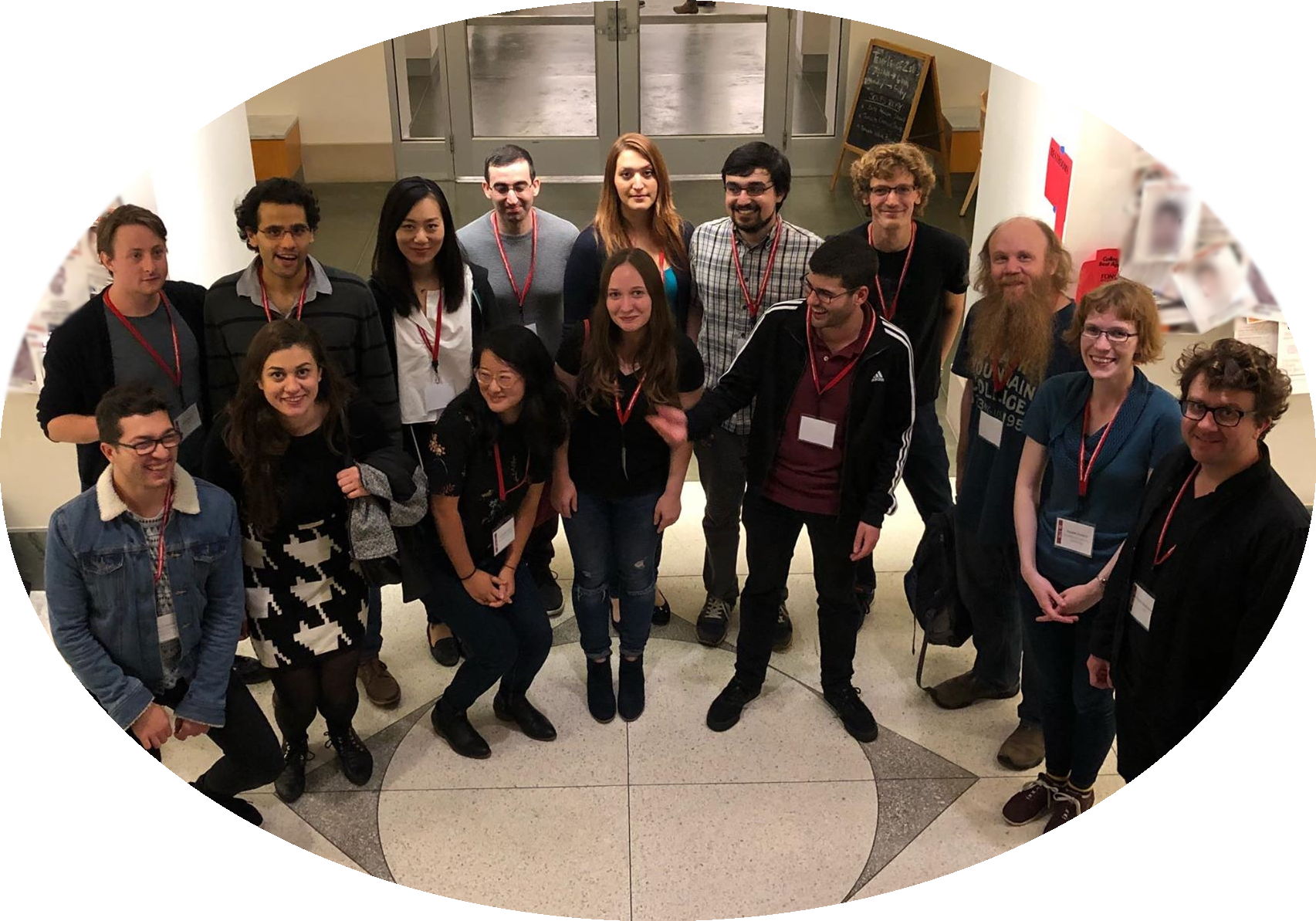
Course Announcements in this post:
- 24.942 Topics in the grammar of a less familiar language
- 24.954 Pragmatics in Linguistic Theory
- 24.956 Topics in Syntax
- 24.963 Linguistic Phonetics
- 24.964 Topics in Phonology
- 24.966J Laboratory on the Physiology, Acoustics, and Perception of Speech
- 24.979 Topics in Semantics
- 9.19/9.190 Computational Psycholinguistics
________________________________________________________________________
24.942 Topics in the grammar of a less familiar language
- Instructors: Kenstowicz, Richards
- Schedule: M 2-5pm
- Room: 32-D831
This year’s Less-Familiar Language will be Wolof (Niger-Congo, Atlantic). We’ll spend the semester learning about Wolofs structure (phonology, morphology, syntax, semantics), and practicing techniques for working with a native speaker of a language to learn about that language.
________________________________________________________________________
24.954 Pragmatics in Linguistic Theory
- Instructor: Fox
- Schedule: T 10am-1pm
- Room: 32-D461
Formal theories of context-dependency, presupposition, implicature, context-change, focus and topic. Special emphasis on the division of labor between semantics and pragmatics. Applications to the analysis of quantification, definiteness, presupposition projection, conditionals and modality, anaphora, questions and answers.
________________________________________________________________________
24.956 Topics in Syntax
- Instructor: Richards
- Schedule: T 2-5pm
- Room: 32-D461
This course will be an exploration of the relation between syntax and phonology, in the framework of Contiguity Theory (Richards 2016). We’ll start by familiarizing ourselves with the main claims of Contiguity Theory, both in the 2016 book and in work done since. This is an approach that posits a different kind of relation between syntax and phonology than is usually assumed; in particular, the syntax can be motivated to perform operations by the need to create phonologically well-formed objects. We’ll discuss the implications of this approach for the architecture of the grammar. Other topics of discussion will include the distribution of overt movements of various kinds, EPP effects, intervention effects, and conditions on pied-piping.
________________________________________________________________________
24.963 Linguistic Phonetics
- Instructor: Flemming
- Schedule: MW 10-11:30am
- Room: 56-180
The study of speech sounds: how we produce and perceive them and their acoustic properties. The influence of the production and perception systems on phonological patterns and sound change. Acoustic analysis and experimental techniques.
We will be considering three fundamental questions:
- How do we produce speech?
- How do we perceive speech?
- How does the nature of these processes influence the sound patterns of languages?
We will also be learning experimental methods and analytical techniques that enable us to address these (and other) questions.
________________________________________________________________________
24.964 Topics in Phonology
- Instructor: Feldman, Katzir, Levy
- Schedule: TR 5-6:30pm
- Room: T 32-D461, R 46-5165
Learning and Linguistic Representations
Models of unsupervised language learning are central to understanding human cognition and replicating it in machines. Computational advances and the availability of large speech and text corpora make it more tractable than ever before to build and evaluate such models. This seminar considers the rich latent structures that are present in human language, and recent computational work in unsupervised learning that can provide insight into what those structures are like and whether and how they might be learned. Seminar participants will take turns leading discussions of original research papers. The seminar is open to graduate students, postdocs, faculty, and well-prepared, highly-motivated undergraduates. Participants should have a strong background in at least one of two areas: (i) linguistic representation; (ii) computational approaches to learning, and should have an interest in gaining expertise in the other area. In addition to participating in and taking turns leading seminar discussions, registered students may be required to complete periodic homework assignments and will write a final paper, either individually or in a group, that relates to unsupervised learning of linguistic knowledge.
________________________________________________________________________
24.966J Laboratory on the Physiology, Acoustics, and Perception of Speech
- Instructor: Braida, Shattuck-Hufnagel, Choi
- Schedule: TR 11am-1pm
- Room: 35-308
Experimental investigations of speech processes. Topics include computer-aided waveform analysis and spectral analysis of speech; synthesis of speech; perception and discrimination of speech-like sounds; speech prosody; models of speech recognition; speech development; analysis of atypical speech; and others. Recommended prerequisite: 6.002, 18.03, or 24.900.
________________________________________________________________________
24.979 Topics in Semantics
- Instructor: Fox, Heim, Schwarzschild
- Schedule: R 2-5pm
- Room: 32-D461
We will begin this seminar with a discussion of issues that arise in the semantics of plurality: when is a predicate true of a plural definite description and when is it false?, are there cases where it is neither true nor false (cases of homogeneity)?, Is there anything interesting to say about when a sentence which neither true nor false is taken to be true, how do answers to these questions bear on the semantics of various constituents dominating a plural definite description?, etc. We will then move to discuss other areas of grammar where similar questions have been raised (questions, generics, conditionals, neg-raising). This, as usual, will likely take us to problems that are not directly related to those with which we will start.
________________________________________________________________________
9.19/9.190 Computational Psycholinguistics
- Instructor: Levy
- Schedule: MW 9:30-11am
- Room: 46-4199
Over the last two and a half decades, computational linguistics has been revolutionized as a result of three closely related developments: increases in computing power, the advent of large linguistic datasets, and a paradigm shift toward probabilistic modeling. At the same time, similar theoretical developments in cognitive science have led to a view major aspects of human cognition as instances of rational statistical inference. These developments have set the stage for renewed interest in computational approaches to human language acquisition and use. Correspondingly, this course covers some of the most exciting developments in computational psycholinguistics over the past decade. The course spans human language comprehension, production, and acquisition, and covers key phenomena spanning phonetics, phonology, morphology, syntax, semantics, and pragmatics. Students will learn technical tools including probabilistic models, formal grammars, neural networks, and decision theory, and how theory, computational modeling, and data can be combined to advance our fundamental understanding of human language acquisition and use.
This course is open to undergraduate and graduate students in Brain & Cognitive Sciences, Linguistics, Electrical Engineering & Computer Science, and any of a number of related disciplines. Enrollees should have (i) one semester of programing experience (ideally Python, fulfillable e.g. by 6.00), plus (ii) either (a) one semester of probability/statistics/machine learning (e.g., 6.041B or 9.40) or (b) one semester of linguistics. The undergraduate section is 9.19, the graduate section is 9.190. Required work will include problem sets, exams, and (for enrollees in 9.190) a final project. Postdocs and faculty are also welcome to participate!
The course will meet twice a week; course format will be a combination of lecture, discussion, and in-class exercises as class size, structure, and interests permit.
MIT Linguistics Colloquium Schedule, Spring 2018
Colloquium talks will be held on Fridays from 3:30-5pm unless otherwise noted. Please visit the colloquium webpage for more details and updates. All questions should be directed to the colloquium organizers, Yadav Gowda and Danfeng Wu.
- February 16: Lucas Champollion (NYU)
- March 9: Sandhya Sundaresan (Uni Leipzig)
- March 23: Judith Tonhauser (Ohio State) - Extended Visit
- April 6: Lyn Frazier (UMass Amherst)
- May 4: Ryan Bennett (Yale/UCSC) - Extended Visit
- May 11: Daniel Rothschild (University College London) - Joint Linguistics/Philosophy Colloquium
LingLunch 2/8: Petr Kusliy (UMass-Amherst)
Speaker: Petr Kusliy (UMass-Amherst)
Title: English Present tense is relative: evidence from VP-fronting
Date and time: Thursday, February 8, 12:30-1:50pm
Location: 32-D461
Abstract:
English Present-under-Past attitude reports are commonly believed to have only the so-called double-access reading (Smith 1978). Roughly, this means that the eventuality described in the embedded clause of the attitude report must overlap the time of the matrix eventuality as well as the utterance time. Present-under-Past attitude reports in languages like Japanese or Russian besides the double-access reading also allow for the so-called simultaneous reading (the embedded eventuality is contemporaneous with the matrix eventuality but not necessarily with the utterance time). The lack of the simultaneous reading in Present-under-Past attitude reports in English lead many researchers to believe that English Present tense is crucially different from Present tense in Japanese or Russian (e.g. Ogihara, 1989; von Stechow, 2003). According to this view, English Present is indexical (i.e. always indicates a time that overlaps the utterance time). Present tense in Japanese and Russian is relative because the time it indicates does not have to overlap the utterance time and can be simultaneous with a local temporal anchor.
In this talk, I focus on the interactions between simultaneous and double-access readings, on the one hand, and VP- and CP-fronting, on the other. To my knowledge, these interactions have never been examined in the literature on tense. I present new data showing that (i) fronted VP versions of Present-under-Past attitude reports allow for a simultaneous reading (together with a double-access reading); (ii) fronted CP versions of Present-under-Past attitude reports do not allow for a simultaneous reading and only have a double-access reading, (iii) in the fronted CP, as well as fronted VP versions of the famous Kamp-Abusch sentences, the most embedded Past does not have a simultaneous interpretation and has to backshift.
I discuss these data and propose an account that contains the following claims: (a) English Present tense has a relative interpretation just like Present tense in Japanese and in Russian; (b) if a tense in a complement CP has a relative interpretation, its temporal anchor is CP-external (not a lambda abstract in the left periphery of the CP); (iii) in a fronted construction, the highest tense cannot be vacuous.
Speaker: Petr Kusliy (UMass-Amherst)
Title: English Present tense is relative: evidence from VP-fronting
Date and time: Thursday, February 8, 12:30-1:50pm
Location: 32-D461
Abstract:
English Present-under-Past attitude reports are commonly believed to have only the so-called double-access reading (Smith 1978). Roughly, this means that the eventuality described in the embedded clause of the attitude report must overlap the time of the matrix eventuality as well as the utterance time. Present-under-Past attitude reports in languages like Japanese or Russian besides the double-access reading also allow for the so-called simultaneous reading (the embedded eventuality is contemporaneous with the matrix eventuality but not necessarily with the utterance time). The lack of the simultaneous reading in Present-under-Past attitude reports in English lead many researchers to believe that English Present tense is crucially different from Present tense in Japanese or Russian (e.g. Ogihara, 1989; von Stechow, 2003). According to this view, English Present is indexical (i.e. always indicates a time that overlaps the utterance time). Present tense in Japanese and Russian is relative because the time it indicates does not have to overlap the utterance time and can be simultaneous with a local temporal anchor.In this talk, I focus on the interactions between simultaneous and double-access readings, on the one hand, and VP- and CP-fronting, on the other. To my knowledge, these interactions have never been examined in the literature on tense. I present new data showing that (i) fronted VP versions of Present-under-Past attitude reports allow for a simultaneous reading (together with a double-access reading); (ii) fronted CP versions of Present-under-Past attitude reports do not allow for a simultaneous reading and only have a double-access reading, (iii) in the fronted CP, as well as fronted VP versions of the famous Kamp-Abusch sentences, the most embedded Past does not have a simultaneous interpretation and has to backshift.
I discuss these data and propose an account that contains the following claims: (a) English Present tense has a relative interpretation just like Present tense in Japanese and in Russian; (b) if a tense in a complement CP has a relative interpretation, its temporal anchor is CP-external (not a lambda abstract in the left periphery of the CP); (iii) in a fronted construction, the highest tense cannot be vacuous.
Syntax Square 2/6 - Danfeng Wu (MIT)
Speaker: Danfeng Wu (MIT)
Title: A copy-based analysis of either in either…or… constructions
Date and time: Tuesday February 6, 1-2pm
Location: 32-D461
Abstract:
While it has been observed since Larson (1985) that either can occur in many different positions in either
or
constructions, no proposal successfully accounts for its various surface positions and restrictions on its distribution. In this talk I argue that the dual identity of either as both a disjunction marker and focus-sensitive operator requires it to c-command both the disjunction phrase and the focused elements. And I argue that it achieves this goal by origination in a c-commanding position relative to the focused constituent, followed by upward movement to c-command disjunction, and that the occurrences of either in different positions are copies in the same movement chain.
Not only does this analysis successfully account for the distribution of either with respect to islands, but it also makes a few predictions. For instance, because these eithers are identical copies in a movement chain, when an independent restriction bans one of them, other copies can still surface to save the sentence.
Speaker: Danfeng Wu (MIT)
Title: A copy-based analysis of either in either…or… constructions
Date and time: Tuesday February 6, 1-2pm
Location: 32-D461
Abstract:
While it has been observed since Larson (1985) that either can occur in many different positions in either or constructions, no proposal successfully accounts for its various surface positions and restrictions on its distribution. In this talk I argue that the dual identity of either as both a disjunction marker and focus-sensitive operator requires it to c-command both the disjunction phrase and the focused elements. And I argue that it achieves this goal by origination in a c-commanding position relative to the focused constituent, followed by upward movement to c-command disjunction, and that the occurrences of either in different positions are copies in the same movement chain.
Not only does this analysis successfully account for the distribution of either with respect to islands, but it also makes a few predictions. For instance, because these eithers are identical copies in a movement chain, when an independent restriction bans one of them, other copies can still surface to save the sentence.
Spring 2018 Reading groups
LingPhil Reading Group (LPRG) will be reprising this semester on Mondays, 1:00-2:00pm, in 32-D831 (the 8th floor conference room). Reading list and contact information can be found on the group’s website.
Phonology Circle will be meeting on Mondays, 5:006:30pm, in 32-D831 (the 8th floor conference room). Please contact Erin Olson and/or Rafael Abramovitz if you would like to reserve a slot.
Syntax Square will be held at the old time-slot: Tuesdays, 1:00-2:00pm, in 32-D461 (the 4th floor seminar room). As always, we welcome works in progress, presentation of papers on topics of interest, practice talks, etc. Please contact Suzana Fong and/or Mitya Privoznov if you would like to give a talk.
LF Reading Group meets on Wednesdays, 1:00-2:00pm in 32-D461. As always, rough ideas, work in progress, practice talks, and presentations of papers from the literature are all very welcome. To reserve a slot, contact Naomi Francis or Tanya Bondarenko.
Ling-Lunch is held on Thursdays, 12:30-1:50pm in 32-D461. Anyone who wishes to present their own linguistics-related research is welcome, although preference will be given to members of the MIT linguistics department. Please contact Cora Lesure or Ömer Demirok to reserve a date.
LF Reading Group 12/13 - Sarah Zobel (University of Tuebingen/MIT)
Speaker: Sarah Zobel (University of Tuebingen/MIT)
Title: Do weak adjunct ‘as’-phrases restrict individual quantifiers?
Date and time: Wednesday December 13, 1-2pm
Location: 32-D461
Abstract:
The central observation in the literature on free adjuncts is that weak adjuncts can be understood as restricting temporal and modal quantifiers (see Stump 1985): weak adjuncts co-occurring with these types of quantifiers are ambiguous between a restricting and a non-restricting, causal-adverbial-clause like meaning, as in (1-a). Strong adjuncts, in contrast, can only have a non-restricting interpretation, as in (1-b).
(1) a. As a 10-year-old, Peter liked gingerbread. (weak)
(Possible: When Peter was 10 years old, he liked gingerbread. [interaction with [PAST])
(Possible: Since Peter is 10 years old, he liked gingerbread.)
b. Being 10 years old, Peter liked gingerbread. (strong)
(Not possible: When Peter was 10 years old, he liked gingerbread. [interaction with [PAST])
(Possible: Since Peter is 10 years old, he liked gingerbread.)
In this talk, I address the question whether weak adjuncts (using `as’-phrases), as in (2), can be understood as restricting nominal quantifiers, and, if not, how the intuitive interpretations found with these examples can be accounted for.
(2) a. As a child, every guest likes gingerbread.
b. As tourists, most visitors own cameras.
I show that the intuitive interpretation of the examples in (2) are not compatible with these `as’-phrases restricting the quantifiers `every guest’ and `most visitors’ in the same manner as observed for temporal and modal quantifiers. I propose that the intuitive interpretation found in these cases is the result of two properties of the ‘as’-phrases: (i) they associate with the individual quantifiers via Non-Obligatory Control, which I analyze similar to discourse anaphora, and (ii) they are not interpreted in the scope of their associated individual quantifiers.
Speaker: Sarah Zobel (University of Tuebingen/MIT)
Title: Do weak adjunct ‘as’-phrases restrict individual quantifiers?
Date and time: Wednesday December 13, 1-2pm
Location: 32-D461
Abstract:
The central observation in the literature on free adjuncts is that weak adjuncts can be understood as restricting temporal and modal quantifiers (see Stump 1985): weak adjuncts co-occurring with these types of quantifiers are ambiguous between a restricting and a non-restricting, causal-adverbial-clause like meaning, as in (1-a). Strong adjuncts, in contrast, can only have a non-restricting interpretation, as in (1-b).
(1) a. As a 10-year-old, Peter liked gingerbread. (weak)
(Possible: When Peter was 10 years old, he liked gingerbread. [interaction with [PAST])
(Possible: Since Peter is 10 years old, he liked gingerbread.)b. Being 10 years old, Peter liked gingerbread. (strong)
(Not possible: When Peter was 10 years old, he liked gingerbread. [interaction with [PAST])
(Possible: Since Peter is 10 years old, he liked gingerbread.)In this talk, I address the question whether weak adjuncts (using `as’-phrases), as in (2), can be understood as restricting nominal quantifiers, and, if not, how the intuitive interpretations found with these examples can be accounted for.
(2) a. As a child, every guest likes gingerbread.
b. As tourists, most visitors own cameras.I show that the intuitive interpretation of the examples in (2) are not compatible with these `as’-phrases restricting the quantifiers `every guest’ and `most visitors’ in the same manner as observed for temporal and modal quantifiers. I propose that the intuitive interpretation found in these cases is the result of two properties of the ‘as’-phrases: (i) they associate with the individual quantifiers via Non-Obligatory Control, which I analyze similar to discourse anaphora, and (ii) they are not interpreted in the scope of their associated individual quantifiers.
Simplicity Workshop videos
Videos of talks from the MIT Workshop on Simplicity in Grammar Learning are now available online! If you would like to see the talks, visit the workshop website.
Whamit! Winter Hiatus
Whamit! will be on its Winter (semi-)hiatus from now until the start of the Spring semester. Weekly posts will resume on February 5th, 2018. In the mean time, we will have rolling posts, publishing breaking MIT Linguistics news as it happens. Thanks to all our contributors, editors, and you dear readers!
See you next year!
Syntax Square 12/5 - Colin Davis
Speaker: Colin Davis (MIT)
Title: Don’t go over the edge: More constraints on stranding at edges
Date and time: Tuesday December 5, 1-2pm
Location: 32-D461
Abstract:
Moving phrases can sometimes leave material behind in phase edges they pass through, a phenomenon I term “edge stranding” (ES). Davis (In prep) shows that the sorts of elements capable of ES are predicted given Cyclic Linearization and a theory of movement as driven by c-command-constrained Agree. In this talk, I extend those findings to make predictions about when a given edge is available as a site for stranding. In essence, I predict that specifiers crossed by a phase-exiting movement step are unavailable for ES, hence the title of this talk. I focus on stranding at vP, which interacts with both subject movement and verb movement. This approach makes good predictions about ES in West Ulster English, Korean, and Japanese, but requires more work to understand facts from Polish and Dutch.
LF Reading Group 12/06 - Tiaoyuan Mao (MIT)
Speaker: Tiaoyuan Mao (MIT)
Title: Mandarin Chinese -ne revisited: Its basic properties and derivation
Date and time: Wednesday December 6, 1-2pm
Location: 32-D461
Abstract:
Mandarin Chinese sentence final particles (SFPs) were, are and will be a hotly-debated topic. The vast majority of studies concentrate on the head-directionality, optionality and multiple semantic interpretation of SFPs, such as the first two issues fall within the domain of FOFC (the Final-Over-Fianl Constraint)(Biberauer, Holmberg and Roberts 2014; Sheehan, Biberauer, Roberts and Holmberg 2017) and Pan and Paul (2016), a.o. In this talk, I will focus on -ne, the most complicated Mandarin SFP, trying to demonstrate a tentative proposal to resolve the tension among different projects about the head-directionality and syntactic derivation of -ne, and to interpret the multiple meanings of -ne in a principled way.
MIT Colloquium 12/8 - Jason Riggle (UChicago)
Speaker: Jason Riggle (University of Chicago)
Title: The co-grammar of English: interjections and other formulaic language
Time: Friday, December 8th, 3:30-5pm
Place: 32-155
Abstract:
Most sentences are unique … except the ones that aren’t. The frequency distribution in any corpus of natural language has a famously `long tail’ filled with unique phrases only ever used once. Conversely, the other end of the distribution is filled with endless repetitions of familiar and formulaic phrases used to manage conversation (yeah, mhm, oh, y’know, right, okay, well), express reactions (aw man, wow, cool, whoa, yuck, yikes, phew), and serve social scripts (good morning, thanks, fuck off, I’m sorry).
We observe three quirky properties that seem to be peculiar to the frequent and formulaic phrases at the fat end of the distribution.
1) phones — phones/phonotactics/phonation outside the productive phonology
2) tones — phrase-specific intonational contours and floating intonational contours
3) emblems — manual gestures with highly conventionalized meaning that occur with (and substitute for) verbal equivalents
These properties tend to occur together and seem to be restricted to the elements at the fat end of the distribution. We propose that this be explained by positing a co-grammar for English that operates over frequent and formulaic phrases. In addition to accounting for the presence and distribution of properties (1-3) a co-grammar makes it possible to account for an over-abundance of surface regularities in the fat end of the distribution (e.g., prosodic doubling: hear hear, there there, come come, now now, aye aye, nix nix, etc.) and the presence of proto-morphology in patterns which seem compositional but not productive ({welp, nope, yup, yep}, {wowza, yowza, wowzers, yowzers, yeppers, yuppers, right-o, neat-o}, {whatevs, natch, obvs, obvi}).
Most sentences are unique … except the ones that aren’t. The frequency distribution in any corpus of natural language has a famously `long tail’ filled with unique phrases only ever used once. Conversely, the other end of the distribution is filled with endless repetitions of familiar and formulaic phrases used to manage conversation (yeah, mhm, oh, y’know, right, okay, well), express reactions (aw man, wow, cool, whoa, yuck, yikes, phew), and serve social scripts (good morning, thanks, fuck off, I’m sorry).
We observe three quirky properties that seem to be peculiar to the frequent and formulaic phrases at the fat end of the distribution.
1) phones — phones/phonotactics/phonation outside the productive phonology
2) tones — phrase-specific intonational contours and floating intonational contours
3) emblems — manual gestures with highly conventionalized meaning that occur with (and substitute for) verbal equivalentsThese properties tend to occur together and seem to be restricted to the elements at the fat end of the distribution. We propose that this be explained by positing a co-grammar for English that operates over frequent and formulaic phrases. In addition to accounting for the presence and distribution of properties (1-3) a co-grammar makes it possible to account for an over-abundance of surface regularities in the fat end of the distribution (e.g., prosodic doubling: hear hear, there there, come come, now now, aye aye, nix nix, etc.) and the presence of proto-morphology in patterns which seem compositional but not productive ({welp, nope, yup, yep}, {wowza, yowza, wowzers, yowzers, yeppers, yuppers, right-o, neat-o}, {whatevs, natch, obvs, obvi}).
SNEWS @ MIT
The Southern New England Workshop in Semantics (SNEWS) took place at MIT on Saturday. Two MIT students participated. Filipe Kobayashi (1st year) presented When modals scope below the progressive, and Keny Chatain (2nd year) presented The referentiality of generic indefinites: evidence from anaphora.
SNEWS 2018 will take place at the University of Massachusetts, Amherst.
Photo credit: Dóra Takács
Syntax Square 11/28 - Elise Newman
Speaker: Elise Newman (MIT)
Title: Middles produce easily if you have enough stuff
Date and time: Tuesday November 28, 1-2pm
Location: 32-D461
Abstract:
It has been proposed in the literature that Anti-locality (Abels 2003, Erlewine 2016) can help us understand a number of subject-object asymmetries in A-bar movement. However, it has been stipulated that such a restriction cannot exist for A-movement due to the idea that subjects move string-vacuously to Spec TP. In this talk, I argue that such subject-object asymmetries also occur with A-movement, and that they also can be explained by Anti-locality. I propose that middles are a direct reflection of this, as can be seen by regarding novel facts about middle formation that previous semantic accounts cannot explain.
Middles look like inchoative unaccusatives except for a few key differences:
- They have unexpressed external arguments
- They have an adverb restriction
(1) a. The ice melted (quickly) (all by itself).
b. The book read *(quickly) (*all by itself).
I propose that objects of middles move through the canonical subject position on their way to Spec TP. The adverb restriction is a result of the objects sensitivity to Anti-locality as it undergoes this movement chain. The two (arguably 3) types of adverb restrictions pattern with how embedded the object is at the beginning of the derivation.
Speaker: Elise Newman (MIT)
Title: Middles produce easily if you have enough stuff
Date and time: Tuesday November 28, 1-2pm
Location: 32-D461
Abstract:
- They have unexpressed external arguments
- They have an adverb restriction
LF Reading Group 11/29 - Moshe Bar-Lev (HUJI)
Speaker: Moshe Bar-Lev (The Hebrew University of Jerusalem)
Title: Don’t mind the gap: an implicature account of Homogeneity
Date and time: Wednesday November 29, 1-2pm
Location: 32-D461
Abstract:
I will present an implicature-based view of Homogeneity with definite plurals (following Magri 2014s lead) in which the universal meaning definite plurals give rise to in positive sentences is the result of implicature calculation, while the existential meaning they give rise to in negative sentences reflects the basic meaning.
The proposed account builds on the implicature approach to free choice disjunction, which I claim behaves similarly to Homogeneity. Given this perspective, Non-maximal readings of definite plurals can be taken to follow from the context-sensitivity of implicature calculation, and neither-true-nor-false judgments can be the result of context-indeterminacy. This is in contrast with a view in which they motivate semantically encoding a truth-value gap (recently Kri 2016).
To support the implicature-based account I will discuss asymmetries between positive and negative contexts in childrens interpretation of definite plurals (Tieu et al. 2015), non-maximal readings, and neither-true-nor-false judgments (Kri & Chemla 2015).
CompLang 11/30 - Takashi Morita (MIT) & Timothy O’Donnell (McGill)
Speaker: Takashi Morita (MIT) & Timothy O’Donnell (McGill)
Title: Bayesian learning of Japanese sublexica
Date/Time: Thursday, November 30th, 5:00-6:30pm
Location: 46-5165
Abstract:
Languages have been borrowing words from each other.
A borrower language often has a different list of possible sound sequences (phonotactics) from a lender’s.
While loanwords may be reshaped so that they fit to the borrower’s phonotactics, they can also introduce new sound patterns into the language.
Accordingly, native and loanwords can exhibit different phonotactics in a single language and linguists have proposed that such a language’s lexicon is better explained by a mixture of multiple phonotactic grammars: words are classified into sublexica (e.g. native vs. loan), and words belonging to different sublexica are subject to different phonotactic constraints.
This approach, however, raises a non-trivial learnability question: Can learners classify words into correct sublexica?
Words are not labeled with their sublexicon, so learners need to infer the classification.
In this study, we investigate Bayesian unsupervised learning of sublexica.
We focus on Japanese data (coded in international phhonetic alphabet), whose sublexical phonotactics has been proposed in linguistic literature.
It will turn out that even a simple Dirichlet process mixture of ngram leads to remarkably successful classification.
Zukoff at Grinnell College
Sam Zukoff (PhD ‘17, post-doc) gave an invited talk at Grinnell College last week. The handout for the talk, entitled Reduplication in Ancient Greek, is available on Sam’s website, here.
Syntax Square 11/21 - Stanislao Zompí (MIT)
Speaker: Stanislao Zompí
Title: *ABA in case morphology and what it may teach us
Date and time: Tuesday November 21, 1-2pm
Location: 32-D461
Abstract:
In this presentation, I try to lay out a comprehensive survey of *ABA effects in case morphology, with an emphasis on case syncretism, case-based wholesale suppletion, and case-based stem-formative allomorphy. Building on work by Baerman et al. (2005), McFadden (2017), and Smith et al. (2017), I claim that all three of these phenomena are constrained by the following universal: No Vocabulary-Insertion rule can apply to both an inherent case and an unmarked core case (nominative/absolutive) without also applying to another core case (accusative/ergative). The case hierarchy that such *ABA effects motivate is thus one where the ergative consistently occupies the same middle field as the accusative, instead of patterning with inherent cases. This offers a new kind of argument against approaches that treat the ergative as just another inherent case, and it favors instead those case-assignment theories that do put ergative and accusative in the same box. Prominent among these is Marantzs (1991) dependent-case theory, whereby accusative and ergative are both treated as dependent casesi.e. assigned to nominals that stand in an asymmetric c-command relation to another as-yet-caseless nominal nearby (cf. also Yip et al. 1987). In this light, I reinterpret Marantzs disjunctive case-assignment hierarchy as a proper containment hierarchy: [[[UNMARKED] DEPENDENT] INHERENT].


