Whamit!

The Weekly Newsletter of MIT Linguistics

Archive for the ‘Announcements’ Category

JK23 Through Photos

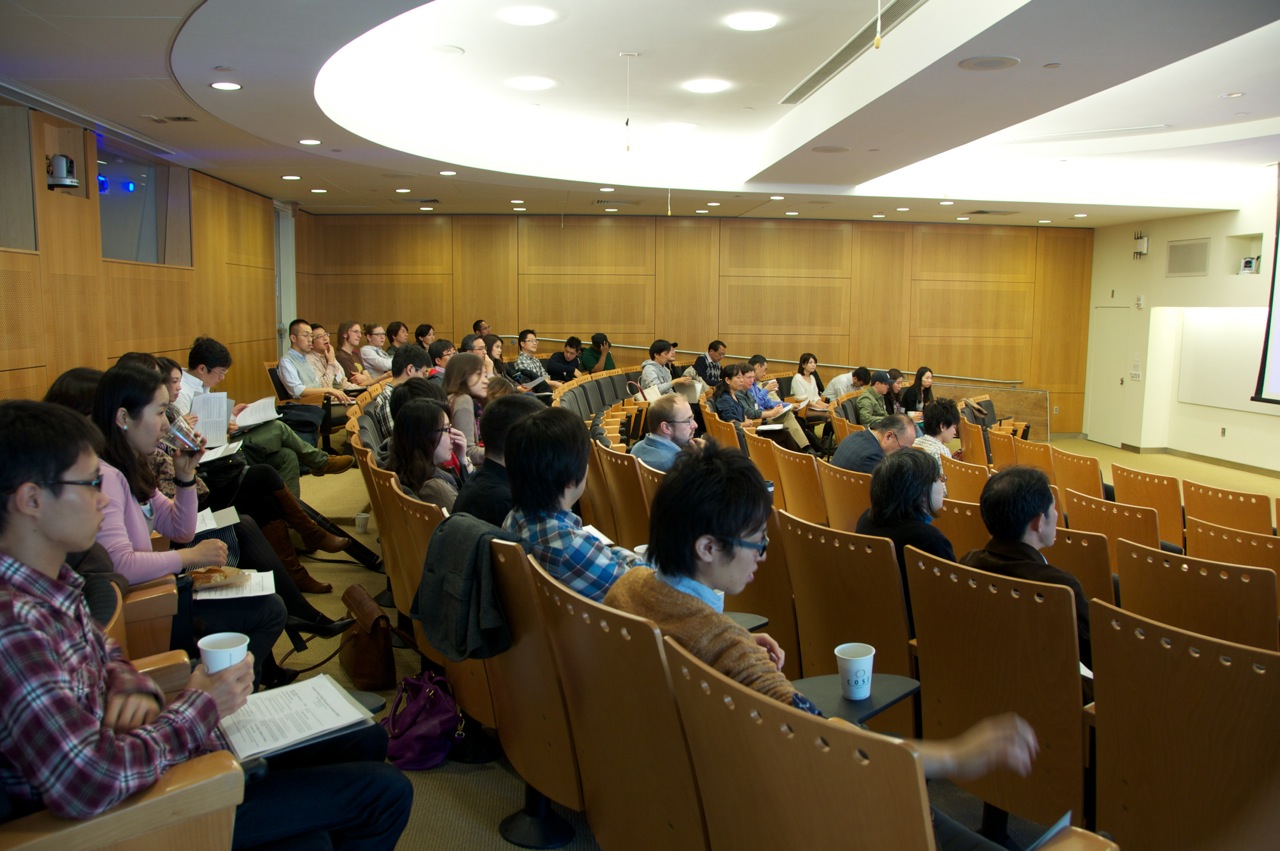
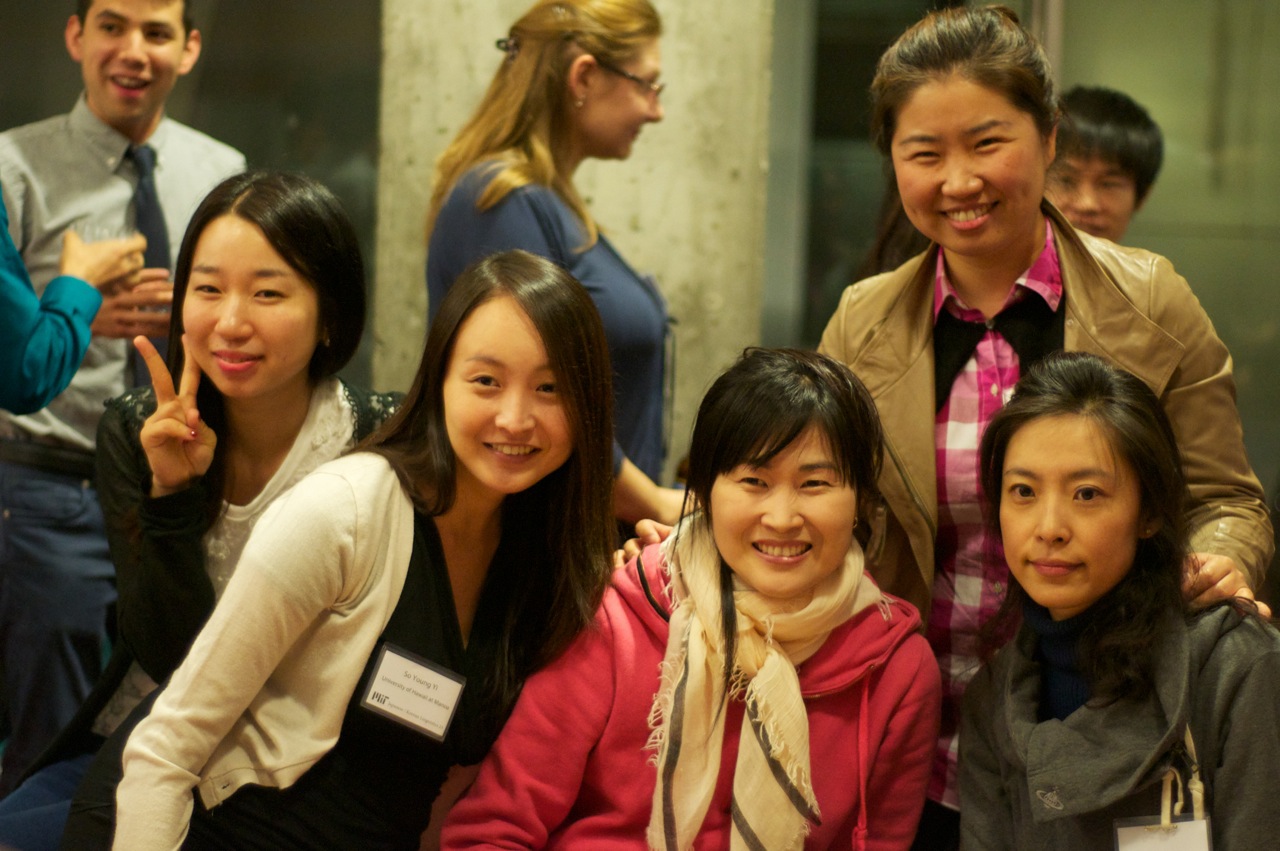
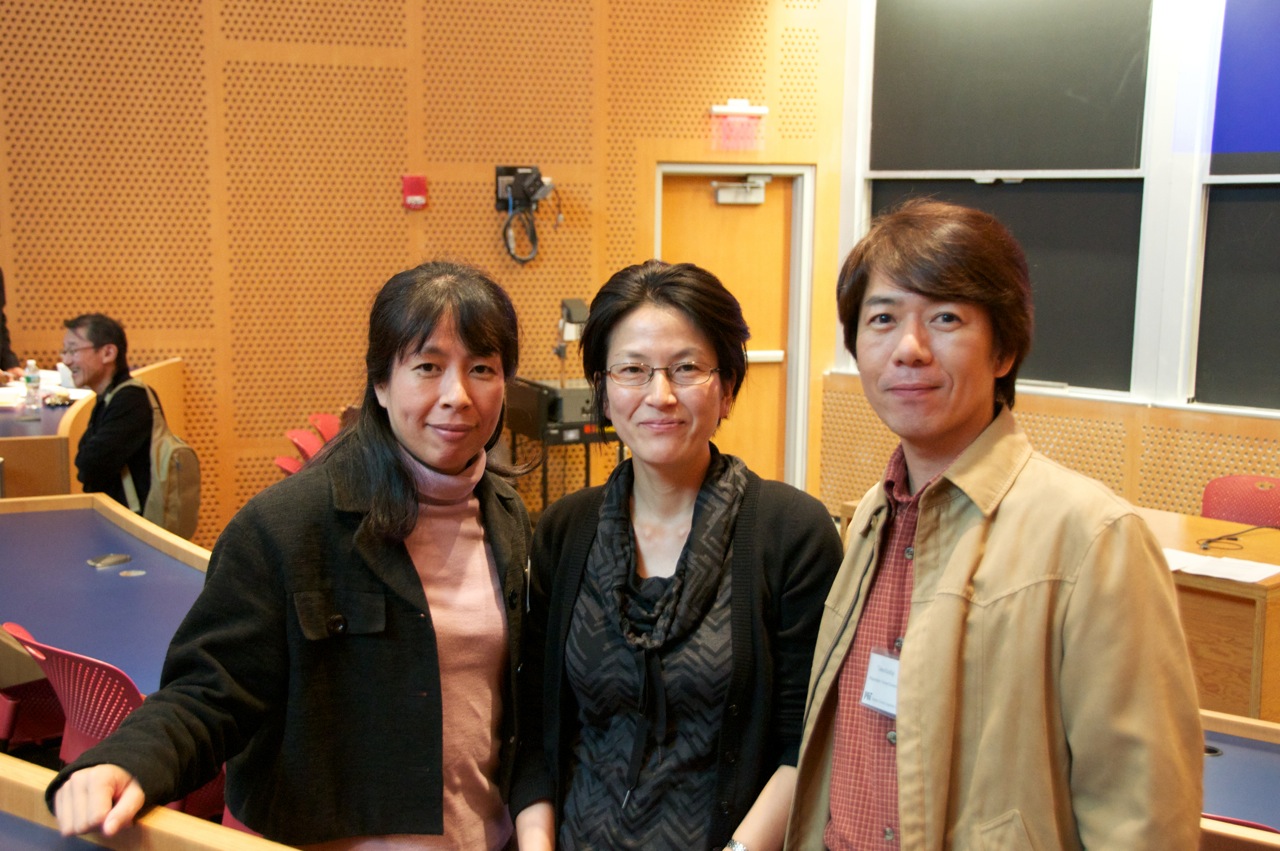
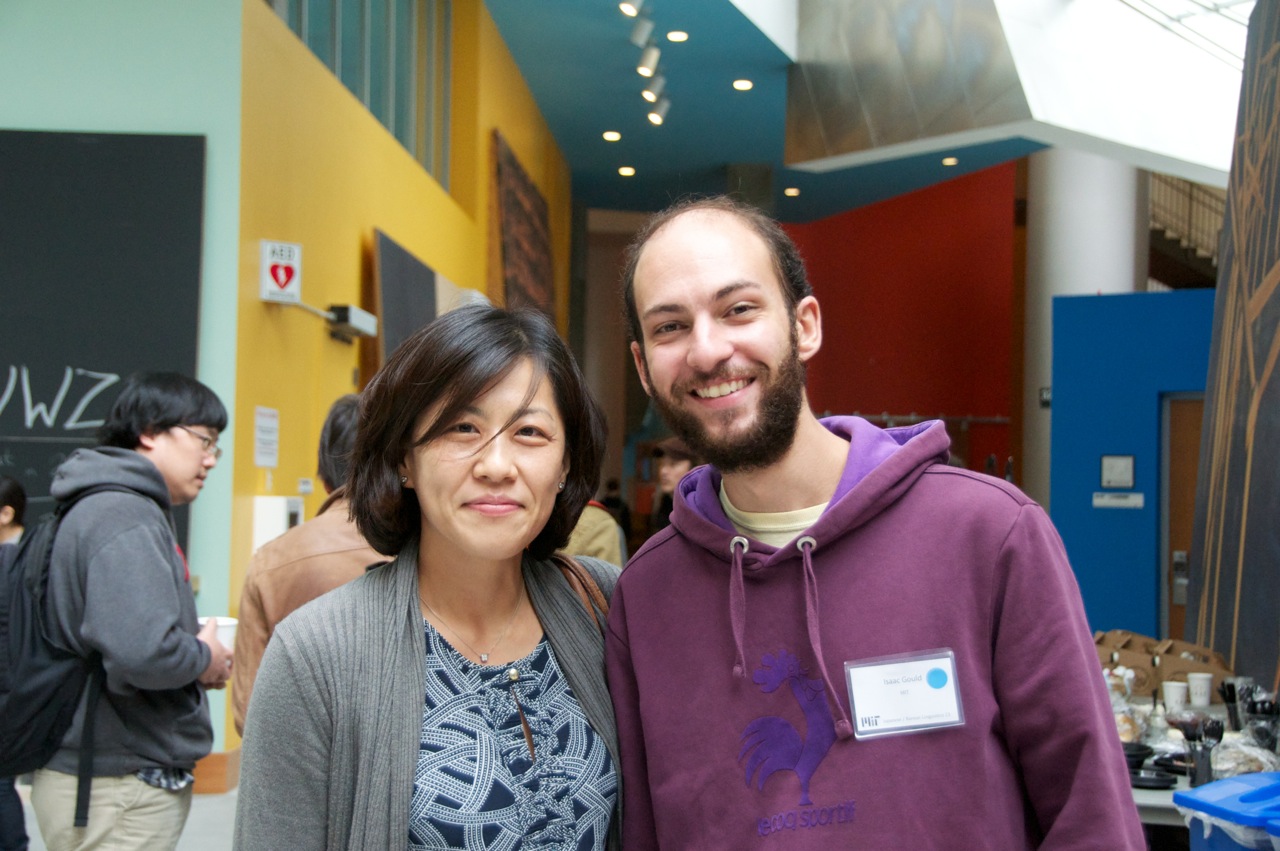
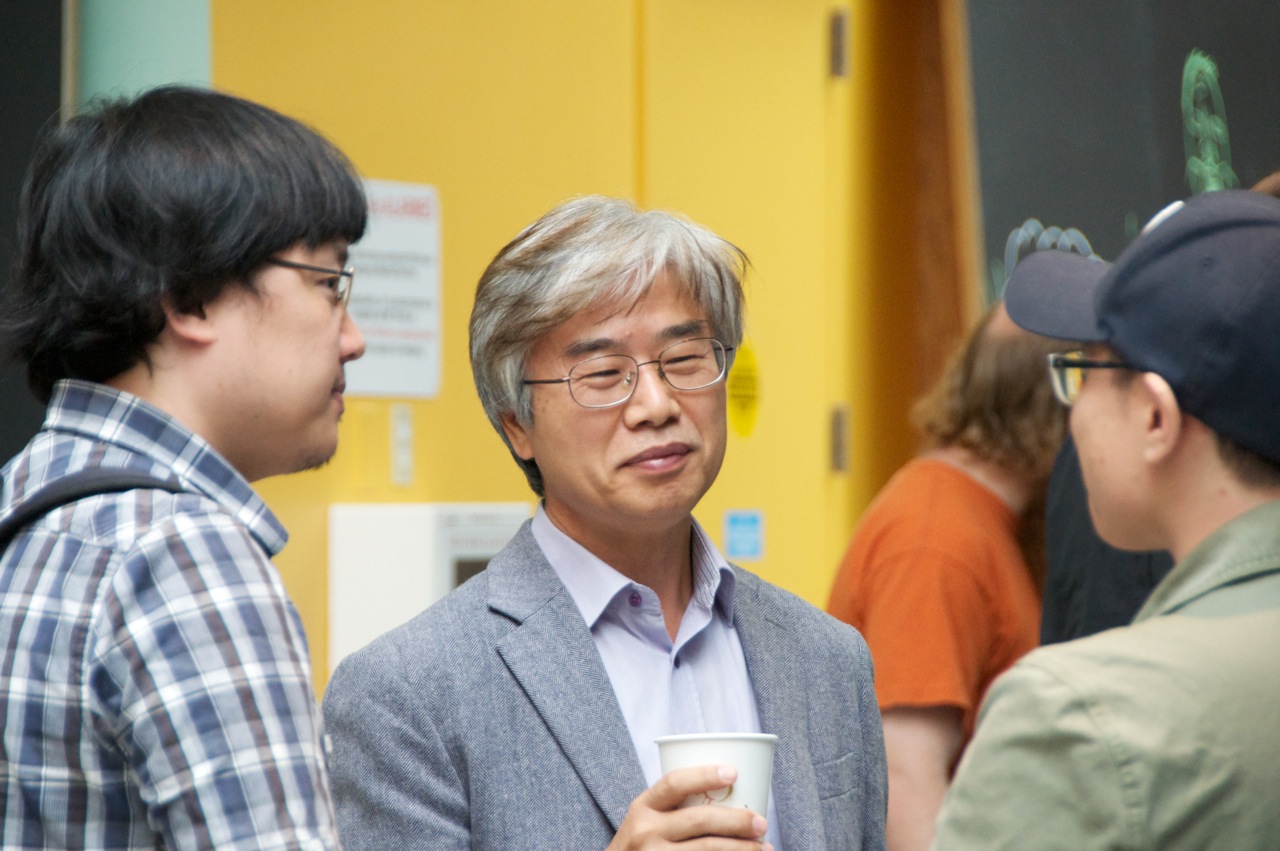
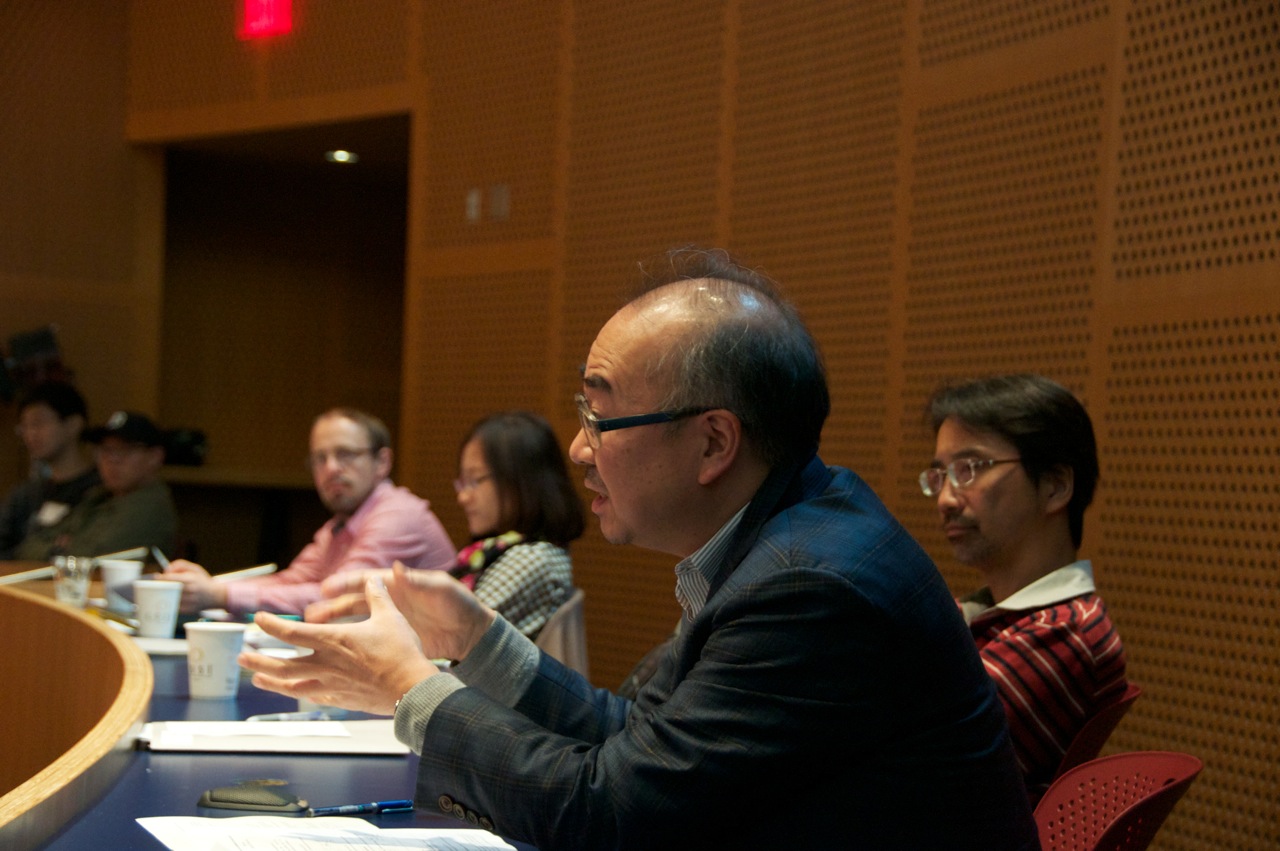
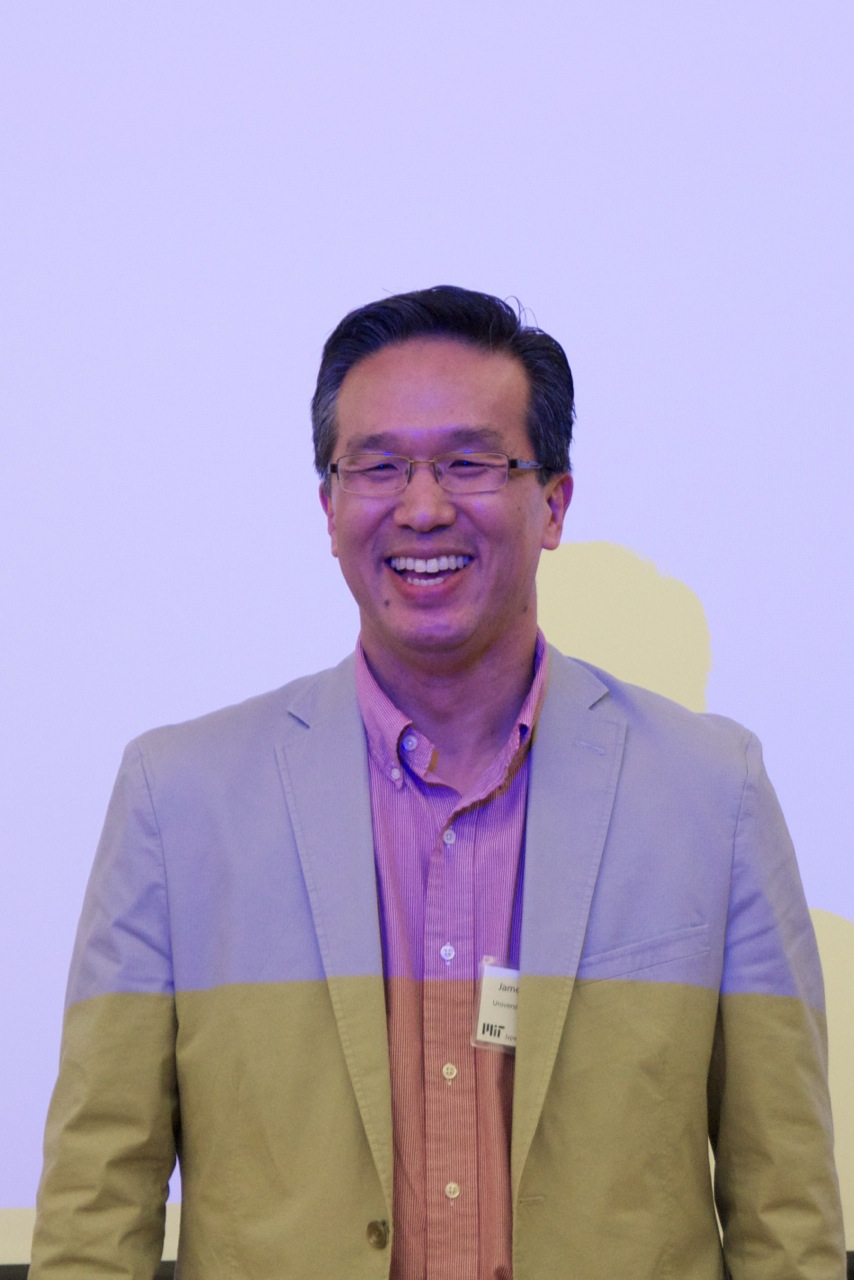
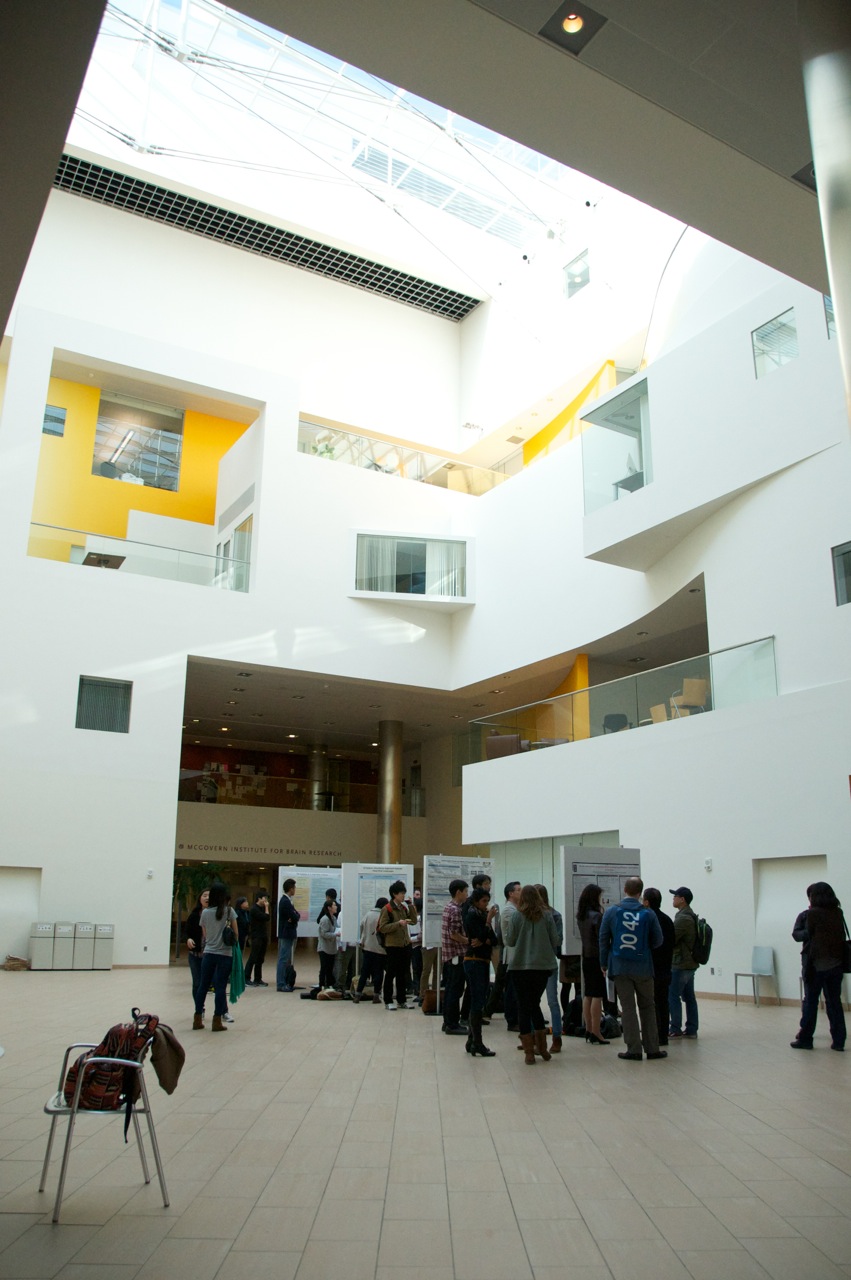
The 23rd Japanese/Korean Linguistics Conference was held this past weekend at MIT. With 23 talks and 14 posters presented over three days, there was much lively discussion among the over 90 participants. The organizers wish to thank the presenters and attendees for making the conference such a resounding success.

Among the participants was the conference’s official mascot (and MVP), Sally, who welcomed the attendees on the first day and stayed through the last day. You’ll find her and others in the photos below, provided by Mitcho Erlewine.

Welcome to the Fall 2013 semester!

Today, Tuesday September 3, is Registration Day. Whamit!, the MIT Linguistics Department Newsletter, appears every Monday during the semester (Tuesdays if Monday is a public holiday). The editorial staff consists of Adam Albright, Kai von Fintel, Michelle Fullwood, Ryo Masuda, and David Pesetsky.

To submit items for inclusion in Whamit! please send an email to whamit@mit.edu by Sunday 6 pm. At the beginning of the semester, we’re particularly interested in news about what members of the department did during the summer break.

Hope to see you all at the departmental barbecue, 12 noon at the Stata amphitheater (rain location: 8th floor departmental lounge)!

Introducing our new lab manager, Erin Olson

Over the summer, our new linguistics lab manager, Erin Olson, started work.  She will be helping with experimental research throughout the linguistics side of the department, including the Phonetics lab and the Experimental Syntax and Semantics lab.

Erin is originally from Minneapolis, Minnesota. She got her BA in Linguistics from McGill University in Montréal, Québec in 2012, and worked at McGill as a research assistant in the Prosody Lab and Fieldwork Lab there until June 2013. She tells us that he’s primarily interested in phonology (especially stress systems), but is also interested in other kinds of experimental research, including sentence processing and first language acquisition. When not concentrating on linguistics, she enjoys “fencing, swimming, drawing, watching hockey, exploring the city, and finding new and interesting places to get a good meal or drink”.   Welcome, Erin!

Whamit Acquisition Shocker 4/1: No Poverty in This Stimulus

It has now been officially confirmed that Whamit!, the independent voice of MIT Linguistics for more than five years, has been acquired by Rupert Murdoch’s Newscorp for almost $3.4 million dollars.  Though described by some as a “brazen attempt to silence a brave beacon of hope in a gray sea of otherwise identical boring linguistics department blogs all starting with the letter wh”, others have denied the presupposition, claiming that it is merely an implicature.  In a carefully worded statement released earlier today, Murdoch promised no “change in editorial” policy under his leadership.  ”Whamit will continue to bring you those fabulous pumpkin-carving pictures  you love each Halloween, and there is no current plan to curtail Whamit’s award-winning, hard-hitting crime coverage.  Only now we will do it with verve.”  Verve could not be reached for comment.  Meanwhile a viral video insisted “there will be some changes made”, others beans, and still others expressed relief that Whamit had at least not been acquired by Fox News.  Participating in the negotiations over the sale were over nineteen current MIT faculty, graduate students, recent alums, current visitors, former visitors and former alums.  Speaking off the record, noted semanticist Irene Heim commented that “it will take us the rest of our lifetime to drink the champagne that they spilled that evening”, but declined to elaborate.

Visiting Members for Spring 2013

Following up on their introductions at the Departmental Lunch last week, Whamit! extends our warmest welcome to the new visiting members of the department for this semester.

Visiting Scholars

  • Heriberto Avelino (Max Planck Institute for Evolutionary Anthropology)
    His research investigates the phonotactics of complex nasals and nasal neutralization avoidance by examining a number of diverse languages which include in its repertoire pre-occluded nasals (DN) as in /tàlúgn/ ‘rooster’ (Nothern Pame, Otomanguean) and post-occluded nasals (ND) as in /ambo/ ‘to climb’ (Karitiana, Tupi).
  • Gary Thoms (University of Edinburgh)
    His research interests are in literary linguistics and syntax.

Postdoctorate Fellow

  • Martin Rohrmeier  is an Intelligence Initiative post-doctoral fellow whose research concerns music cognition and learning and the relation of musical structure to linguistic structure.  Martin studied philosophy, mathematics and musicology in Bonn, Germany, and completed his PhD in musicology in 2010, under the supervision of Dr. Ian Cross.  He has held a research internship with Microsoft Research in Cambridge, UK, and most recently has been a postdoctoral researcher working with Stefan Kölsch at the Free University of Berlin.  While in Berlin, Martin regularly improvised music for  showings of silent films (and he has many other musical talents as well).

Visiting Students

  • Maria (Malu) Luisa de Andrade Freitas (University of Campinas)
    Her research studies person hierarchy phenomena in two native South American languages: Guaraní (Tupí-Guaraní) and Ikpeng (Carib family).
  • Moreno Mitrovi? (University of Cambridge, Jesus College)
    His research is on the syntax and semantics of coordinate construction in Indo-European.
  • Tomislav Socanac (University of Geneva)
    He is part of a research project that aims to account for the cross-linguistic properties of the subjunctive mood category.

Welcome to the Spring 2013 Term!

Whamit! welcomes all the members of the MIT Linguistics community to the spring semester. The editorial staff is comprised of Adam Albright, Kai von Fintel, Michelle Fullwood, Ryo Masuda, and David Pesetsky.

We look forward to receiving items for inclusion in Whamit! throughout the semester, including reports of acceptance to conferences and journals. To submit items for inclusion please send an email to whamit@mit.edu by Sunday 6pm.

Hope to see you all at the Registration Day Lunch today at noon at the 8th floor lounge!

MIT Linguistics Colloquium Schedule, Spring 2013

The updated schedule for this term’s MIT Linguistics Colloquium is posted below. All talks are on Fridays, 3:30-5:00 p.m. in room 32-141 unless otherwise noted. For further information, please contact the organizers for this semester, Yusuke Imanishi and Wataru Uegaki.

March 8: Lisa Matthewson (UBC)
April 5: Sharon Inkelas (UC Berkeley)
April 19: Arsalan Kahnemuyipour (University of Toronto Mississauga)
April 26: Mark Baker (Rutgers)
May 10: Andrew Nevins (UCL)
May 17: Emmanuel Chemla (LSCP-CNRS (Paris))

MIT Linguistics to host Japanese/Korean Linguistics 23 and NECPhon in Fall 2013

We’re excited to announce that two conferences will be hosted by our department next fall.

The 23rd Japanese/Korean Linguistics Conference (JK23) is the longest running conference on Japanese and Korean linguistics, offering a forum for the presentation of research that contributes to our understanding of the structure and history of the two languages. Next year’s meeting is scheduled for October 11-13, 2013. The website for JK23 is at http://jk.mit.edu/.

The Northeast Computational Phonology Workshop (NECPhon) is an informal gathering of scholars working on or interested in aspects of computational phonology. The meeting date is to be determined.

Stay tuned for further information.

Course announcement: “More on Questions”

*How much does this truck not weigh?

24.S94: More on Questions
Danny Fox
class website: https://stellar.mit.edu/S/course/24/fa12/24.S94/index.html

Times and locations:
Week 1, class 1 & 2: Wednesday 9/26 2:30-5:30pm; Friday 9/28 2:00pm-5:00pm (32-D461)
Week 2, class 3 & 4: Wednesday 10/3 2:30-4:30pm; Friday 10/5 2:00pm-5:00pm (32-D461)
Week 3, class 5 : Wednesday 10/10 2:30-5:30pm (32-D461)
Week 3, class 6 : probably Thursday 10/11 2:00-5:00 (or as arranged with class) (location TBA)

In this class I will try to develop an argument for a particular treatment of pair-list readings in multiple wh-questions that I made in a 2010 seminar (taught with Irene and Kai).

The starting point is Dayal’s proposal that questions are associated with a maximality presupposition – the requirement that one true member of the Hamblin-denotation entail all true members. As Dayal shows, maximality accounts for uniqueness in simple singular wh questions (Which boy came? is associated with the inference that exactly one boy came). Dayal’s proposal, which provides the basis for a family accounts of negative islands and related phenomena, fails to derive the pair list readings of multiple wh-questions, such as Which boy read which book?.

I will try to argue that this problem can be resolved if multiple questions denote families of questions, derived from logical forms that obey Richard’s tucking-in generalization. The rest of the class will investigate various issues that have a potential bearing on the proposal: issues pertaining to quantificational variability in questions, to pair-list readings that arise from normal quantification (e.g. Which book did every boy read?), and to the nature of superiority.

Welcome to the Fall 2012 semester!

Today, Tuesday Sept. 4, is Registration Day. Whamit!, the MIT Linguistics Department Newsletter appears every Monday during the semester. The editorial staff consists of Adam Albright, Kai von Fintel, Michelle Fullwood, Ryo Masuda, and David Pesetsky.

To submit items for inclusion in Whamit! please send an email to whamit@mit.edu by Sunday 6pm. At the beginning of the semester, we’re particularly interested in news about what members of the department did during the summer break.

Hope to see you all at the departmental lunch, 12pm at the 8th floor lounge!

Summer Pause 2012

This is the last regular issue of Whamit! for the 2011-2012 academic year. We will resume publication on Fall Registration Day, Tuesday, Sept 4.

Have a nice summer!

Monday & Tuesday holidays

Just a reminder that Monday and Tuesday of this week are holidays at MIT, and no classes will be held (unless otherwise specified). Monday is Patriots’ Day, which commemorates the battles of Lexington and Concord. Tuesday, of course, commemorates the day after the battles of Lexington and Concord. In theory, Wednesday should celebrate the day after Tuesday, but holidays lack the property of recursion.

Formal Approaches to South Asian Linguistics @MIT next weekend

Next Saturday and Sunday (March 17 & 18), MIT will be hosting the second workshop on Formal Approaches to South Asian Languages (FASAL 2), with papers in formal syntax, semantics and morphology. The invited speakers are: Rajesh Bhatt (University of Massachusetts, Amherst), Veneeta Dayal (Rutgers), Brendan Gillon (McGill) and Maria Polinsky (Harvard). The conference will be great — see you there!

No ESSL meeting this week

There will be no Experimental Syntax and Semantics lab meeting this week, due to Presidents’ Day.

Join us next Monday (2/27) at 5:30 for the first meeting of a short two-session reading group in which we will discuss theoretical and experimental (ERP-related) papers on Blocking effects. Contact Hadas if you would like to participate and get the reading list in advance.

And because Tuesday is a Monday…

…there will be no Syntax Square this week. But next week, Syntax Square returns, with a presentation by DaeYoung Sohn. Watch for the announcement in the next Whamit!

Experimental Syntax and Semantics Lab organizational meeting

The Experimental Syntax and Semantics lab is having its first lab meeting of the semester Monday at 5:30 pm, in the fourth floor seminar room, 32-D461. It will be primarily an organizational meeting and there will be pizza. All are welcome!

LFRG organizational meeting - 2/16

There will be a short organizational meeting for the LF Reading Group on 16 February (Thursday) at 10 am in 32-D831.

Final Whamit! for 2011

This is the last regular Whamit! issue for this semester and for 2011. We may publish a special edition or two to let you know about events in the department during January. We will return to our weekly schedule on Registration Day, February 6, 2012. Have a wonderful winter break!

Ling50@MIT: The briefest of reports

As you know, last weekend our department hosted a remarkable event: 50 years of Linguistics at MIT: a scientific reunion, which Paul Kiparsky characterized in his talk as “an emotionally and intellectually charged couple of days.”

It sure was. Well more than 200 people were in attendance. Rather than talk at length about three days of wonderful talks by our alumni, current and former faculty, an excellent poster session or the hallway reunions of old friends (who in some cases had not met for years) — not to mention all the new acquaintainces made at Ling 50 — we just want to let you know that (as we’ve come to expect in the 21st century) the event was well-documented:

Photos: There are several great photo collections already available on the Facebook pages of various eminent linguists. (Some have been shared on our own Facebook page.) Very soon we will post to the Ling 50 website a large collection of our own photos (many of them by official Ling 50 paparazzi Mitcho Erlewine and Hrayr Khanjian).  [Update:  They are available at https://www.facebook.com/MITLinguistics?sk=photos.]

Handouts and posters:We will also be uploading handouts and posters to the Ling 50 website very soon. [Update (January 18): They have all been posted!]

Videos: The talks and lengthy discussion sections from Ling50@MIT are being posted on Youtube. At the moment, all but the welcoming remarks and first two sessions are available. We hope to have a complete collection in the next few days. [Update:  All the sessions plus the welcoming remarks are now available.]

Where is Whamit?

You may have heard about our little shindig over the weekend. A full report is forthcoming once the editors of Whamit! recover from three days of inspirational talks and emotional reunions.

This week! 50 years of Linguistics at MIT: a scientific reunion

Date/Time: Friday, December 9 to Sunday, December 11, 2011
Location: Friday 10:00-1:05, Koch 76-156 A&B; thereafter in Stata 32-123
Website: http://ling50.mit.edu

50 years ago, in the fall of 1960, Jerome Wiesner, director of the Research Laboratory of Electronics, and William N. Locke, head of the Department of Modern Languages, proposed to MIT the formation of a graduate program in linguistics whose faculty was to include Noam Chomsky and Morris Halle. The rest, as they say is history.

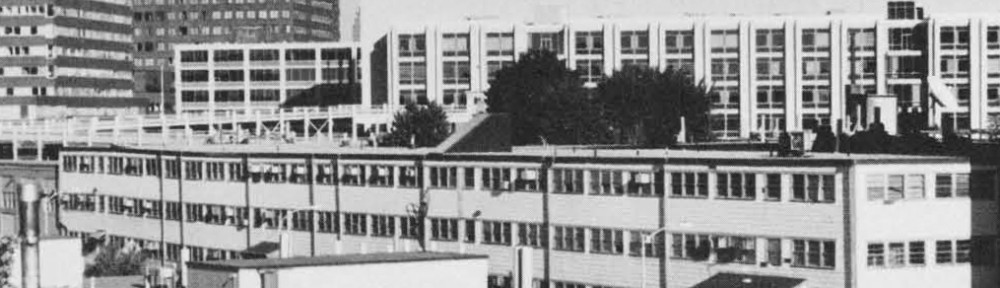
building 20

This week, more than two hundred alumni, former visitors and faculty, along with current students, faculty, visitors and other MIT linguists will meet for three days of talks, discussion, posters, photographs, meals and reminiscences — as we celebrate a half-century of linguistics in our department with “50 years of Linguistics at MIT: a scientific reunion”.

The schedule of talks can be found here and a schedule of posters by alumni, present and former visitors and current students can be found here. The program has been designed to allow lengthy (and no doubt heated) discussion, of the sort for which our group is famous, and topics have been chosen that reflect the wide range of linguistic issues that have been explored at MIT over the past fifty years. Saturday features a talk by Noam Chomsky, and the reunion ends on Sunday with a talk by Morris Halle.

Noam & Morris

Film about Wampanoag language revival this Thursday


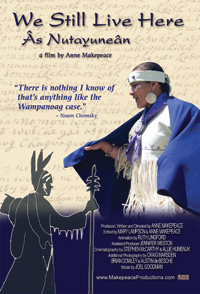
At MIT this Thursday, there will be a screening of the film We Still Live Here (Âs Nutayuneân):

Date/Time: Thursday, Nov 17, 7:00pm
Location: 1-190

Celebrated every Thanksgiving as the Indians who saved the Pilgrims from starvation, and then largely forgotten, the Wampanoag Tribes of Cape Cod and Martha’s Vineyard are now saying loud and clear, and in their Native tongue, “Âs Nutayuneân,”—We Still Live Here. The Wampanoag’s ancestors ensured the survival of the first English settlers in America, and lived to regret it. Now a cultural revival is taking place. Spurred on by their celebrated linguist, Jessie Little Doe Baird, recent winner of a MacArthur ‘genius’ award, the Wampanoag are bringing their language home. Like many Native American stories, this one begins with a vision. Years ago, Jessie began having recurring dreams: familiar-looking people from another time speaking in an incomprehensible language. These visions sent her on an odyssey that would uncover hundreds of documents written in Wampanoag, lead her to a Masters in Linguistics at MIT, and result in an unprecedented feat of language reclamation by her people. Jessie’s daughter Mae is the first Native speaker of Wampanoag in a century.

Jessie Little Doe Baird received her S.M. degree from this department in 2000, where her advisor was the legendary late Ken Hale. We wrote about Jessie on the occasion of her MacArthur award in 2010, where we also noted our colleague Norvin Richards’ role in continuing Ken’s contributions to the Wôpanâak Language Reclamation Project.

After the screening, Jessie and Norvin will be joined in a discussion and question & answer session by film maker Anne Makepeace, and by Nitana Hicks (S.M. Linguistics, 2006), another member of the Mashpee Wampanoag involved in the reclamation effort.

Cosponsored by MIT Program in Women’s and Gender Studies, Women in Film and Video/New England, The Technology and Culture Forum, The Office of Minority Education, The Office of Student Activities and MIT Linguistics.

Genetics of Language presentation on Wednesday

Simon FisherSimon Fisher, the director of the Max Planck Institute for Psycholinguistics in Nijmegen, will give a short presentation for linguists on the genetics of language:

Date: Sept 21 (Wednesday)
Time: 11am-12pm
Location: 32-D461

Dr. Simon’s presentation will include an informal introduction to genetics and how language and genetics can be studied together and will leave time for questions and discussion. His presentation to our group will be followed at 4:00 by a more formal talk in the Department of Brain and Cognitive Sciences.

Phonology Circle resumes 9/12

The first meeting of the Phonology Circle for the fall semester will be Monday, 9/12, at 5pm in 32-D831. We will have an organizational meeting to discuss the schedule for the rest of the semester. If you cannot come to the meeting but would like to reserve a date, please contact Michael Kenstowicz

.circle

Welcome to the Fall Semester!

Today, Tuesday 9/6, is Registration Day. Whamit!, the MIT Linguistics Department Newsletter appears every Monday during the semester. The editorial staff consists of Adam Albright, Kai von Fintel, Michelle Fullwood, Ryo Masuda, and David Pesetsky.

To submit items for inclusion in Whamit! please send an email to whamit@mit.edu by Sunday 4pm before the next Whamit! appears. At the beginning of the semester, we’re particularly interested in news about what members of the department did during the summer break.

Summer Pause

This is the last issue of this academic year. Whamit! will resume publication on Tuesday, Sept 6.

Have a nice summer!

Workshop honouring Jean-Roger Vergnaud

Pritty Patel-Grosz reports:

A few months ago we were saddened to hear that Jean-Roger Vergnaud (MIT class of 1974) passed away. Last week (May 5th-7th), there was a workshop at USC honouring his work, called “Parallel Domains: Locality in syntax/phonology and the representation of constituency.” The program can be found here.

Past/present members of the MIT linguistics community who participated include:

  • Noam Chomsky (Emeritus MIT professor) keynote speaker
  • Bill Idsardi (MIT class of 1992) main session talk
  • Julie Legate (MIT class of 2002) main session talk, member of the panel discussion
  • Rita Manzini (MIT class of 1984) main session talk
  • Pritty Patel-Grosz (current MIT student) main session talk
  • Carson Schuetze (MIT class of 1997) main session talk
  • Dominique Sportiche (MIT class of 1984) invited talk

Language and the Human Mind - Open House

The department opened its doors to visitors last Saturday as part of the MIT-wide open house Under the Dome, and received a steady stream of visitors curious about our contribution, a series of activities under the theme “Language and the Human Mind”.

Visitors learned about a number of interesting languages, among them the Mayan languages of Central America, Uyghur and the Wampanoag language of the native inhabitants of Massachusetts. They viewed posters explaining recent research projects our graduate students and UROPs have undertaken, stepped into the Experimental Syntax & Semantics Lab to participate in psycholinguistic experiments designed to reveal how language interfaces with the conceptual-intentional systems of the mind, then hunkered down to solve linguistics puzzles about Mayan, with chocolate their reward for correct answers.

A selection of photos from the event (more here):

Peter Graff discusses Big Brother

Visitors learning about Uyghur, photo by Jeremy Jessica Coon talks to visitors

Thank you to all who participated in the open house and made it a success! Thanks also to Adam Albright, Micha Breakstone, Mitcho Erlewine, Jeremy Hartman and Kirill Shklovsky for reports and photographs.

Grant proposals and funding info session at Harvard

On Tuesday, April 19, 4:30-6:30pm, Joan Maling (NSF) will be at Harvard
speaking about sponsored research, grant proposals, and general issues of
funding. She will give a presentation and will then take questions from the
audience. Everyone is welcome. The meeting will be in Boylston Hall 303.

Special pre-WCCFL Syntax Square 4/19

Please join us for a special session of Syntax Square at 3pm this Tuesday with practice talks and practice posters for WCCFL. The preliminary schedule is as follows:

3.00pm-3.40pm (talk): Claire Halpert. Case, agreement, EPP and information structure: A quadruple-dissociation in Zulu.

3.40pm-4.00pm (poster): Alya Asarina. Constraints on Quantifier Lowering.

4.00pm-4.40pm (talk): Claire Halpert and Hadil Karawani. Aspect in counterfactuals from A(rabic) to Z(ulu).

4.40pm-5.00pm (poster): Bronwyn M. Bjorkman. The Crosslinguistic Defaultness of BE.

5.00pm-5.40pm (talk): Michael Yoshitaka Erlewine. Share to Compare: the Mandarin b? Comparative.

5.40pm-6.00pm (poster): Coppe van Urk. Visser’s Generalization: A Window into the Syntax of Control.

Date: Tuesday, April 19

Location: 32-D461

Welcome to the spring semester!

Whamit! welcomes all the members of the MIT Linguistics community to the spring semester. The editorial staff consists of Adam Albright, Kai von Fintel, David Pesetsky, and newcomers Michelle Fullwood and Ryo Masuda (who take over for Claire Halpert as student editors). Thank you Claire for all your hard work on Whamit! over the past year and more!!!

We look forward to receiving items for inclusion in Whamit! throughout the semester. To submit items for inclusion please send an email to whamit@mit.edu by Sunday 4pm before the next Whamit! appears.

MIT Linguistics major featured in the Tech

In case you missed it, the Tech recently featured an article highlighting the linguistics major, including interviews with David Pesetsky and several current majors.

http://tech.mit.edu/V130/N46/linguistics.html

L&P Registration Day Lunch Today

Don’t forget the Department of Linguistics and Philosophy Registration Day Lunch:

Tuesday, September 7th, 12noon-2pm

8th floor lounge

Syntax Square: Tuesdays 1-2PM

Syntax Square will be meeting regularly this semester on Tuesdays, 1-2PM (location TBA). If you are interested in leading a discussion, please email Claire Halpert (halpert@mit.edu). Our first meeting will be Tuesday 9/14.

LFRG: Wed Sept 8, 1:30-2:30pm

LFRG will have it’s first fall meeting on Wednesday at 1:30PM. It will meet regularly this semester on Wednesdays at 2pm.

WHAT: the first LFRG of the semester

WHEN: September 8, Wednesday, 1:30PM-2:30PM (note an earlier end time than usual)

WHERE: 32-D831

Agenda for the meeting:

- organizational issues (who wants to present, what the LFRG people want to do besides traditional presentations of work in progress made
within the department, etc.)

- “how I spent my summer” stories

- ice cream!

Phonology Circle resumes Monday 9/13

The first meeting of the Phonology Circle for the fall semester will be next Monday, 9/13, at 5pm in 32-D831. We will have an organizational meeting schedule the rest of the semester, and discuss lab issues, etc.

If you would like to present this coming Monday, please let Adam know as soon as possible!

Polinsky Lab reading group: Agent-Extraction/Anti-Agreement

Jessica Coon and Pedro Mateo Pedro are organizing a fall reading group on Agent Extraction phenomena. Meetings will take place Tuesdays at 4:00 at Harvard (exact location TBD), beginning 9/14. If you are interested in attending, please email Jessica Coon (jcoon@fas.harvard.edu) for more information.

Agent-Extraction/Anti-Agreement Reading Group Description:

This reading group investigates restrictions on the extraction of transitive subjects, with special focus on Mayan languages. We begin with an in depth look at so-called “Agent Focus” (AF) constructions in the Mayan language family. AF constructions occur when transitive subjects are questioned, relativized, or fronted for topic/focus (A-Bar extracted) and have been described as semantically and syntactically transitive (i.e. two full DP arguments), but morphologically intransitive (only one argument may agree) (Aissen 1999). After reading about AF and its range of variation in Mayan, we turn to similar “Anti-Agreement” effects more broadly as they have been described in certain Austronesian languages (e.g. Chung 1998) and in some languages of Africa (e.g. Ouhalla 1993).

Introducing Syntax Square!

Please join us for the first-ever meeting of syntax square, our new syntax discussion group. The group will provide an informal venue for department members to discuss their work in progress, present interesting research they’ve encountered, or practice for conference talks.

We’ll be meeting regularly throughout the semester on Tuesdays, 1-2pm in 32-D461. For our first meeting, however, we’ll meet at 5pm, Wednesday, February 17, in the 8th floor lounge.

We’ll cover organizational issues and discuss syntax (speaker TBA) at our first meeting. Cookies will be served. If you have questions or are interested in leading a discussion, please email Claire Halpert (halpert@mit.edu).

Ling Lunch slots still available

There are still several slots available for ling-lunch this semester, including this coming Thursday (Feb 11). The full list of dates still available is: Feb 11, 18, and 25, and Mar 11.

If you are interested in giving a ling-lunch talk, please contact Alya and Bronwyn, stating which date(s) you would prefer. As always, ling-lunch will meet every Thursday from 12:30 to 1:45 in D461 in the Stata Center (Building 32).

The schedule of speakers will soon be posted to the department website; each week the title and abstract for the upcoming ling-lunch will also appear in WHAMIT.

Welcome to the spring semester!

Whamit! welcomes all the members of the MIT Linguistics community to the spring semester. We look forward to receiving items for inclusion in Whamit! throughout the semester. Items received by Saturday will be published in the following Monday’s edition. Please email all submissions to .

Ling-lunch openings: 11/19 & 12/10

There are still two remaining openings for Ling-lunch this semester: 11/19 & 12/10. If you are interested in presenting your work on either of these dates, please contact Bronwyn Bjorkman (bmbjork@mit.edu) or Guillaume Thomas (gthomas@mit.edu).

Meet Ling-09, Pt. 2

There are two more incoming first-year students who have sent us brief introductions this week.

Jorie Koster-Moeller is from Corrales, New Mexico. She got her BA from Pomona College, and is
currently doing a joint program through the linguistics department and the brain
and cognitive science department. She’s particularly interested in semantics,
both formal and experimental, and psycholinguistics. She also enjoys most
anything mountain-related, such as backpacking and rockclimbing.

Edwin Martin Howard apologises that you’ve had to wait a whole week to hear about him, but he was out of email contact last weekend whilst enjoying a break in the wilds of rural Quebec - the Canadian province that he now also, in addition to his native Scotland, calls home. During his time in Montreal, he has become a proficient French speaker, and he completed a BA in Linguistics at McGill, writing an honours thesis on the semantics of superlatives and NPI licensing. The best thing that’s ever happened to him was the birth of his son, just over a year ago.

Use the phonetics lab? Sign up for the mailing list!

This is a periodic reminder that if you ever use the phonetics lab space or equipment, you should subscribe to the phonlab e-mail list: (it’s extremely low volume)

http://mailman.mit.edu/mailman/listinfo/phonlab

In addition, if you are not sure about the correct way to do something in the lab, please just ask someone who knows. (This includes signing up for times to reserve the booth, recording to a file, adjusting the levels or switch mics, adjusting the fitting of the head-mounted microphone, and so on). Finally, if you know of others who use the lab but who might not be on one of the ling lists, such as RA’s/UROPs, class participants, and so on, please forward this to them, and be sure they know where to look for instructions/training, and who to go to for help.

This term’s visitors to MIT Linguistics

Visiting Students (5)

*Aysa Arylova*: PhD student at the University of Groningen, The Netherlands. Aysa is investigating the morphosyntactic realization of syntactic dependency as a function of the structure building operation Merge. Her work will include an extensive typological survey and the development of a formal analysis.

*Micha Breakstone*: PhD student at Hebrew University, Israel. Micha is fascinated by “Universal Degrees.” Different assumptions regarding the nature of degree processing (e.g., universal density) have led him to exciting speculations about how the linguistic module in the mind/brain may interact with other cognitive modules, as well as with pragmatic knowledge about the world.

*Marcus Lunguinho*: PhD Student at the University of Sao Paulo, Brazil. Marcus’s research focuses on “Auxiliary Verbs and the Theory of Grammar,” and the following two areas in particular: 1) the defective morphological paradigms of certain auxiliaries; 2) the syntax of the non-finite domains selected by auxiliary verbs.

*Dimitris Michelioudakis*: PhD student at the University of Cambridge, United Kingdom. Dimitris’s current research is on the syntactic status of Inherent (“Dative”) Case in different diachronic and diatopic varieties of Greek.

*Coppe van Urk*: MA student at Utrecht University, The Netherlands. Coppe’s research mainly concerns issues in modern generative syntax, specifically in the area of Control.

Visiting Scholars (3)

*Manchun Dai*: Professor at the National Research Center for Foreign Language Education at Beijing Foreign Studies University, China. Professor Dai’s interests revolve around Second Language Acquisition and Syntax.

*Jeongah Kim*, Researcher at the Institute of Language and Information Studies at Yonsei University, Korea. Professor Kim’s research interests are in phonetics, phonology, morphology and the phonology-phonetics interface. She is interested in recent developments in phonology, including Optimality Theory, Correspondence Theory and Sympathy Theory.

*Anna Roussou*: Associate Professor at the University of Patras, Greece. Professor Roussou’s main research interests are in syntax (Greek, comparative, diachronic) and its interfaces with morphology/lexicon and semantics.

[Thanks, Michel!]

Meet Ling-09

Several of the incoming first year students have sent us brief introductions.

mitcho (Michael Yoshitaka Erlewine) grew up in Minnesota and is thus actively looking
forward to the Boston winter. While at the University  of Chicago he worked on the
syntax/semantics of Mandarin comparatives.  Since then, he’s lived in Taiwan and Japan,
most recently working for  Mozilla.

Hadas Kotek grew up in a small town in northern Israel. Hadas reports: “My name literally means myrtle and is a shortened version of Hadassah, the Hebrew name of the biblical queen Esther. I did a BA in linguistics at Tel-Aviv university, then studied the first year of my MA at the Humboldt university in Berlin and the second year back at Tel-Aviv university. My previous work focused mainly on formal semantics and its interface with syntax. At present I am planning to continue working in these same areas.”

Junya Nomura reports: “I’m from Japan. My main interst is in syntax. I’ve studied especially Japanese syntax, but I’m planing to study other East Asian languages such as Korean, Vietnamese, Thai and Khmer, too. Apart from linguistics, I like sports, especially basketball and baseball, and shogi (Japanese chess).”

Daeyoung Sohn reports: “I am from South Korea. I have an MA in linguistics, and BAs in international relations study and English. I am interested mainly in Syntax and also have interest in Semantics. ”

Yusuke Imanishi reports: “I was born and grew up in Nara, Japan. The city is not as famous and large as cities like Tokyo and Osaka. Nevertheless, it is filled with nature preserves, forests and temples/shrines!! We also have a big Buddha, which reaches the height of approx. 50m. I completed my MA in Linguistics at Osaka University in Spring 2009. My thesis proposes that dative subjects in the Standard Japanese and some Japanese dialects are structurally Case-assigned, opposed to traditional analyses. I also extended empirical coverage to other languages and attempted to devise a unified account of dative subject constructions. My research interests include syntactic theory and comparative syntax based on a macro/micro-parametric approach. I’m also interested in the interfaces of phonology and semantics with syntax. 

Iain Giblin is from Australia. He reports: “My academic background is in music, but I’ve had a long interest in linguistics and in my postgraduate music studies I sought to apply generative models of language to music. I’m also interested in the philosophical questions that arise from the generative approach. I’m looking forward to the program here at MIT and learning all the techniques of modern linguistic theory so I won’t commit myself to one domain just yet. I still like to noodle around on the guitar and Boston is a great guitar town.”

Stay tuned for intros to the rest of the incoming class.

MITWPL #60: Presuppositions and Implicatures

MITWPL has just published its 60th volume. The title of the volume is
“Presuppositions and Implicatures. Proceedings of the MIT-Paris Workshop’”,
edited by Paul Égré and Giorgio Magri. The volume collects 13 papers by
scholars from MIT, Harvard and the École Normale Supérieure that came out of a
collaboration between MIT and Paris sponsored by the MIT France Program and the
MIT France Seed Fund for Collaborative Research. The abstracts of the papers are
already available on the MITWPL website.

Peter Graff to present at CLS

Peter Graff and T. Florian Jaeger will be presenting their talk, The OCP is a pressure to keep words distinct: Evidence from Aymara, Dutch and Javanese at the 45th Annual Meeting of the Chicago Linguistic Society.

Raj Singh to Carleton University

Raj Singh (MIT linguistics PhD 2008, currently postdoc in Brain &
Cognitive Science at MIT) has accepted an assistant professorship at
the Institute of Cognitive Science at Carleton University, Ottawa,
Canada. Congratulations, Raj!

Ling Lunch 2/19-Pritty Patel, Patrick Grosz, Evelina Fedorenko and Ted Gibson

This week’s Ling Lunch features a talk by Pritty Patel, Patrick Grosz, Evelina Fedorenko and Ted Gibson (MIT)


Title: “Restrictions on E-type pronouns: Making the case for Uniqueness”

Time: Thurs 12:30-1:45

Place: 32-D461

Phonology Circle 2/9-Hrayr Khanjian

Phonology circle resumes this week. Please note that we are returning to our usual Monday afternoon time slot!


Speaker: Hrayr Khanjian

Title: Stress-dependent vowel reduction

Time: Monday 2/9, 5pm

Location: 32-D831

Ice Cream Social

The Department of Linguistics & Philosophy will hold its annual ice cream social.

When: Registration Day, February 2, 2009
Where: 32-D850 (Lounge)
Time: 2:00—4:00

Sabine Iatridou and Agustin Rayo will be hosting games starting at 3:00 PM.

Welcome Back!

Spring 2009 Colloquia

There are seven colloquia scheduled for this semester:

2/27/09 - T. Florian Jaeger (University of Rochester)

3/6/09 - Lisa Travis (McGill)

3/20/09 - Anna Szabolcsi (NYU)

4/3/09 - Jeroen van Craenenbroeck (KU Brussels)

4/17/09 - Sharon Rose (UCSD)

4/24/09 - Daniel Buring (UCLA)

5/1/09 - Philippe Schlenker (Institut Jean-Nicod)

Unless otherwise announced, the talks will take place at 3:30pm, in
room 32-141.

Links of the week

Strange VP ellipsis in the news (second email down the page).

Strange right node raising in the news.

Music-Language Reading Group continues

The Music-Language reading group, which meets on Fridays at 3:30 when there is no colloquium, has a website on which readings and topics for our meetings are posted.  Last Friday, we discussed grouping and meter in the context of West African drum music (Claire Halpert led the discussion) and in the context of clave patterns and related rhythmic phenomena (Jonah Katz led the discussion).  At our meeting this Friday, we will discuss aspects of the syntax of tonal harmony.

Fun link of the week

An illustration of the effects of visual information on auditory processing.

Modularity Reading Group update

The Modularity Reading Group has changed the time and place of their meetings.

From now on, the group will meet Friday mornings, 10am-12pm, in 24-402.

To keep up to date with what’s happening in the group, see their website at:

http://web.mit.edu/linguistics/groups/modularity/

NSF Endangered Language Grants/Fellowships - Deadline November 1st

The joint NSF/NIH program for documenting endangered languages will be accepting funding applications until Saturday, November 1st.

LF reading group Wed 10/15: Jeremy Hartman

Jeremy Hartman will lead a discussion of Phillipe Schlenker’s Expressive Presuppositions on Wednesday at 3PM in 26-310. If you would like to present a paper or would like to see a particular paper discussed, please let us know. More information can be found on the LF Reading Group’s webpage

Use the phonetics lab? Sign up for the mailing list!

This is a periodic reminder that if you ever use the phonetics lab space or equipment, you should subscribe to the phonlab e-mail list: (it’s extremely low volume)

http://mailman.mit.edu/mailman/listinfo/phonlab

In addition, if you are not sure about the correct way to do something in the lab, please just ask someone who knows. (This includes signing up for times to reserve the booth, recording to a file, adjusting the levels or switch mics, adjusting the fitting of the head-mounted microphone, and so on). Finally, if you know of others who use the lab but who might not be on one of the ling lists, such as RA’s/UROPs, class participants, and so on, please forward this to them, and be sure they know where to look for instructions/training, and who to go to for help.

LF Reading Group - Wed 10/8 at 3pm

In preparation for Chris Kennedy’s colloquium, LF Reading Group will discuss two of his papers this week: Vagueness and Grammar (L&P, 2007) and Modes of Comparison (CLS, 2008). Reading the papers is not a prerequisite to attend. See you on Wednesday at 3PM in 26-310.

MathMod II/1 this Thursday 5pm, 32-D831

Last year we started a research group studying experimental and
quantitative methods in the investigation of linguistic theory. Due to popular
demand we will continue our meetings this year.

The format of the group will be similar to Phonology Circle/LF Reading group and
other seminars. Participants can propose sessions which should fall roughly into
one of three categories:

  1. You have recently run an experiment and would like to discuss ways in which
    to analyze and/or make sense of your data.
  2. You have a particular project and would like to talk about ways in which to
    experimentally test your hypotheses.
  3. You stumbled upon a particular experimental or statistical method and would
    like to learn what it’s all about.

MathMod meets biweekly on Thursdays at 5pm in 32-D831. For details and information, please contact Peter Graff.

Music Language Reading Group - this Friday

The first meeting of the Music Language Reading group will be this Friday, Sept. 26, from 3:30-5:00, location TBA. If you’re interested in participating, and you haven’t been receiving emails, please contact David Pesetsky or Jonah Katz to be added to the list.

LingWiki Exists

One of the best-kept secrets in the department is LingWiki, a collaborative repository of general information concerning life inside and outside the department, compiled by students. It’s chock full of useful tidbits, especially for those new to the department and/or the area. Please have a look. Also, if you’re a student, please help us by adding information.

Music and Language Reading Group

From Jonah Katz and David Pesetsky:

We are interested in starting a reading group based loosely around linguistics-inspired approaches to music cognition, especially structural approaches to music theory. The idea would be to start out by going through part or all of Lerdahl & Jackendoff’s Generative Theory of Tonal Music, a foundational text in this area. We would help ‘teach’ the book to some extent, because it’s dense and difficult, and we’ve both spent a lot of time with it.  After going through GTTM, we’d like to keep meeting. Some ideas are to look at more recent literature in this area or, ideally, to encourage people to start and discuss their own projects.We want the group to be accessible to anybody with a minimal background in playing/studying music. For instance: if you can’t transpose an orchestral score on sight, don’t worry!  But if you can’t read music at all, you’d probably need some remedial study — we’d need to assume that. If you can’t analyze chord progressions, fine; if you don’t know what a ‘chord’ is, this is probably not for you. Please let us know (e-mail jkatz and pesetsk) if you have any interest in participating in such a group this semester. Our impression is that there are lots of musical people in the department and increasing interest in this topic.

MIT Libraries Faculty Book Delivery Pilot Project

[[From the MIT Libraries site](http://libraries.mit.edu/about/faqs/faculty-book-delivery.html):]

>Implemented in the fall of 2008, the Faculty Book Delivery Pilot Project offers faculty the opportunity to have books delivered to their offices upon request. The service takes 2-3 days, and is initiated using the “Your Account” feature in Barton. .

Basically, you order the book via Barton and it gets sent via campus mail. Together with the book drop on the ground floor of Stata, faculty may never have to set foot in the library again. No word yet on whether in a later phase graduate students could get this service as well.

Reg Day Party!

On Tuesday, September 2, Registration Day, 3pm to 5pm, there will be a welcome party to celebrate the beginning of the fall semester in the main lounge of the Department of Linguistics & Philosophy. Everybody is welcome!

Ling-08 Arrives

There are 8 students in the incoming class:


Samer Al Khatib, who goes by ‘Sam’, grew up in Palestine, Jordan, and Vancouver. He did his undergrad in computer science at UBC, and has just finished an MA in linguistics at Simon Fraser University. He’s interested in semantics and pragmatics (and the relationship between the two), as well as theoretical syntax, syntactic typology, historical linguistics, and Semitic languages.


Young Ah Do is from Korea, and has a B.A. and M.A. from Seoul National University. Young Ah is interested in phonology.


Natasha Ivlieva is from Moscow, where she studied in the Department of Theoretical and Applied Linguistics at Moscow State University. She is mostly interested in syntax and the syntax-semantics interface.


Marie-Christine Meyer is from Germany. She studied philosophy and linguistics at the University of Tuebingen, the University of Potsdam, and Humboldt University Berlin, where she recently completed an M.A. Although she’s interested in every area of linguistics, her main has been and most likely will be semantics, pragmatics, and philosophy of language.


Liudmila Nikolaeva, who goes by ‘Liuda’, graduated from the Linguistics Department of the Russian State University for the Humanities a year ago, and has been a grad student there for the last year. Her main interests are syntax, semantics, and fieldwork.


Rafael Nonato reports that tendonitis makes him succinct.


Sasha Podobryaev is from Moscow, where he studied linguistics at Moscow State University. His primary area of interest is syntax.


Igor Yanovich

Welcome, visitors!

The start of the fall semester brings with it a bumper crop of new visitors. We offer a hearty welcome to those who have already arrived:

Visiting Scholars

  • Hyunsook Kang (Professor, Hanyang University Division of English Language & Culture)

    Research interests: interface of phonology and phonetics

  • Anthi Revithiadou (Assistant Professor of Comparative Linguistics, University of Aegean)

    Primary research interests: metrical theory, prosodic phonology and areas of the morphosyntax-phonology
    interface. She works on Standard Greek and its dialects with emphasis on those
    that were in contact with Turkish (e.g. Pontic, Cappadocian, Rhodian Muslim
    Greek, etc.). She currently explores the accentual differences among various
    Ancient Greek dialects.

  • Hiroyuki Tanaka (Associate Professor, Kwansei Gakuin University)

    Research interests: the syntax of complementizers and its interaction with semantics and morphology.

  • Chi-lin Wang (Associate Professor, National Taiwan University of Science and Technology)

    Research interests: interlanguage phonology with a focus on phonotactics

Visiting Students

  • Gaetano Fiorin (University of Verona)

    Research interests: the degree of semantic competence of dyslexic children

  • Marina (Marlies) Kluck (University of Groningen)

    My research concerns the syntax and semantics of sentence amalgamation. I analyse these as paratactic construals involving multidominance (‘sharing’).

  • Gary Thoms (Strathclyde University)

    I’m in second year of a PhD on literary language, specifically the unusual
    language of 20th century avant garde literature. The broader questions of my
    project are largely metatheoretical, and the specific topics which substantiate
    this inquiry include the semantic-pragmatic distinction, optional movement and
    derivational morphology.

  • Stefano Versace (Universita degli Studi di Milano)

    Currently working on a dissertation project investigating the generativist approach to meter and its possible application in Italian contemporary poetry.

More visitors will be arriving in the coming weeks, so stay tuned for further announcements!

Two New Members of MIT Linguistics

MIT Linguistics PhD alum Michela Ippolito and her husband had their first child: Martina was born in Toronto on July 4th:

DSCF1315.JPG

Kazuko Yatsushiro and MIT Linguistics PhD alum Uli Sauerland had their third child: Mika Sauerland was born on August 1st:

DSC02423_2.jpg

LingLunch 5/8: Alya Asarina & Kirill Shklovsky

Alya Asarina & Kirill Shklovsky

Title TBA

Thursday, May 8, 12:30-1:45

32-D461

Ezra to Michigan

Ezra Keshet has accepted a one-year visiting professorship in semantics at the University of Michigan. Congratulations, Ezra!

Guide to funding opportunities

Stanford keeps a comprehensive list of funding opportunities available to linguistics grad students. Have a look.

[Thanks Hrayr!]

ELF Grants - Deadline April 21st

The Endangered Language Fund provides grants for ‘language maintenance and linguistic field work’. The deadline to apply for this year is Monday, April 21st. More information is available on the ELF’s website.

[Thanks Jessica!]

Early Notice - NSF ‘Documenting Endangered Languages’ Program

This one doesn’t have a deadline until November, but it looks like a rather involved application process, with potentially great rewards. The NSF, in partnership with the National Endowment for the Humanities, is offering sizable grants and fellowships to support work on endangered languages. Details can be found here.

[Thanks Jessica!]

Happy spring break

Whamit! wishes everyone a happy spring break! We will return next week with regular updates.

Welcoming new visitors

We welcome two new visitors who have arrived this week:

  • Nabila Louriz (Assistant Professor, English Department at Hassan II University in Casablanca, Morocco)

    Visiting Scholar until July

    Research interests: loanword phonology
  • Georgios Spathas (PhD student, University of Utrecht)

    Post-Doctoral Fellow until December 08

    Research interests: syntax and semantics of gender features on bound pronouns, especially in Modern Greek

Welcome to Enoch Aboh, Visiting Professor

A special warm welcome to visiting professor Enoch Oladé Aboh, who is visiting from the University of Amsterdam this semester, until May 08.

Research interest: theoretical syntax; comparative syntax (e.g., Kwa vs. Germanic/Romance, Kwa vs. Sinitic, Kwa vs. Caribbean creoles); discourse-syntax interface; language creation and language change.

Enoch will be teaching an undergraduate seminar and co-teaching a graduate seminar with Michel DeGraff:

24.910 Topics in Linguistic Theory: Information Structure at the Edge
24.921 [Special Topics in Linguistics: A transatlantic sprachbund? Gbe and Haitian Creole in a comparative-syntax perspective](http://stellar.mit.edu/S/course/24/sp08/24.921/index.html)

Registration Day Ice Cream & Games

The Department of Linguistics & Philosophy

ICE CREAM SOCIAL

When: Registration Day, Monday, February 4, 2008
Where: 32-D850 (Lounge)
Time: 2:00—4:00

Games will start at 3:00pm

WELCOME BACK

Welcoming new visitors

A warm welcome to several new visitors who have recently arrived in the department:

  • Zhijun Jin (Professor, East China Normal University)

    Visiting Scholar until December 08

    Research interests: second language acquisition, language change and American second language education, including teaching methods, second language teachers formation, etc.

  • Seok Han Kang (Professor, University of Incheon)

    Post-Doctoral Fellow until December 08

    Research interests: prosody, phonology, developmental structure for ESL, the relationship between production and perception

  • Joan Mascaró (Professor, Universitat Autonoma de Barcelona, Catedràtic d’Universitat)

    Visiting Scholar for spring semester

    Research interests: phonology, morphology and romance languages; stress-controlled harmonic systems

More visitors will be arriving in the next couple weeks, so stay tuned for further announcements!

Film and Music event Jan. 25!

FiLmprov
Parade: Animated Films with Musical Improvisation
FRIDAY, JANUARY 25, 8 PM.
Free.
Killian Hall, MIT, 160 Memorial Drive, Cambridge

Animated films by Kate Matson with jazz improvisation by the FiLmprov Ensemble: Peter Bloom, Mark Harvey, *Jay Keyser*, Bill Lowe, Chris Rakowski, and Phil Scarff

Presented by MIT Music and Theater Arts

Join Kate Matson’s theatre of visual improvisation and the inspired brass band journey through time and space as FiLmprov presents Parade.

The FiLmprov Ensemble includes six renowned improvisers: Peter Bloom, flute and saxophones, Mark Harvey, trumpet, *Jay Keyser, trombone*, Bill Lowe, bass trombone and tuba, Chris Rakowski, accordion and saxophones, and Phil Scarff, saxophones. These musicians have performed with a wide array of artists, including the Aardvark Jazz Orchestra, the John Coltrane Memorial Concert Ensemble, Natraj, the New Liberty Jazz Band, and Cecil Taylor.

Kate Matson has presented her animated films at the Museum of Fine Arts, Boston, Harvard University, MIT, the Society for the Arts, Religion, and Contemporary Culture, in New York City, among other venues.

MITing of the Minds 2008

MITing of the Minds 2008
4th Annual MIT Philosophy Alumni Conference
Thu Jan 24, Fri Jan 25, 09:30am-05:45pm, 32-D461

This year’s MITing of the Minds is the Fourth Annual MIT Philosophy Alumni Conference. The conference will showcase recent work in a variety of areas in contemporary philosophy. Presentations will cover topics in metaphysics, philosophy of language, epistemology, and ethics, and will be accessible to a broad audience. Each day will feature talks by MIT faculty members, current students, and alumni of the graduate program.

Web:

Phonetics Lab Mailing List

Stay up to date on developments in the phonetics lab — be on the phonetics lab mailing list!

Publishing Smart: A Hands-on IAP Workshop

[*Publishing Smart: A Hands-on Workshop on Journal Quality Measures and Publisher Copyright Policies*](http://news-libraries.mit.edu/blog/2008-publishing-smart/913/)

Addresses what copyright means to you as an author, how you can assess a publisher’s copyright policies, and how you can use web-based tools that assess journal quality. Open access publishing models and the use of the MIT amendment to alter standard publisher agreements will also be discussed.

WHEN: Friday, January 18, 2 - 3 pm
WHERE: [14N-132, DIRC](http://libraries.mit.edu/ask-us/instruction/dirc.html)

Syntax Square - Omri Doron (UMass Amherst) & Ido Benbaji-Elhadad (MIT)

Speaker: Omri Doron (UMass Amherst) & Ido Benbaji-Elhadad (MIT)
Title: Saving FACE: Fragment answers, copy theory, and radical trace conversion
Time: , 1pm - 2pm
Location: 32-D461

Abstract: Jacobson (2016) observes that fragment answers to which-questions seem to have different felicity conditions than fully spelled out answers and even ones with VP ellipsis, as demonstrated in (1). Jacobson takes this fact as evidence against an analysis of Fragment Answers as the result of Clausal Ellipsis (FACE, in short; Merchant, 2005), and proposes an analysis that treats them as connected to their preceding questions via a special syntactic relation. But FACE has its merits: (i) It explains why fragments seem sensitive to constraints on movement and morphosyntactically connected to their hypothesized “original position”; and (ii) it unifies fragment answers, VP ellipsis and sluicing under the same recoverability conditions. In this talk, we propose a novel account of Jacobson’s puzzle which does not give up FACE, and instead points at the parallelism constraint on ellipsis as the source of infelicity in (1a). Specifically, assuming trace conversion (Fox, 1999), we propose that the mismatch between the trace left by which Math professor and the one left by Mary prevents them from satisfying parallelism. In doing so, we argue for a modification to the process of trace conversion.

(1) Q: Which Math professor left the party early?
a. #Mary, but she’s not a Math professor.
b. Mary left the party early, but she’s not a Math professor.
c. Mary did, but she’s not a Math professor.

Phonology Circle 3/10 - Chelsea Tang (MIT)

Speaker: Chelsea Tang (MIT)
Title: Reduplicative Opacity in G?k?y?: Evidence for Backcopying and BR-Distantial Faithfulness
Time: Wednesday, March 10th, 5pm - 6:30pm
Location: 32-D831

Abstract: Backcopying is an overapplication phenomenon where the reduplicant undergoes a phonological process, then the base “copies back” from the reduplicant even when the environment is not met in the base. The veracity of backcopying data has been the center of debate in contemporary theories of reduplication (see McCarthy and Prince 1995; Inkelas and Zoll 2005; Kiparsky 2010; and McCarthy, Kimper, and Mullin 2012, among others) as it bears on whether a theory under or over-generates. In this talk, I present new backcopying data from Gi?ku?yu? and provide an analysis within Base-Reduplicant Correspondence Theory (BRCT; McCarthy and Prince 1995) with Distantial Faithfulness Constraint (Kirchner 1995).

Gi?ku?yu? has two types of backcopying? (1) optional backcopying (i.e., backcopied and non-backcopied variants are in free variation) when prenasalized stop formation (/Nt, N?/ ? [?d], /N?/ ? [?d?], /Nk, N?/ ? [?g]) and foot reduplication interact; (2) obligatory backcopying when prenasalized stop formation, foot reduplication, and Meinhof’s law (NC?…N?(C) ? N?…N?(C)) interact. A sample of the data is shown below?

1) Optional Backcopying

Stem N+Stem N+RED+Stem
[t??iðia] ‘help’ [?d??iðia] ‘help me’ [?d??iða=?d??iðia] or [?d??iða=t??iðia] ‘help me a little’

[???a] ‘draw’ [?d???a] ‘draw me’ [?d???a=?d???a] or [?d???a=???a] ‘draw me =’

[?i?ikana] ‘remember’ [?di?ikana] ‘remember me’ [?di?a=?di?ikana] or [?di?a=?i?ikana] ‘remember me =’

*Note: *[t??iða=?d??iðia]; *[???a=?d???a]; *[?i?a=?di?ikana]

2) Obligatory Backcopying

Stem N+Stem N+RED+Stem
[??ma] ‘defeat’ [n?ma] ‘defeat me’ [n?ma=n?ma] ‘defeat me a little’

[?omia] ‘feed’ [nomia] ‘feed me’ [noma=nomia] ‘feed me a little’

[?ando?a] ‘remind sb. of a debt’ [nando?a] ‘remind me of a debt’ [nanda=nando?a] ‘remind me to pay x =’

*Note: *[n?ma=??ma] ~ *[??ma=n?ma]; *[noma=?omia] ~ *[?oma=nomia]; *[nanda=?ando?a] *[?anda=nando?a]

To account for the obligatory backcopying cases, I propose that the distinguishing factor lies in the onset’s ratio of nasality in the base vs. the reduplicant. On a ratio-of-nasality scale of [t, k, ?, ?, ?] = 0, [?d, ?d?] = 1, [n] = 2, a Distantial Faithfulness constraint penalizes segments in RED that differ too much from their Base correspondents. Consequently, Base-Reduplicant pairs like [?d?]…[?] are acceptable because their nasality distance is ?1, whereas [n]…[?] is disfavored because the ‘distance’ is 2.

LingLunch - Yiannis Katochoritis (MIT)

Speaker: Yiannis Katochoritis (MIT)
Title: Long-distance agreement on Procrustes’ bed: a revival of spec-head
Time: , 12:30pm - 2pm
Location: 32-D461

Abstract: Long-distance agreement (LDA) refers to the phenomenon where a matrix verb may (optionally) agree in ?-features with an embedded argument of its complement clause, otherwise showing default agreement with the entire complement clause. Spanning a clausal boundary and appearing to involve no displacement of the embedded goal, LDA has been one of the core empirical arguments in favor of the operation Agree, which dissociates agreement from movement.

This talk has a double aim: first, to present a previosuly unnoticed observation; that is, (almost) all geographically diverse LDA languages share fundamental typological properties: they are verb-final, with a (full or split) ergative alignment, and with default SOV order; moreover, LDA-transparent embedded clauses are always either restructuring VPs or nominalized/participial TP/CPs; and once a potential LDA goal somehow overtly fronts to the left of the matrix verb, LDA (usually) becomes obligatory.

Second, I attempt to account for this empirical picture through little bits of Kayne’s (1994) Antisymmetry, Bobaljik’s (2008) m-case hierarchy, and the magic power of pied-piping. Specifically, I will suggest a unified analysis of LDA as local feature-checking in a (covert) spec-head configuration, which may allow for iterative feature-copying under recursive merge. Depending on two parameters, the specifier of the agreeing verbal head is filled either directly by the moving DP goal or by the complement clause that pied-pipes the goal at its edge. Hence, LDA is derived via Merge, not Agree. This will eventually yield a typology of (at least) four types of LDA systems, among which I will (struggle to) intergrate the outlier named Algonquian.

The analysis hinges on two crucial premises: one, LDA often features movement properties/constraints; two, the optionality of LDA is only apparent, as it obligatorily interacts with scope and/or information-structure, reducing to the reflex of independently motivated syntactic processes. Thus, I will distinguish between two types of agreement: narrow-syntactic agreement feeds LF or further syntactic operations, and involves downwards valuation by some interpretable feature, (plausibly) under spec-head. This contrasts with uninterpretable agreement, which is pushed post-syntactically, at early PF, and may operate from a distance, via upwards valuation (though still c-command-based).

Phonology Circle 3/10 - Chelsea Tang (MIT)

Speaker: Chelsea Tang (MIT)
Title: Reduplicative Opacity in G?k?y?: Evidence for Backcopying and BR-Distantial Faithfulness
Time: Wednesday, March 10th, 5pm - 6:30pm
Location: 32-D831

Abstract: Backcopying is an overapplication phenomenon where the reduplicant undergoes a phonological process, then the base “copies back” from the reduplicant even when the environment is not met in the base. The veracity of backcopying data has been the center of debate in contemporary theories of reduplication (see McCarthy and Prince 1995; Inkelas and Zoll 2005; Kiparsky 2010; and McCarthy, Kimper, and Mullin 2012, among others) as it bears on whether a theory under or over-generates. In this talk, I present new backcopying data from Gi?ku?yu? and provide an analysis within Base-Reduplicant Correspondence Theory (BRCT; McCarthy and Prince 1995) with Distantial Faithfulness Constraint (Kirchner 1995).

Gi?ku?yu? has two types of backcopying? (1) optional backcopying (i.e., backcopied and non-backcopied variants are in free variation) when prenasalized stop formation (/Nt, N?/ ? [?d], /N?/ ? [?d?], /Nk, N?/ ? [?g]) and foot reduplication interact; (2) obligatory backcopying when prenasalized stop formation, foot reduplication, and Meinhof’s law (NC?…N?(C) ? N?…N?(C)) interact. A sample of the data is shown below?

1) Optional Backcopying

Stem N+Stem N+RED+Stem
[t??iðia] ‘help’ [?d??iðia] ‘help me’ [?d??iða=?d??iðia] or [?d??iða=t??iðia] ‘help me a little’

[???a] ‘draw’ [?d???a] ‘draw me’ [?d???a=?d???a] or [?d???a=???a] ‘draw me =’

[?i?ikana] ‘remember’ [?di?ikana] ‘remember me’ [?di?a=?di?ikana] or [?di?a=?i?ikana] ‘remember me =’

*Note: *[t??iða=?d??iðia]; *[???a=?d???a]; *[?i?a=?di?ikana]

2) Obligatory Backcopying

Stem N+Stem N+RED+Stem
[??ma] ‘defeat’ [n?ma] ‘defeat me’ [n?ma=n?ma] ‘defeat me a little’

[?omia] ‘feed’ [nomia] ‘feed me’ [noma=nomia] ‘feed me a little’

[?ando?a] ‘remind sb. of a debt’ [nando?a] ‘remind me of a debt’ [nanda=nando?a] ‘remind me to pay x =’

*Note: *[n?ma=??ma] ~ *[??ma=n?ma]; *[noma=?omia] ~ *[?oma=nomia]; *[nanda=?ando?a] *[?anda=nando?a]

To account for the obligatory backcopying cases, I propose that the distinguishing factor lies in the onset’s ratio of nasality in the base vs. the reduplicant. On a ratio-of-nasality scale of [t, k, ?, ?, ?] = 0, [?d, ?d?] = 1, [n] = 2, a Distantial Faithfulness constraint penalizes segments in RED that differ too much from their Base correspondents. Consequently, Base-Reduplicant pairs like [?d?]…[?] are acceptable because their nasality distance is ?1, whereas [n]…[?] is disfavored because the ‘distance’ is 2.